%22%2F%3E%0A%20%20%3Ccircle%20cx%3D%22220%22%20cy%3D%22150%22%20r%3D%22180%22%20fill%3D%22%2322d3ee%22%20fill-opacity%3D%220.12%22%2F%3E%0A%20%20%3Ccircle%20cx%3D%221010%22%20cy%3D%22130%22%20r%3D%22220%22%20fill%3D%22%2338bdf8%22%20fill-opacity%3D%220.08%22%2F%3E%0A%20%20%3Ccircle%20cx%3D%22920%22%20cy%3D%22520%22%20r%3D%22170%22%20fill%3D%22%2322d3ee%22%20fill-opacity%3D%220.06%22%2F%3E%0A%20%20%3Cpath%20d%3D%22M140%20430h920%22%20stroke%3D%22url(%23line)%22%20stroke-width%3D%2212%22%20stroke-linecap%3D%22round%22%2F%3E%0A%20%20%3Cpath%20d%3D%22M220%20360c120-150%20260-220%20380-220s260%2070%20380%20220%22%20fill%3D%22none%22%20stroke%3D%22%2367e8f9%22%20stroke-opacity%3D%220.5%22%20stroke-width%3D%2216%22%20stroke-linecap%3D%22round%22%20stroke-linejoin%3D%22round%22%2F%3E%0A%20%20%3Cpath%20d%3D%22M300%20398h600%22%20stroke%3D%22%2394a3b8%22%20stroke-opacity%3D%220.24%22%20stroke-width%3D%228%22%20stroke-linecap%3D%22round%22%2F%3E%0A%20%20%3Ctext%20x%3D%22220%22%20y%3D%22510%22%20fill%3D%22%23e2e8f0%22%20fill-opacity%3D%220.7%22%20font-family%3D%22Arial%2C%20Helvetica%2C%20sans-serif%22%20font-size%3D%2238%22%20letter-spacing%3D%228%22%3EINSIGHTS%3C%2Ftext%3E%0A%3C%2Fsvg%3E)
IPO milestone for China’s humanoid robots
What actually happened in Shanghai—and why investors treated it like a sector IPO, not a single-name trade
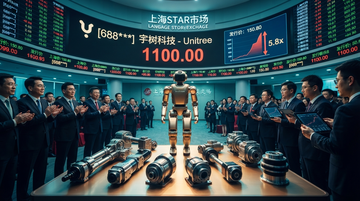
Unitree Robotics (officially Yushu Technology) listed on Shanghai’s STAR Market on Aug 19, 2026 after pricing its IPO at 150.80 yuan per share.
On the debut day, Reuters reported the stock opened at 1,100 yuan and later pared gains, still pointing to a roughly 5x+ move versus the IPO price level. Investors didn’t just price a robotics brand—they priced a repeatable supply chain for humanoid hardware in a market where most key component capacity is already local.
IPO offer price
150.80 yuan
Unitree (Yushu Technology) IPO price, reported Aug 6, 2026
Opened on debut
1,100 yuan
Shanghai STAR Market open price on Aug 19, 2026
Implied debut pop vs IPO price
≈5.8x
1,100 / 150.8 based on Reuters open-vs-offer comparison
Money in → capex out
The supply chain reads the IPO filing like a roadmap: proceeds were earmarked for robot-body R&D and a manufacturing base
A sector rerating only matters if the issuer can turn public funding into robot throughput. Even before the first-day price action, the IPO documentation trail and offer coverage point to proceeds being directed toward the “build path” rather than only marketing.
On the Shanghai listing track, the IPO application acceptance coverage cited a planned raise of RMB 4.202 billion from the draft prospectus stage. Separately, coverage around the offering terms described planned gross proceeds around 6.10 billion yuan and about 4.20 billion yuan allocated across four projects including robot-body research and development and an intelligent-robot manufacturing base.
That combination is what makes this debut a funding machine for suppliers: it increases the odds that early demand concentrates in the hardest-to-substitute subassemblies (high-tolerance transmissions and motion control) rather than in easily re-sold software.
| Metric | Value | What it supports for the supply chain |
|---|---|---|
| Planned IPO raise (application-stage) | RMB 4.202 billion | Raises the probability that R&D and manufacturing steps get funded at scale, pulling demand forward for mechanics-grade parts |
| Planned gross proceeds (offering coverage) | ≈6.10 billion yuan | Frames the size of the capital pool investors are underwriting for near-term execution |
| Planned investment across projects (offering coverage) | ≈4.20 billion yuan across 4 projects | Directs attention to robot-body R&D + manufacturing base, the layers suppliers can monetize first |
Who gets paid first
Actuators, harmonic reducers, and precision sensing are the “first check” categories—here’s why that bias fits a humanoid capex cycle
Humanoids scale differently than, say, a fixed industrial arm. The business bottleneck is the ability to produce repeatable joint torque with acceptable lifetime, while keeping cost per joint dropping over time.
That shifts early capital toward three hardware layers:
1) Actuators / motor-control power stages (torque density, thermal design, drive electronics reliability) 2) Joint transmissions—often harmonic-drive style reducers for compact high reduction in each limb joint 3) Precision sensing (force/torque and other joint feedback used to stabilize motion and reduce the “tuning tax”)
When an IPO-fueled manufacturer signals near-term robot-body R&D and manufacturing-base buildout, these layers typically see demand earlier than long-horizon autonomy work, because the robot can’t be field-tested or iterated without those joints in volume.
- Favors suppliers tied to joint transmissions because every additional robot in field testing needs high-reduction hardware to be durable and cost-down capable.
- Prioritizes precision sensing for faster control iteration, because feedback quality shortens the time from prototype instability to repeatable motion.
- Accelerates actuator procurement when manufacturing-base ramp begins, since joint-level integration determines the pace of usable robot units.
Global angle
US procurement firewall doesn’t just slow competitors—it can reroute value into domestically scalable Chinese suppliers that Tesla Optimus can’t buy quickly
The investment question is whether China’s public-market capital cycle improves only Unitree’s balance sheet—or whether it compounds into a broader supplier ecosystem that creates a “hardware moat.”
In practice, the US procurement firewall argument matters because the bottleneck for US robotics programs often isn’t the algorithm—it’s the supply chain for high-tolerance joint components and the ability to source them at scale under export controls.
A market where a flagship humanoid maker can fund manufacturing-base ramp tends to improve local lead times and pricing, which makes it harder for a competitor to catch up through procurement speed alone. That can delay Tesla Optimus’ cost-down curve if its approach depends on buying or qualifying comparable supply quickly enough to translate prototype success into unit economics.
Investor translation
What to watch next: whether IPO capex turns into repeatable joint volume (and how quickly that shows up in supplier fundamentals)
A debut pop can fade quickly if the IPO money doesn’t convert into unit ramp. The next confirmation signals are supply-chain measurable:
- Order lead times and quoted capacity from motion-transmission and motor-control suppliers
- Capex follow-through on the manufacturing base category disclosed in offering coverage
- Cost-down progress: margin structure for mechanics vendors tends to respond with a lag, not instantly
For investors, the tactical horizon is the next 1–2 quarters of guidance language from upstream component vendors (or their disclosed customer mix changes). The structural horizon is 12–36 months: whether humanoid joint supply becomes a real volume business with predictable gross margin bands.
Listed hardware proxies the Unitree IPO-capex cycle is most likely to influence
- A Unitree-driven humanoid scale-up would increase near-term reducer-adjacent demand, but the timing depends on whether local transmission orders shift from pilot to volume.
- Over 1–3 years, stronger humanoid throughput can support utilization for precision parts, yet margin upside can be capped by price competition in China.
- If the sector’s capex cycle pulls forward harmonic-drive style reducer orders, Leader Harmonious Drive Systems can benefit from volume demand as humanoid units move from prototypes to field testing.
- In the short term, the move is uncertain because supplier allocations can be gated by qualification timelines and long lead components.
- Export controls and qualification friction can limit direct Optimus-style procurement optionality, so Denso’s upside may be delayed unless it gains alternative channels.
- If humanoid hardware ramps materially, specialty metallurgy demand can increase steel intensity, but any effect is likely indirect and shows up slowly through industrial supply chains.