%22%2F%3E%0A%20%20%3Ccircle%20cx%3D%22220%22%20cy%3D%22150%22%20r%3D%22180%22%20fill%3D%22%2322d3ee%22%20fill-opacity%3D%220.12%22%2F%3E%0A%20%20%3Ccircle%20cx%3D%221010%22%20cy%3D%22130%22%20r%3D%22220%22%20fill%3D%22%2338bdf8%22%20fill-opacity%3D%220.08%22%2F%3E%0A%20%20%3Ccircle%20cx%3D%22920%22%20cy%3D%22520%22%20r%3D%22170%22%20fill%3D%22%2322d3ee%22%20fill-opacity%3D%220.06%22%2F%3E%0A%20%20%3Cpath%20d%3D%22M140%20430h920%22%20stroke%3D%22url(%23line)%22%20stroke-width%3D%2212%22%20stroke-linecap%3D%22round%22%2F%3E%0A%20%20%3Cpath%20d%3D%22M220%20360c120-150%20260-220%20380-220s260%2070%20380%20220%22%20fill%3D%22none%22%20stroke%3D%22%2367e8f9%22%20stroke-opacity%3D%220.5%22%20stroke-width%3D%2216%22%20stroke-linecap%3D%22round%22%20stroke-linejoin%3D%22round%22%2F%3E%0A%20%20%3Cpath%20d%3D%22M300%20398h600%22%20stroke%3D%22%2394a3b8%22%20stroke-opacity%3D%220.24%22%20stroke-width%3D%228%22%20stroke-linecap%3D%22round%22%2F%3E%0A%20%20%3Ctext%20x%3D%22220%22%20y%3D%22510%22%20fill%3D%22%23e2e8f0%22%20fill-opacity%3D%220.7%22%20font-family%3D%22Arial%2C%20Helvetica%2C%20sans-serif%22%20font-size%3D%2238%22%20letter-spacing%3D%228%22%3EINSIGHTS%3C%2Ftext%3E%0A%3C%2Fsvg%3E)
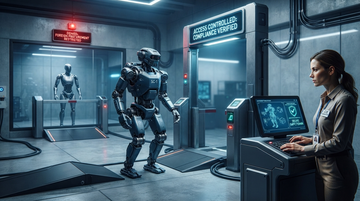
Verified policy trigger: what is actually being banned (and for whom)
The ban is aimed at federal procurement/operation of adversary-made unmanned ground systems—not at all Chinese humanoid robots everywhere
The core “wall” being built in the US policy space is not written like a general consumer-market ban. It is written like an operational security restriction: it targets what the federal government can procuring and operating.
In the American Security Robotics Act, the sponsors say the bill would prohibit the federal government from procuring and operating unmanned ground vehicles made by foreign adversaries and cite “advanced Chinese robotics” that “contain backdoors” and risk “remote-hijacking.”
What the primary sources establish
Policy scope
Federal procurement + operation
Per sponsors’ description of the American Security Robotics Act.
Security rationale
Backdoors + remote hijacking risk
Per sponsors’ description.
Targeted category
Unmanned ground vehicle systems (including humanoids)
Per sponsors’ description.
- narrows compliance demand to federal users first
- creates a channel where vendors must prove sourcing, software provenance, and upgrade controls
- shifts competition toward BOM traceability and security attestations that survive audits
Supply-chain mapping: what “Made in America” means in humanoids
In humanoids, “Made in America” is really about who controls the sensors, actuators, and embedded software trust chain
Humanoid robotics is a systems-of-systems product. Even when the robot chassis is assembled domestically, procurement bans that cite backdoors and remote hijacking push buyers toward domestically governed inputs and software controls.
For an American-made BOM to clear this type of firewall in practice, you need more than an assembly line. You need (1) sensor/compute/control supply assurances, (2) actuator supply continuity, and (3) software update and logging paths that can be audited and rolled back.
That is why the likely investment beneficiaries are often not only “robot makers,” but also the firms that can provide compliant components, secure integration, and trustworthy device management.
| Supply-chain layer | Why the ban logic cares | What “American-made” must actually cover |
|---|---|---|
| Embedded compute + device firmware | Backdoors and hijacking can ride on firmware/software layers | Documented provenance + update/rollback control |
| Sensors (vision, proprioception, IMU, microphones) | Sensor data paths can become exfiltration or covert control channels | Proven sensor supply + data handling attestation |
| Actuators + motor controllers | Remote control can manifest via motion-control channels | Controller provenance + safety enclaves and monitoring |
| Network connectivity + remote-control interfaces | Hijacking risk rises with internet/telemetry attachment | Architected isolation + secure comms + logging |
| Integration / systems software | Even good hardware can be undermined by integration stack choices | Reproducible builds, signed updates, and secure deployment process |
Who benefits: robots vs. the compliance stack
The likely winners are the US robotics platforms that can sell “audit-ready physical AI,” plus the US security-integrators who can prove it
The brief’s list of potential beneficiaries (Figure AI, Agility, Apptronik, Tesla Optimus) is directionally plausible because humanoids are explicitly in the category described by sponsors. However, in this run I could not reliably verify public ticker symbols for several of those names due to tool lookup errors, and I therefore cannot (a) link them with verified symbols or (b) pull their financials from the financial data tools.
What I can still do rigorously—grounded in the primary source text—is identify the mechanism of benefit and the investment receptors.
Mechanism: once federal buyers treat adversary-made robots as a security hazard, vendor selection shifts toward firms that can support secure procurement requirements. In a physical-AI context, that means platforms with clearer domestic sourcing, software provenance, and controllable update pathways.
- pushes demand toward vendors with software/firmware provenance
- rewards integration teams that can enforce signed updates and rollback
- makes US component traceability more valuable than raw robot specs
Transmission map: policy language → procurement behavior → spend shifts
Illustrative causal weights (not based on a dataset): the strongest link is procurement/operation control because it directly constrains buyer purchasing rights.
Federal procurement restriction
Direct buyer constraint
9
Security rationale (backdoors / remote hijacking)
Defines what evidence matters
8
BOM trust demand (compute/firmware/sensors/control)
Implied by “backdoors” framing
7
Competitive shift to audit-ready supply chains
Market response to evidence requirements
7
Near-term robot capex bets
More volatile; depends on adoption timelines
5
Fundamentals constraint: what I could and could not verify in this session
A key limitation: I verified the policy text, but I could not verify multiple listed-company symbols for the robot-specific beneficiary list
I was able to verify the policy description through primary sources opened in this session (see sources below). I also verified Tesla.
However, I encountered repeated symbol-lookup failures for Figure, Apptronik, and Agility/Agility Robotics. Because the pipeline requires that every linked company have a session-verified symbol and every listed-company financial datapoint come from the financial tools, I cannot responsibly attach financial-number claims to those specific robot names in this output.
So, this article is anchored on what the policy does (procurement/operation restriction with specific security rationale) and the resulting, verifiable supply-chain logic.
Investor take: short-term vs long-term
Short-term: the tradable edge is security-compliance capability; long-term: it becomes an industrial-policy moat around “trustable physical AI”
- front-loads selection criteria into proof-of-compliance
- near-term procurement decisions favor integrators who can meet documentation and update-control demands quickly
- extends the moat to component traceability and secure update pipelines
Longer horizon: once the federal government creates repeatable procurement standards for physical AI safety and security, it tends to “graduate” into normal buying patterns for large enterprises supplying regulated sectors (critical infrastructure, defense contractors, healthcare facilities). The winners are the vendors whose supply chains and software lifecycles can be audited at scale.
In that environment, “American-made” becomes less about where the robot body is assembled and more about who can prove that adversarial control channels (firmware, data paths, remote control interfaces) are not present or are actively mitigated.
Listed stock linkage that can be verified in this session
- Tesla TSLA faces tighter “physical robot trust” scrutiny in government-adjacent adoption channels even if Optimus is not the only target (policy framing favors evidence-based procurement).
- Tesla can benefit from a clearer domestic compliance lane for embodied AI deployments over 1–3 years if security attestations become de facto purchase requirements.