%22%2F%3E%0A%20%20%3Ccircle%20cx%3D%22220%22%20cy%3D%22150%22%20r%3D%22180%22%20fill%3D%22%2322d3ee%22%20fill-opacity%3D%220.12%22%2F%3E%0A%20%20%3Ccircle%20cx%3D%221010%22%20cy%3D%22130%22%20r%3D%22220%22%20fill%3D%22%2338bdf8%22%20fill-opacity%3D%220.08%22%2F%3E%0A%20%20%3Ccircle%20cx%3D%22920%22%20cy%3D%22520%22%20r%3D%22170%22%20fill%3D%22%2322d3ee%22%20fill-opacity%3D%220.06%22%2F%3E%0A%20%20%3Cpath%20d%3D%22M140%20430h920%22%20stroke%3D%22url(%23line)%22%20stroke-width%3D%2212%22%20stroke-linecap%3D%22round%22%2F%3E%0A%20%20%3Cpath%20d%3D%22M220%20360c120-150%20260-220%20380-220s260%2070%20380%20220%22%20fill%3D%22none%22%20stroke%3D%22%2367e8f9%22%20stroke-opacity%3D%220.5%22%20stroke-width%3D%2216%22%20stroke-linecap%3D%22round%22%20stroke-linejoin%3D%22round%22%2F%3E%0A%20%20%3Cpath%20d%3D%22M300%20398h600%22%20stroke%3D%22%2394a3b8%22%20stroke-opacity%3D%220.24%22%20stroke-width%3D%228%22%20stroke-linecap%3D%22round%22%2F%3E%0A%20%20%3Ctext%20x%3D%22220%22%20y%3D%22510%22%20fill%3D%22%23e2e8f0%22%20fill-opacity%3D%220.7%22%20font-family%3D%22Arial%2C%20Helvetica%2C%20sans-serif%22%20font-size%3D%2238%22%20letter-spacing%3D%228%22%3EINSIGHTS%3C%2Ftext%3E%0A%3C%2Fsvg%3E)
Auto manufacturing & industrials
What’s being considered: a sale of the Brampton assembly footprint
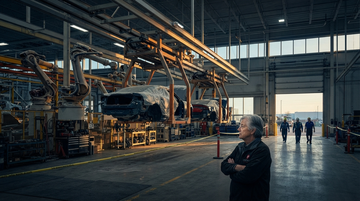
Unifor, the Canadian autoworkers union, said Stellantis is considering selling a Canada assembly plant as part of shifting production plans. The reported target is the Brampton, Ontario facility, with the related North America manufacturing footprint and contract negotiations tied to multiple Stellantis Canada assets.
The key market question isn’t the transaction itself; it’s whether this is the next step after months of constrained utilization—meaning a capacity reduction that forces suppliers and labor to re-route.
Event snapshot (what is publicly reported)
Reported party raising the sale idea
Unifor
Says Stellantis is considering selling the Canada assembly plant
Reported plant location
Brampton, Ontario
Toronto-area assembly facility referenced in the union report
Why it’s being debated now
Tariff-driven production re-routing
The sale discussion arrives amid North American auto capacity rebalancing
Supply-chain mechanics
How a plant sale transmits through the auto value chain
- A sale typically changes the allocator of stamped/assembled vehicle demand for local tiers—new owners renegotiate rate cards, and incumbents bid for residual work.
- If Brampton stops being a full assembly node, upstream modules shift tiers (e.g., castings, closures, interiors), raising risk that North American suppliers lose scale even if total OEM volumes remain flat.
- Because Brampton sits inside a multi-plant region, a divestiture forces logistics network redraws (inbound parts and outbound finished vehicles), which can move inventory buffers to different plants and states/provinces.
For investors, the danger in reading this as a simple real-estate story is that the economics of a vehicle assembly plant are not separable from the supply allocation that surrounds it. Brampton being contemplated for sale implies the company may decide that the most capital-efficient response to North American uncertainty is to reduce the number of places it has to keep production-ready.
The financial tell
Why this matters now: OEM discipline is visible in Stellantis’ earnings pattern
Revenue, FY2025
€153.5B
FY2025, reported Feb 26, 2026
Net income, FY2025
-€22.3B
FY2025, reported Feb 26, 2026
Revenue, FY2024
€156.9B
FY2024, reported Feb 27, 2025
Net income, FY2024
€5.5B
FY2024, reported Feb 27, 2025
Stellantis’ recent profitability swing gives context for why a company might move from short-term scheduling fixes to asset-level actions. In FY2025 it reported a net loss, following profitability in FY2024.
The investor implication: when margins deteriorate, the next defense is usually utilization and then footprint. That’s what makes a Canada plant sale discussion an unusually high-signal item, even before any deal terms are known.
Upstream beneficiaries and victims
Who wins if Brampton capacity shrinks (and who risks losing volume)
The most direct upstream exposure is to auto parts suppliers that concentrate engineering + manufacturing capacity inside the Canada/US production lane. If Brampton transitions away from full assembly, suppliers that were sized around that demand can see lower local pickup, even if overall Stellantis vehicle volumes don’t collapse.
Conversely, suppliers that already serve the higher-utilization plants in the region can benefit from redirected allocations—especially where new owners or remaining plants consolidate sourcing.
| Layer | What a sale likely changes | What to watch next |
|---|---|---|
| Vehicle assembly | Seat of production and utilization schedule | Evidence of model/platform assignment changes across the Canada footprint |
| Tier-1 modules/components | Order allocation, rate cards, and plant-level PPV | Customer/supplier statements about reallocated production content |
| Tier-2 materials & tooling | Tooling amortization horizon and volumes | Guidance changes around capex, headcount, and plant utilization |
| Logistics network | Route density, lead times, and buffer strategy | Freight/capacity changes that follow plant closures or consolidation |
Union leverage and political overlay
Why labor-politics can accelerate (or block) capacity exits
Because the discussion originates with Unifor and intersects with the next bargaining cycle, investors should expect the sale narrative to be less about price and more about obligations: what the new owner must assume, what Stellantis must unwind, and what governments require to keep employment commitments in place.
That overlay is why this event is structurally important for supplier contracts too. A buyer might only proceed if they believe the labor-cost trajectory supports the plant’s future utilization.
Horizon view
Near-term catalysts vs. 1–3 year outcomes to track
- Within weeks: see contract and production-schedule updates tied to Brampton/Stellantis Canada labor discussions.
- Within quarters: watch supplier guidance for regional volume shifts (capacity ramp/hold language, plant-utilization commentary, and capex pauses).
- Over 1–3 years: track whether a sold plant stays in vehicle assembly or converts to a narrower role, because the latter often compresses local supplier content.
The market will likely price this as a binary question—sale or no sale. But the deeper edge for investors is to monitor whether the underlying economics point toward divestiture of assembly itself, or divestiture of particular vehicle programs. Either way, supply allocations change.
Listed stocks most likely to feel the shockwaves
- Stellantis would convert an operational Canada problem into a footprint decision if a sale proceeds, which markets typically re-rate on event-driven risk.
- In the next 1–2 quarters, management commentary should reveal whether Brampton is replaced or consolidated, clarifying North America cost structure.
- A sale that reduces Brampton vehicle content could pressure near-term module demand for the Canada production lane.
- If Stellantis consolidates models into higher-utilization plants, Magna can capture replacement content elsewhere, but margins may depend on re-pricing.
- If OEMs exit Canada assembly, GM could gain access to redistributed regional demand—but only if the tariff re-routing leaves market share up for grabs.
- Over 1–3 years, watch whether the industry rebalances capacity in a way that changes pricing discipline across North America.