%22%2F%3E%0A%20%20%3Ccircle%20cx%3D%22220%22%20cy%3D%22150%22%20r%3D%22180%22%20fill%3D%22%2322d3ee%22%20fill-opacity%3D%220.12%22%2F%3E%0A%20%20%3Ccircle%20cx%3D%221010%22%20cy%3D%22130%22%20r%3D%22220%22%20fill%3D%22%2338bdf8%22%20fill-opacity%3D%220.08%22%2F%3E%0A%20%20%3Ccircle%20cx%3D%22920%22%20cy%3D%22520%22%20r%3D%22170%22%20fill%3D%22%2322d3ee%22%20fill-opacity%3D%220.06%22%2F%3E%0A%20%20%3Cpath%20d%3D%22M140%20430h920%22%20stroke%3D%22url(%23line)%22%20stroke-width%3D%2212%22%20stroke-linecap%3D%22round%22%2F%3E%0A%20%20%3Cpath%20d%3D%22M220%20360c120-150%20260-220%20380-220s260%2070%20380%20220%22%20fill%3D%22none%22%20stroke%3D%22%2367e8f9%22%20stroke-opacity%3D%220.5%22%20stroke-width%3D%2216%22%20stroke-linecap%3D%22round%22%20stroke-linejoin%3D%22round%22%2F%3E%0A%20%20%3Cpath%20d%3D%22M300%20398h600%22%20stroke%3D%22%2394a3b8%22%20stroke-opacity%3D%220.24%22%20stroke-width%3D%228%22%20stroke-linecap%3D%22round%22%2F%3E%0A%20%20%3Ctext%20x%3D%22220%22%20y%3D%22510%22%20fill%3D%22%23e2e8f0%22%20fill-opacity%3D%220.7%22%20font-family%3D%22Arial%2C%20Helvetica%2C%20sans-serif%22%20font-size%3D%2238%22%20letter-spacing%3D%228%22%3EINSIGHTS%3C%2Ftext%3E%0A%3C%2Fsvg%3E)
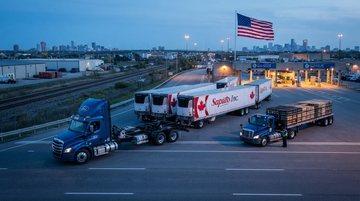
If the usual script in tariff stories is “Canada is the tariff victim,” the latest Canada–U.S. escalation under Section 338 is written differently: Canada is (reported to be) preparing a concession package meant to stop new 50% duties from landing.
The investor-relevant twist is not the headlines about 50% rates—it’s the structure of the concession swap. Canada’s bargaining position connects three supply-chain choke points—autos, dairy quota allocation, and provincial alcohol restrictions on U.S. products—into one time-bound negotiation, with an Aug. 19, 2026 effective date acting like a single deadline that can move cash flows across multiple industries at once.
Verified policy shock: what Section 338 actually does (and when)
Section 338 isn’t a broad embargo—it’s a 50% “sector-specific lever” with a hard Aug. 19 trigger
On July 20, 2026, the U.S. invoked Section 338 and announced additional duties of up to 50% on specified Canadian imports, tied to allegations of Canadian discrimination in targeted areas.
In the official Federal Register document for the dairy-related proclamation, the duty is effective at 12:01 a.m. ET on Aug. 19, 2026. That date matters because it sets the “inventory/cargo decision window” for upstream inputs, processors, and downstream retail distribution.
Load-bearing facts you can date-check
U.S. duty framework
Up to 50% Section 338 duties
Section 338 allows additional duties up to 50% (generally not earlier than 30 days after findings/proclamation).
Hard start date (dairy proclamation)
Aug. 19, 2026 12:01 a.m. ET
Applies to goods entered for consumption or withdrawn from warehouse for consumption on/after that time.
Tariff rate cited for the episode
50% punitive level
Reuters reports the U.S. unveiled 50% tariffs on covered categories.
What triggered it (and why it was designed to bite)
The U.S. framed the targets as “discrimination” spanning autos, dairy, and U.S.-alcohol access
Reuters’ reporting of the U.S. rationale ties the Section 338 action to three categories that are operationally hard to reroute quickly once duties land:
1) Autos: the U.S. cited Canada’s tariffs/quotas on U.S. cars. 2) Dairy: the U.S. cited Canada’s dairy supply-management regime. 3) Alcohol: the U.S. pointed to provincial halts on the sale of U.S. alcohol.
That triad is a “supply-chain” design. Auto and dairy are manufacturing/processing-heavy; alcohol is distribution/jurisdiction-heavy. Those structural differences determine who can absorb costs and who can’t.
- Autos become an engineering-and-logistics pricing problem because Canadian market access can be altered by tariffs/quotas, not just by import volumes.
- Dairy becomes a quota-allocation problem because supply management and quota rules decide who gets volume rather than whether product exists.
- Alcohol becomes a distribution-and-licensing problem because provincial actions can shut off U.S. brands even if tariffs are later adjusted.
The flipped narrative: Canada’s concession package
Reportedly, Ottawa is offering concessions to remove retaliatory tariffs and restore U.S. alcohol—turning the dispute into a swap
The core “script flip” is that Canada is not merely absorbing pressure—it is reportedly discussing a concession package intended to prevent new Section 338 levies from taking effect.
In reporting attributed to the negotiation stream, Canada’s side is described as willing to:
- remove retaliatory tariffs on U.S. products such as autos,
- make changes in how dairy quotas are allocated (without necessarily dismantling supply management), and
- end provincial bans so that U.S. alcohol returns to shelves.
Framed this way, the probability of resolution is higher than in a one-way “Canada pays” scenario, because Canada is signaling it can move politically and administratively on the very levers the U.S. is using.
Transmission mechanism: why auto, dairy, and alcohol don’t move together
One negotiation, three different “first movers”: parts makers, processors, and beverage distributors
Even though all three industries are tied to the same Section 338 episode, the cash-flow transmission channels differ. That means markets may overreact to the wrong segment if they assume tariffs affect everything the same way.
Autos: the cost shock is concentrated in cross-border vehicle flows and inputs, and it can propagate quickly through OEM build plans and tier-1/tier-2 pricing.
Dairy: the shock is concentrated in who receives quota allocation. Even if products exist, allocation rules determine whether brands/processors can access volume at non-tariff economics.
Alcohol: the shock is concentrated in provincial product bans and procurement/distribution access. In the short term, the distribution lever can dominate tariff math.
| Supply-chain node | U.S. pressure lever | Canada concession lever (reported) | Market “first repricing” |
|---|---|---|---|
| Auto manufacturing + OEM procurement | 50% tariff exposure via Section 338 autos coverage | Removing counter-tariffs on U.S. autos (and related tariff adjustments) | OEM and parts pricing expectations within 1–2 quarters |
| Dairy processors + brand importers | Dairy supply management & quota allocation dispute | Modifying quota allocation rules (not necessarily dismantling supply management) | Processor margin expectations as volumes become tariff-economical |
| U.S. beverage brands + Canadian distributors/retail access | Provincial halts on U.S. alcohol sales | Ending provincial bans / restrictions that block U.S. alcohol | Channel availability and near-term volume estimates |
Data-grounded context: pick listed beneficiaries by where the concession reaches
Listed market lenses: parts makers and dairy processors benefit if tariffs/retaliation unwind; alcohol beneficiaries depend on provincial rule reversal
To avoid “headline-only” investing, the right lens is: which listed cash flows are most sensitive to tariff removal and quota/procurement access restoration.
Using listed proxies with meaningful North American consumer exposure:
- Magna International is a parts supplier where auto tariff easing can change OEM purchasing plans.
- Saputo is a dairy processor exposed to quota and pricing mechanics.
- Constellation Brands and Diageo are alcohol-heavy consumer brands where access restorations matter as much as tariffs.
- Ford Motor Company represents OEM exposure to cross-border vehicle cost shocks.
Fundamentals and current operating context (why the macro shock matters to margins)
Margins and operating leverage suggest the macro shock lands fastest where pricing power is weakest
Lower or middling operating margins mean the same tariff shock can create disproportionate earnings volatility. In particular, Ford Motor Company’s low TTM operating margin suggests a higher sensitivity to cost changes versus a consumer brand with much stronger operating margins.
This is not a forecast of the exact earnings impact. It’s a reason the “resolution probability” matters for equities: if the swap succeeds, the market can reprice from worst-case margins faster in auto and dairy than in high-margin alcohol categories.
Investor scenarios: what to watch between now and Aug. 19
Two horizons: what moves first (weeks) vs. what sustains (quarters to 1–3 years)
- In the next days-to-weeks, watch for confirmation language on whether retaliatory tariffs and provincial alcohol bans are actually being lifted (not just discussed).
- In 1–2 quarters, expect the auto and dairy nodes to show the first earnings sensitivity because production/pricing and quota-volume economics adjust faster than consumer beverage refresh cycles.
- Over 1–3 years, sustained resolution matters less for whether tariffs exist and more for whether allocation rules and distribution access become predictable again for supply-chain contracting.
Related listed plays (evidence-backed linkage through the swap channels)
- Tariff relief on cross-border autos improves margin sensitivity because Ford operates at ~1.9% TTM operating margin.
- If the swap stalls, auto cost uncertainty pressures earnings expectations within 1–2 quarters ahead of Aug. 19 cargo pricing.
- Over 1–3 years, the stock responds to whether tariff regimes stabilize rather than any single proclamation date.
- If auto retaliation unwind happens, parts procurement should re-rate as demand visibility improves given Magna has ~5.6% TTM operating margin.
- Near term (weeks–quarters), tariff easing reduces risk premia on OEM build plans which typically flows into tier-1 output schedules.
- Over 1–3 years, stable cross-border terms support volume-based contract depth for complex systems and modules.
- Because dairy is quota-allocation sensitive, changes toward tariff-economical allocation improve processor volume economics with ~7.0% TTM operating margin.
- In the short term, a confirmed quota-allocation adjustment can reprice expected EBITDA within 1–2 quarters via volume and pricing assumptions.
- Over 1–3 years, sustained predictability in supply management reduces contracting risk for dairy inputs and finished cheese pricing.
- If provincial bans are lifted and U.S. alcohol returns to shelves, alcohol channel access supports near-term volume recovery for high-margin brands with ~35.9% TTM operating margin.
- If provincial rule reversal is delayed, the stock faces a delayed demand snapback even if some tariffs are reduced.
- Over 1–3 years, the key is whether distribution access becomes durable, so Constellation benefits from recurring planning certainty.
- U.S.-alcohol “return to shelves” primarily depends on provincial actions, so a confirmed lift can unlock incremental distribution volume even before long-run tariff questions resolve.
- If provincial restrictions remain, tariff changes alone won’t translate to immediate sell-through (distribution bottleneck).
- Over 1–3 years, durable rules improve order stability for on-premise and retail channels in Canada.