%22%2F%3E%0A%20%20%3Ccircle%20cx%3D%22220%22%20cy%3D%22150%22%20r%3D%22180%22%20fill%3D%22%2322d3ee%22%20fill-opacity%3D%220.12%22%2F%3E%0A%20%20%3Ccircle%20cx%3D%221010%22%20cy%3D%22130%22%20r%3D%22220%22%20fill%3D%22%2338bdf8%22%20fill-opacity%3D%220.08%22%2F%3E%0A%20%20%3Ccircle%20cx%3D%22920%22%20cy%3D%22520%22%20r%3D%22170%22%20fill%3D%22%2322d3ee%22%20fill-opacity%3D%220.06%22%2F%3E%0A%20%20%3Cpath%20d%3D%22M140%20430h920%22%20stroke%3D%22url(%23line)%22%20stroke-width%3D%2212%22%20stroke-linecap%3D%22round%22%2F%3E%0A%20%20%3Cpath%20d%3D%22M220%20360c120-150%20260-220%20380-220s260%2070%20380%20220%22%20fill%3D%22none%22%20stroke%3D%22%2367e8f9%22%20stroke-opacity%3D%220.5%22%20stroke-width%3D%2216%22%20stroke-linecap%3D%22round%22%20stroke-linejoin%3D%22round%22%2F%3E%0A%20%20%3Cpath%20d%3D%22M300%20398h600%22%20stroke%3D%22%2394a3b8%22%20stroke-opacity%3D%220.24%22%20stroke-width%3D%228%22%20stroke-linecap%3D%22round%22%2F%3E%0A%20%20%3Ctext%20x%3D%22220%22%20y%3D%22510%22%20fill%3D%22%23e2e8f0%22%20fill-opacity%3D%220.7%22%20font-family%3D%22Arial%2C%20Helvetica%2C%20sans-serif%22%20font-size%3D%2238%22%20letter-spacing%3D%228%22%3EINSIGHTS%3C%2Ftext%3E%0A%3C%2Fsvg%3E)
Verified operational event → investor payoff is throughput timing
The Ohio restart isn’t just another EV factory headline—it tests whether demand softness can be managed fast enough
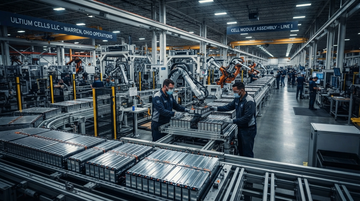
A Reuters report (Aug 12, 2026) says the Ultium Cells joint venture plant in northeast Ohio—co-owned by General Motors and LG Energy Solution—is scheduled to restart production of battery cells next week after a seven-month shutdown. Reuters also frames the output as “for GM EVs,” making the restart a concrete throughput event tied to GM’s Ultium ramp rather than a generic capacity announcement.
- restores physical battery-cell throughput after a production pause that lasted into 2026
- anchors demand at the GM EV product pipeline rather than a broad “export capacity” narrative
- puts 1,400 workers back to work in a facility designed for EV cell manufacturing
- measures how quickly the JV can re-scale when EV ordering patterns remain slower/less certain than original planning
Mechanism
What “battery on demand” actually means in operations: running rates, not just nameplate GWh
In a demand-soft EV environment, “battery on demand” is primarily a scheduling problem: deciding when to start (or restart) lines, how much workforce and maintenance to carry, and how to renegotiate supply volumes up the chain so that battery-cell output doesn’t outrun vehicle shipments. The Ohio restart matters because it turns that scheduling problem into a near-term, observable change in cell production flow—especially when demand is not “back to trend” yet.
| What happened | Why it matters for investors | What you can monitor next |
|---|---|---|
| Ultium Cells restarts cell production at the Ohio plant (next week; after a seven-month shutdown) | throughput rises first, so upstream materials and downstream EV builds can move in lockstep | worker call-backs, production run announcements, and GM EV build/ship updates |
| A separate Samsung SDI US cell JV consolidation story (different partner; different event) | JV restructuring changes corporate/asset scope; it does not automatically prove line-by-line production rate recovery | completion of consolidation steps, capacity reallocation, and revised customer contracts |
GM financial context
GM’s margin narrative still needs near-term offsets—so cell restart timing becomes an input to “how fast margins recover”
GM’s July 21, 2026 commentary (via a Reuters report on its quarterly core profit outlook) highlights that tariff-related dynamics can still swing reported results even when demand isn’t fully cooperative. GM maintained a view that tariffs would hit its bottom line by $2.5 billion to $3.5 billion, while also raising profit outlook and pointing to consumer strength—meaning margin recovery is a multi-variable equation, not only EV volume. In that setup, faster-than-expected battery-cell ramp at the Ohio facility would reduce the probability that EV unit economics stay trapped behind slower Ultium ramp rates.
GM revenue (FY2025)
$185.0B
FY2025 income statement, filed Jan 27, 2026
GM operating cash flow (FY2025)
$26.9B
FY2025 cash flow statement, filed Jan 27, 2026
GM free cash flow (FY2025)
$11.1B
FY2025 cash flow statement, filed Jan 27, 2026
Second-order supply-chain impact
Lithium and cathode exposure: when cell throughput resumes, so do pull signals—yet the profit split depends on run-rate vs. price
Even without a single-day linear relationship between a cell line restart and spot lithium prices, the restart changes the probability distribution for how quickly battery materials demand returns. For lithium chemicals (notably Albemarle), demand is highly sensitive to ramp timing across major automakers and battery makers. In cathodes, the mechanism is similar: higher cell output increases expected pull through cathode supply, but whether this improves margins for producers depends on negotiated contract structures and prevailing pricing power at the time run-rate changes.
- A run-rate-up shock from the Ohio restart increases the chance that upstream suppliers must re-allocate volumes back into battery-grade material streams.
- A run-rate-up that fails to translate into EV shipments increases the risk that supply chain contracts absorb volume mismatch via pricing pressure and/or inventory builds.
- The investor lens should be margin recovery velocity: production timing affects whether fixed-cost absorption improves quickly enough to counterbalance demand softness.
Investor playbook
What to watch next (short-term and 1–3 year horizons)
- Next few weeks: workforce call-back completion should precede any visible stabilization in outputs, which then feeds into GM’s near-term production planning.
- Next quarter: GM Ultium vehicle builds/shipments vs. prior expectations will indicate whether the Ohio restart is truly “battery on demand” or an early-cost re-intensification.
- 1–3 years: contracted supply re-optimization (especially around lithium and cathode inputs) will show whether scaling decisions became more demand-responsive across 2026–2028.
Supply chain linkages
The supply chain is a set of timing constraints: who gets punished is the one with the slowest contractual adjustment cycle
The “battery on demand” thesis succeeds when battery supply partners can adjust quickly enough to match vehicle demand—meaning they avoid over-accumulating inventory and avoid running unprofitable utilization rates for too long. The Ohio restart is a practical proof point: it demonstrates that the system can be switched back on. But the market will still punish whichever link cannot adjust its volumes, procurement terms, and production schedules fast enough to keep battery-cell run-rate aligned with GM’s sales reality.
Listed stocks likely to be sentiment-linked to the Ohio restart (and why)
- General Motors benefits if the Ohio restart pulls forward usable Ultium output into GM EV shipment windows over the next 1–2 quarters.
- GM risk remains if restart economics increase fixed-cost absorption before unit deliveries rise, delaying margin recovery.
- Over 1–3 years, GM’s credibility improves if battery supply partners demonstrate faster re-scaling aligned to demand rather than one-off restarts.
- LG Energy Solution gets a near-term positive signal if the Ohio line restart restores higher utilization after shutdown costs within weeks.
- In 1–3 years, the thesis strengthens if LG can convert rescaled output into repeatable contract stability across demand cycles.
- If EV demand remains soft, there is still upside/limit: restart helps, but pricing power may lag run-rate improvements.
- Albemarle can see sentiment support if the restart improves the probability of re-accelerating lithium pull signals into 2026–2027.
- Downside exists if demand mismatch persists: additional output without sustained EV shipment can cap the improvement in real-term lithium pricing and margins.
- Over 1–3 years, outcome depends on whether lithium demand growth becomes more stable due to responsive battery scheduling rather than volatile ramp-ups.