%22%2F%3E%0A%20%20%3Ccircle%20cx%3D%22220%22%20cy%3D%22150%22%20r%3D%22180%22%20fill%3D%22%2322d3ee%22%20fill-opacity%3D%220.12%22%2F%3E%0A%20%20%3Ccircle%20cx%3D%221010%22%20cy%3D%22130%22%20r%3D%22220%22%20fill%3D%22%2338bdf8%22%20fill-opacity%3D%220.08%22%2F%3E%0A%20%20%3Ccircle%20cx%3D%22920%22%20cy%3D%22520%22%20r%3D%22170%22%20fill%3D%22%2322d3ee%22%20fill-opacity%3D%220.06%22%2F%3E%0A%20%20%3Cpath%20d%3D%22M140%20430h920%22%20stroke%3D%22url(%23line)%22%20stroke-width%3D%2212%22%20stroke-linecap%3D%22round%22%2F%3E%0A%20%20%3Cpath%20d%3D%22M220%20360c120-150%20260-220%20380-220s260%2070%20380%20220%22%20fill%3D%22none%22%20stroke%3D%22%2367e8f9%22%20stroke-opacity%3D%220.5%22%20stroke-width%3D%2216%22%20stroke-linecap%3D%22round%22%20stroke-linejoin%3D%22round%22%2F%3E%0A%20%20%3Cpath%20d%3D%22M300%20398h600%22%20stroke%3D%22%2394a3b8%22%20stroke-opacity%3D%220.24%22%20stroke-width%3D%228%22%20stroke-linecap%3D%22round%22%2F%3E%0A%20%20%3Ctext%20x%3D%22220%22%20y%3D%22510%22%20fill%3D%22%23e2e8f0%22%20fill-opacity%3D%220.7%22%20font-family%3D%22Arial%2C%20Helvetica%2C%20sans-serif%22%20font-size%3D%2238%22%20letter-spacing%3D%228%22%3EINSIGHTS%3C%2Ftext%3E%0A%3C%2Fsvg%3E)
The Print: 124% Export Growth Is Not a Rebound, It's a Reroute
BYD sold 419,211 new energy vehicles at wholesale in July 2026, up 21.8% year-over-year and 3.9% sequentially — the third consecutive month of YoY growth, the first streak of its kind since the company ended a brutal 14-month domestic skid in April. The headline number undersells what changed: overseas shipments of passenger vehicles and pickups reached 179,841 units, up 124.3% YoY, while the implied domestic book fell roughly 9% to about 239,370 units (per CNEVPost cross-checks of BYD's official disclosures). Exports are now 43% of total volume — a threshold that looked impossible when domestic subsidies were subsidizing every transaction in 2023.
Total July sales
419,211 units
+21.8% YoY; +3.9% MoM (Reuters, Aug 1, 2026)
Overseas shipments
179,841 units
+124.3% YoY; 43% of total
Implied domestic sales
~239,370 units
Down ~9% YoY; third month of double-digit China softness
7-month YTD sales
2,227,722 units
On pace for ~3.88M full year vs. 5.0–5.5M target
7-month YTD exports
972,097 units
Annualized ~1.67M, above 1.5M guide
The run-rate math matters more than the monthly print. Exports over the first seven months of 2026 already total 972,097 units — annualized, that is 1.67 million vehicles shipped abroad, comfortably above BYD's own raised 1.5 million-unit guidance. The 5 million-unit total-volume target, by contrast, requires a monthly pace of 554,456 units for the remaining five months, 32% above July's actual run. The street implication: consensus has been anchoring on total volume; the correct frame is mix.
Why the Tariff Thesis Failed: BYD Routes Around Every Wall
The conventional trade-policy view — articulated by every Wall Street auto desk since the September 2024 Section 301 hike — held that a 100% US tariff on Chinese EVs and a 17–35.3% EU countervailing duty would throttle export velocity. Both have hit. The US still blocks passenger-car imports outright. The EU raised BYD's combined duty to 27% (10% base + 17% countervailing). Yet BYD more than doubled its BEV imports into the EU during the same window, and global exports grew 124%. The wall is real; the reroute is faster.
- Thailand Rayong plant (150,000-unit capacity) now ships the Dolphin to Europe to bypass the EU's China-origin duty — a direct cost advantage vs. a 27% in-tariff competitor.
- Brazil Camaçari plant (initial 150,000 units, scaling to 300,000) has cleared 100,000 locally produced vehicles and is taking 100,000-unit export orders from Mexico and Argentina — both of which blocked the US-market route.
- Hungary Szeged plant delayed to Q4 2026 production, but remains the long-term EU tariff-bypass once operational, with 27% of marginal economics tied to its ramp.
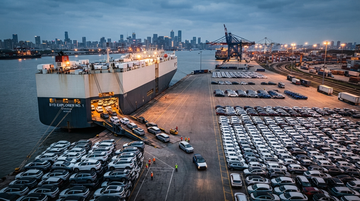
- An eight-ship, BYD-owned roll-on/roll-off fleet (BYD Explorer No. 1 through Jinan) is now complete, with capacity to transport ~1 million vehicles annually — a fixed cost that collapses the marginal export logistics cost to near zero.
- PHEV product mix sidesteps the EU's BEV-specific countervailing duty entirely; Brussels is now drafting PHEV tariffs precisely because BYD's hybrid volume is growing fastest.
The Profit Math: Why Exports Are Saving the Quarter
Q1 2026 was ugly on the income statement: BYD revenue fell 11.8% YoY to 150.2 billion yuan ($21.0B), and net profit collapsed 55.4% to 4.08 billion yuan ($597M) — a three-year low, per Yahoo Finance/CNBC. Gross margin recovered to 18.8%, but operating cash flow was down 67.5% as the domestic price war compressed each unit. The export channel is the offset: overseas gross margins run materially above domestic on a like-for-like trim level, and every redirected unit lands at a higher contribution per vehicle.
| Period | Revenue (CNY) | YoY change | Net profit (CNY) | YoY change | Net margin |
|---|---|---|---|---|---|
| Q1 2025 | 170.4B | — | 9.15B | — | 5.4% |
| Q2 2025 | 200.9B | — | 6.36B | — | 3.2% |
| Q3 2025 | 194.9B | — | 7.82B | — | 4.0% |
| Q4 2025 | 207.3B | — | 8.16B | — | 3.9% |
| Q1 2026 | 150.2B | −11.8% | 4.08B | −55.4% | 2.7% |
| TTM (Aug 2026) | 753.3B | — | 26.4B | — | 3.5% |
The mix shift is the part the income statement has not yet caught up with. The Q1 print covered a quarter where exports were already growing strongly but before the May–July acceleration (May 160,644 overseas units, June 175,349, July 179,841). At a blended incremental mix of ~40% export revenue at higher unit economics, the Q2 and Q3 prints should show material margin recovery even with flat total volume. BYD's forward P/E sits at ~21x on HK shares against a current P/B of 3.5x — that multiple is being held down by the Q1 disappointment, not the export trajectory.
Second-Order Read: Who's Actually Losing the Volume
The transmission into US and European auto OEMs is no longer theoretical. BYD registered 162,400 vehicles in Europe in H1 2026, up from 70,500 a year earlier (bitauto.my) — a 130% jump that takes volume against the most protected incumbent set on the planet. Tesla still leads BYD in absolute Q2 BEV deliveries (480,126 vs. 557,090 for BYD's BEV-only count), but the gap is now 77,000 units and shrinking. In Europe specifically, BYD has outsold Tesla in registrations every month of 2026 so far.
Q2 2026 BEV deliveries: BYD reclaims the global lead
BYD BEV-only vs. Tesla total — global registrations, Q2 2026
Unit: vehicles
BYD (BEV only)
557,090
Tesla (total)
480,126
BYD Europe H1 2026
162,400
The US-listed names are absorbing the spillover through different mechanisms. Tesla at $1.23T market cap and 285x trailing P/E is priced for a volume story that BYD's reroute directly contests; Q2 2026 revenue of $28.2B and EPS of $0.34 (a 43% YoY EPS contraction) leaves no margin for share loss in Europe or Latin America. General Motors and Ford, with $185B and $188B in TTM revenue respectively, face the slower-moving threat: their dealer-channel ICE-heavy mix in Mexico (where BYD already holds 70% of EV registrations) and the price pressure on entry trims as Chinese PHEVs undercut domestic options by 20–30% on like-content. Stellantis, meanwhile, is in the worst position of the US-listed group — negative net margin, $1.9B in TTM free cash burn, and exposed to the same Latin America and European price pressure with no EV-native product in market.
Supply Chain Winners: The Picks and Shovels Trade
Two under-discussed beneficiaries sit upstream of the export engine. The eight-ship BYD-owned RoRo fleet removes dependence on third-party carriers (where the global auto-shipping spot rate ran at multi-year highs through 2024–2025) and creates a 1 million-unit/year fixed logistics asset that scales with BYD's own volume — but also rents capacity to peers in less than peak periods. The second is the battery-verticalization story: BYD makes roughly 27% of its own battery cells, and the export mix is HEAVIER in PHEV and higher-content BEV trims that pull more cells per vehicle than its domestic budget line. The 100% China cell content also means CATL's pricing power inside the BYD supply chain is structurally capped, while BYD's own battery segment gross margin (internal estimate, not separately disclosed) is now contributing to the 18.8% group gross margin recovery.
- RoRo fleet completion locks in 1M-unit export logistics capacity at fixed cost — BYD's incremental export margin is structurally higher than peers who rent.
- Brazil Camaçari 100K-units milestone includes a 50% local-parts target by year-end 2026, building a Mercosur supply chain that will outlast any tariff regime change.
- Hungary plant Q4 2026 production start, even on reduced volume, allows BYD to redirect high-end trims to the EU at 0% additional duty — the 27% duty is only on China-built vehicles.
- Mexico's January 1, 2026 EV tariff hike to 50% is bypassed by BYD shipping to Argentina from Brazil (intra-Mercosur), not Mexico directly — a route the USMCA framework cannot reach.
What's Priced In, What Isn't, and What Moves Next
Short-term (days to quarters): the August and September monthly prints will be the first data points post the EU PHEV announcement. If July's 124% export growth holds or accelerates, the consensus has to upsize 2026 export estimates by 150–200K units and rebase the mix toward higher-margin geographies. The likely near-term beneficiaries are BYD itself (re-rated on export durability) and battery cell suppliers with European exposure. Near-term victims are Tesla European volume and Stellantis Latin America share.
Long-term (1–3 years): the structural question is whether the 5 million-unit total target is even the right one. If BYD's export run-rate stabilizes at 1.6–1.7 million units and domestic stabilizes at ~2.5 million, the company plateaus at ~4.1–4.2 million units — meaningfully below the guided 5 million but at materially better margin because of the export mix. The Hungary plant, the Brazil plant, and any future USMCA-compliant capacity in Mexico are the milestones to watch. Each one is a tariff-bypass that converts a percentage point of additional volume from 'at risk' to 'locked in.' The downstream consequence for GM and Ford is that the Latin American and Southeast Asian markets they once counted as defensive (low EV penetration, low Chinese presence) are now actively being taken.
Investable names tied to the BYD export reroute
- July exports of 179,841 units at +124.3% YoY put 2026 exports on a 1.67M-unit pace, beating the 1.5M guide by ~11%.
- Q1 2026 net margin compressed to 2.7%; export mix at 43% of volume should pull Q2 net margin back toward 3.5–4.0% on higher blended unit economics.
- Eight-ship fleet at full operation plus Hungary Q4 2026 start permanently lowers the marginal cost of EU-bound export, extending the tariff bypass window through 2027.
- Watch the EU PHEV countervailing duty announcement (drafted June 2026) as the single biggest near-term catalyst for the 1.5M export thesis.
- Q2 2026 EPS of $0.34 was down 43% YoY; at 285x trailing P/E, the stock cannot absorb another quarter of European share loss to BYD (which has outsold Tesla in Europe every month of 2026).
- Latin America is the next contested market — BYD's Brazil plant adds 100,000 units of regional capacity, and Tesla has no comparable local footprint.
- Tariff walls that protect Tesla's US volume do not protect its Q2 2026 European deliveries of ~85K units, where every percentage point of share loss is a direct revenue hit.
- Q2 2026 revenue $47.4B and 3.2% operating margin leave limited cushion if BYD's Mexican consumer base (70% EV share) expands into the entry-trim segments GM sells through Chevrolet.
- GM's 50%-local content rule in Mexico was designed for ICE; BYD's 100% China-built imports via distributors and the Brazil-export route circumvent this entirely.
- Tariff insulation holds in the US, but mix shift in Latin America erodes the price umbrella that has supported GM's 5.7% gross margin.
- TTM net loss of −$1.85/share and free cash flow yield of 12.4% reflect an EV transition that BYD's export velocity is now outrunning in Latin America — Ford's most price-sensitive market.
- Ford's Mexico-built EV strategy (leveraging USMCA) is exposed if Trump administration extends 50% Mexico tariffs to USMCA-compliant auto content in the July 2026 USMCA review.
- Ford's TTM P/S of 0.31x is cheap for a reason; the export reroute is one more reason it stays cheap.
- Negative TTM net margin (−12.1%) and $1.9B free cash burn make Stellantis the most leveraged to the Latin American share loss — Argentina and Brazil are 20%+ of group volume.
- No EV-native product in market to compete with BYD's Dolphin, Yuan Plus, and Seal in the €20–35K segment where Stellantis's Peugeot, Citroën, and Fiat brands operate.
- Forward P/E of 7x discounts some of this, but the reroute extends the timeline to margin recovery by another 12–18 months.
- VW's European volume is directly contested by BYD's 130% H1 2026 European registration growth; the China joint ventures (VW Anhui) are the most exposed channel.
- Lowest multiple of the European set (P/B 0.20x, P/S 0.12x) prices in much of the share-loss risk, but the EU PHEV duty could actually help VW by closing BYD's current loophole.
- Tariff-insulated Brazil operations face direct competition from BYD's Camaçari plant ramp — a 2027 headwind for VW's most profitable overseas segment.
- Geely sits at 18.8% EU countervailing duty (10% base + 8.8% specific) — the second-lowest of the major Chinese exporters, ahead of BYD's 27% total.
- Geely's separate Europe build-out (Spain plant from Geely-owned Volvo, Hungary via joint ventures) creates a parallel tariff-bypass route that benefits as Chinese export momentum validates the strategy.
- Domestic mix recovery plus export growth in 2026 puts Geely on a similar reroute path to BYD, with smaller scale but cleaner valuation.