%22%2F%3E%0A%20%20%3Ccircle%20cx%3D%22220%22%20cy%3D%22150%22%20r%3D%22180%22%20fill%3D%22%2322d3ee%22%20fill-opacity%3D%220.12%22%2F%3E%0A%20%20%3Ccircle%20cx%3D%221010%22%20cy%3D%22130%22%20r%3D%22220%22%20fill%3D%22%2338bdf8%22%20fill-opacity%3D%220.08%22%2F%3E%0A%20%20%3Ccircle%20cx%3D%22920%22%20cy%3D%22520%22%20r%3D%22170%22%20fill%3D%22%2322d3ee%22%20fill-opacity%3D%220.06%22%2F%3E%0A%20%20%3Cpath%20d%3D%22M140%20430h920%22%20stroke%3D%22url(%23line)%22%20stroke-width%3D%2212%22%20stroke-linecap%3D%22round%22%2F%3E%0A%20%20%3Cpath%20d%3D%22M220%20360c120-150%20260-220%20380-220s260%2070%20380%20220%22%20fill%3D%22none%22%20stroke%3D%22%2367e8f9%22%20stroke-opacity%3D%220.5%22%20stroke-width%3D%2216%22%20stroke-linecap%3D%22round%22%20stroke-linejoin%3D%22round%22%2F%3E%0A%20%20%3Cpath%20d%3D%22M300%20398h600%22%20stroke%3D%22%2394a3b8%22%20stroke-opacity%3D%220.24%22%20stroke-width%3D%228%22%20stroke-linecap%3D%22round%22%2F%3E%0A%20%20%3Ctext%20x%3D%22220%22%20y%3D%22510%22%20fill%3D%22%23e2e8f0%22%20fill-opacity%3D%220.7%22%20font-family%3D%22Arial%2C%20Helvetica%2C%20sans-serif%22%20font-size%3D%2238%22%20letter-spacing%3D%228%22%3EINSIGHTS%3C%2Ftext%3E%0A%3C%2Fsvg%3E)
Labor risk meets a different geography
A full-day stoppage lands just as Hyundai’s value driver is supposed to be North America, not exports
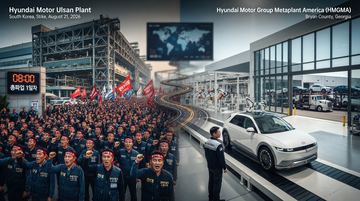
Hyundai’s union staged a 16-hour full-day halt across three Korea production sites, with an Aug. 21, 2026 walkout covering the morning and afternoon shifts (8 hours each).
That matters to investors because it happens at the same moment Hyundai’s longer-term narrative is shifting toward the U.S. as a growth engine, supported by the company’s Georgia/Alabama footprint. Even if the strike is in Korea, the cost and scheduling pressure travels through inventory timing, component availability, and “who absorbs the wage catch-up” across the supply chain.
What the strike actually looks like (as disclosed in reporting)
Strike date
Aug. 21, 2026
Full strike carried out on the day of publication’s reporting
How long it lasts
16 hours total
8 hours for the morning shift plus 8 hours for the afternoon shift
Where production is halted
Ulsan, Jeonju, Asan
Plants reported as fully halted
How many workers participate
~39,000
Reported scope includes office and production staff
Supply-chain transmission
Why a Korea stoppage can still hit the U.S. output engine
- A Korea plant halt compresses build schedules, so Hyundai pulls forward inbound parts that are already booked—tightening supplier capacity even if the U.S. line is operating.
- When suppliers face sudden schedule changes, they shift costs via expedited logistics and overtime, which shows up downstream as price pressure rather than just near-term downtime.
- Parts commonality means even “non-U.S.” disruptions can reduce available finished-vehicle inventory, limiting shipments into the U.S. at the exact moment tariff uncertainty makes delivery timing more valuable.
To make this investable, you have to separate (1) production timing risk from (2) structural cost risk. The strike’s immediate effect is calendar loss; the lasting effect is whether wages (and the settlement mechanism) recalibrate the baseline for future labor cost per vehicle. That re-pricing is what ultimately determines whether the U.S. ramps faster than costs—or slower.
Who pays for the catch-up?
The sector’s next benchmark is a bargaining outcome—and it decides margins across tiers
Your “who pays” question has a clean hierarchy: (a) the OEM absorbs some wage inflation through operating margin compression, (b) suppliers absorb via lower utilization and higher input/labor pass-through, and (c) downstream buyers absorb via higher vehicle pricing and/or slower demand growth.
On paper, Hyundai’s profitability profile suggests it can absorb only so much before the cost shock forces a pricing response. Hyundai Motor’s gross profit margin sits at ~17.4% (TTM) and operating profit margin at ~5.1% (TTM), which is a thinner cushion than investors often assume when only looking at top-line scale.
Gross margin
17.4%
Hyundai Motor TTM figures from company overview metrics
Operating margin
5.1%
Hyundai Motor TTM figures from company overview metrics
EBIT margin
6.3%
Hyundai Motor TTM figures from company overview metrics
Balance sheets matter for shock absorption
Supplier balance sheets determine how quickly price resistance turns into production risk
Different tiers respond differently because their cash conversion and leverage profiles differ. In the Hyundai ecosystem, Hyundai Mobis is positioned as a major components and systems supplier; Hyundai Steel is a materials supplier. In a demand-sensitive labor shock, the first “credit risk” signal often appears as working-capital stress and inventory/receivable timing, not as long-term solvency.
Hyundai Mobis shows a comparatively supportive operating/cash capacity profile versus more cyclical industrial suppliers in downturns, which generally means it can smooth a short disruption better—but it can also pass through costs faster when the bargaining benchmark rises.
| Company | Operating margin (TTM) | Gross margin (TTM) | Net profit margin (TTM) | Cash conversion proxy (TTM) |
|---|---|---|---|---|
| Hyundai Motor Company | 5.1% | 17.4% | 4.6% | Receivables/payables/inventory cycle metrics shown in company overview |
| Hyundai Mobis Co.,Ltd | 5.6% | 14.6% | 5.8% | Inventory/receivables turnover metrics shown in company overview |
| Hyundai Steel Company | 1.0% | 6.3% | -0.1% | Lower profitability and higher sensitivity shown in company overview |
Short-term vs long-term
What moves in days–quarters vs. what changes over 1–3 years
- Days–quarters: A full halt creates schedule gaps that first show up as utilization drops and inventory replenishment timing across components.
- Days–quarters: Investors typically reprice OEM/supplier margins when management discusses catch-up costs; the market watches the first pricing commentary more than the strike headline.
- 1–3 years: The key is whether the bargaining outcome lifts the baseline labor cost per vehicle, and whether Hyundai’s North America output mix is enough to offset it via scale and pricing power.
The investable tell will be whether Hyundai can maintain its North America growth-through-output strategy without sacrificing margin. If the wage settlement becomes a sector reference point, the winners are usually those with (1) pricing leverage, (2) lower labor intensity per dollar of value added, or (3) better mix into powertrain/components with less direct labor pass-through.
Listed market links investors can trade on
- A Korea production halt reduces output cadence, pressuring near-term earnings visibility even if North America grows on longer lead times.
- Hyundai’s ~5.1% operating margin (TTM) offers limited room if the wage catch-up becomes a recurring cost baseline.
- As a key OEM components supplier, Mobis can experience cash/timing pressure when OEM build schedules swing.
- If labor settlements reprice the system, Mobis’s component economics may benefit from faster pass-through over 1–3 years, but margins remain exposed to volume swings.
- With ~1.0% operating margin (TTM), Hyundai Steel has less shock-absorption capacity if industrial labor costs reset upward.
- If steel prices can’t fully reprice, the wage benchmark can compress spreads before it improves utilization.
- If a wage settlement becomes a sector benchmark, labor cost inflation can raise the cost floor for U.S. OEMs in days–quarters.
- However, Ford’s broader mix can offset some labor pressure if vehicle pricing holds; direction depends on management cost guidance.
- When OEM production rhythms shift, Tier-1 component demand can move with build schedules first, then with pricing later.
- If the wage catch-up lifts labor-sensitive costs, BorgWarner may face margin pressure unless it can reprice contracts.
- If OEMs and suppliers prioritize uptime to protect shipments, Cummins can gain from higher aftermarket and service pull-through in days–quarters.
- Over 1–3 years, a sector-wide wage reset can push demand toward efficient powertrain value, supporting revenue mix resilience.