%22%2F%3E%0A%20%20%3Ccircle%20cx%3D%22220%22%20cy%3D%22150%22%20r%3D%22180%22%20fill%3D%22%2322d3ee%22%20fill-opacity%3D%220.12%22%2F%3E%0A%20%20%3Ccircle%20cx%3D%221010%22%20cy%3D%22130%22%20r%3D%22220%22%20fill%3D%22%2338bdf8%22%20fill-opacity%3D%220.08%22%2F%3E%0A%20%20%3Ccircle%20cx%3D%22920%22%20cy%3D%22520%22%20r%3D%22170%22%20fill%3D%22%2322d3ee%22%20fill-opacity%3D%220.06%22%2F%3E%0A%20%20%3Cpath%20d%3D%22M140%20430h920%22%20stroke%3D%22url(%23line)%22%20stroke-width%3D%2212%22%20stroke-linecap%3D%22round%22%2F%3E%0A%20%20%3Cpath%20d%3D%22M220%20360c120-150%20260-220%20380-220s260%2070%20380%20220%22%20fill%3D%22none%22%20stroke%3D%22%2367e8f9%22%20stroke-opacity%3D%220.5%22%20stroke-width%3D%2216%22%20stroke-linecap%3D%22round%22%20stroke-linejoin%3D%22round%22%2F%3E%0A%20%20%3Cpath%20d%3D%22M300%20398h600%22%20stroke%3D%22%2394a3b8%22%20stroke-opacity%3D%220.24%22%20stroke-width%3D%228%22%20stroke-linecap%3D%22round%22%2F%3E%0A%20%20%3Ctext%20x%3D%22220%22%20y%3D%22510%22%20fill%3D%22%23e2e8f0%22%20fill-opacity%3D%220.7%22%20font-family%3D%22Arial%2C%20Helvetica%2C%20sans-serif%22%20font-size%3D%2238%22%20letter-spacing%3D%228%22%3EINSIGHTS%3C%2Ftext%3E%0A%3C%2Fsvg%3E)
Verdict first
The headline loss is the right number—but the real signal is USPS’s cost/volume mismatch inside “parcel-like” categories
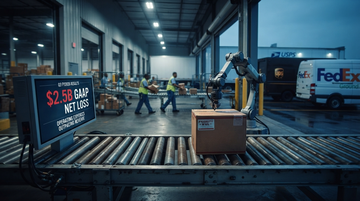
USPS’s latest quarterly GAAP net loss landed at $2.5B, even as operating revenue increased. That combination is the key: it shows USPS is struggling to convert incremental parcel-like demand into incremental profit—despite taking actions that temporarily support pricing. For investors following the parcel duopoly, the takeaway is not “postal is broken”; it’s that the industry’s margin math is fragile when volume declines while networks’ fixed/semifixed costs keep moving.
USPS GAAP net loss (latest quarter reported)
$2.5B
3 months ended Jun. 30, 2026; USPS reports net loss (GAAP) of $2.5B
Operating revenue (same quarter)
$19.9B
3 months ended Jun. 30, 2026; operating revenue $19.9B
Operating expenses (same quarter)
$22.5B
3 months ended Jun. 30, 2026; operating expenses $22.5B
Shipping & Packages volume
1,554M
3 months ended Jun. 30, 2026; down vs 1,609M prior year quarter
What happened
USPS grew “Shipping and Packages” revenue while volume declined—yet total expenses rose too
In its quarter reported for the three months ended Jun. 30, 2026, USPS posted a $2.5B quarterly GAAP net loss. Total operating revenue rose to $19.9B (+$1.1B, +6.1% YoY), but total operating expenses rose to $22.5B (+$438M, +2.0% YoY). Within that, the “parcel-like” proxy—USPS’s “Shipping and Packages” category—showed revenue growth alongside piece-volume decline.
| Category | Revenue (million, current) | Revenue (million, prior) | Volume (million, current) | Volume (million, prior) | Implied volume change |
|---|---|---|---|---|---|
| Shipping and Packages | $8,250 | $7,662 | 1,554 | 1,609 | -3.4% |
| First-Class Mail (context) | $6,133 | $5,878 | 9,460 | 9,803 | -3.5% |
| Marketing Mail (context) | $4,018 | $3,578 | 13,782 | 13,208 | +4.3% |
- USPS’s operating revenue increased primarily with growth in USPS Ground Advantage (captured in the “Shipping and Packages” subcategory) and strength in Marketing Mail, aided by price increases in First-Class Mail and Marketing Mail.
- USPS simultaneously reported Shipping and Packages volume fell 3.4% while Shipping and Packages revenue rose 7.7%, implying that pricing/ mix is not fully offsetting declining pieces.
- Operating expenses rose as retirement benefits and other compensation/benefit lines increased, with rising transportation-related costs also cited.
Why it matters for UPS/FedEx
Why USPS’s economics forecast parcel duopoly pricing pressure
Duopoly carriers manage margins through a mix of (1) yield management (pricing and service mix), (2) cost absorption (network utilization), and (3) labor/benefits timing. USPS shows what happens when (a) piece volumes soften and (b) cost lines still rise: even revenue growth via price does not prevent losses. The second-order effect for UPS and FedEx is that they face a structurally similar question—whether incremental yield can outpace incremental cost when volumes don’t cooperate.
- If volume declines while costs rise, carriers’ “price per piece” gains can be erased by labor and benefits dynamics (timing) plus transportation cost sensitivity.
- USPS’s temporary price actions (time-limited transportation-related price increase implemented Apr. 26, 2026 for certain Shipping and Packages offerings) help revenue, but the quarter still closed with a large GAAP loss—signaling limited elasticity at the operating margin level.
- A strategy that relies on only pricing to stabilize earnings becomes brittle when pieces trend down (even if revenue trends up).
Causal chain
USPS isn’t just losing money—its planning and cost/volume alignment has been the recurring failure mode
USPS’s loss pattern is not a one-quarter anomaly. The USPS Office of Inspector General describes a recurring divergence between strategy projections and actual outcomes—where expenses exceeded projections and the service work-hour reductions/initiative progress did not align with assumed volume declines. That’s the planning analog of the quarterly signal: if the operating model cannot translate demand changes into cost structure fast enough, losses persist.
- OIG notes DFA-plan projections diverged from actual results, with expenses exceeding projections and initiatives progressing slower than needed to realize savings.
- OIG also highlights a measurement gap: USPS did not track initiative progress back to the DFA plan in a way that allowed OIG to determine how much savings (if any) initiatives delivered versus plan.
- GAO underscores that USPS’s total expenses have continued to outpace total revenue and that USPS has been on GAO’s High Risk list, reinforcing that the issue is structural rather than episodic.
Near-term vs long-term
What to watch next: the timing of cost absorption vs the timing of pricing actions
In the near term, the key question for parcel margins is not whether carriers can raise prices—it’s whether volume stabilizes quickly enough for the cost lines to stop growing faster than revenue. USPS’s quarter showed revenue growth and expense growth at the same time, while “Shipping and Packages” pieces declined. Over the next 1–3 years, investors should watch whether any network or labor/benefits reform reduces sensitivity to volume shocks (cost absorption speed). If USPS continues to show revenue/yield support without margin stabilization, it increases the odds that the broader market will tolerate more frequent yield resets or promotional tactics—pressuring UPS/FedEx operating leverage.
| Layer | USPS evidence (this session) | Investor implication for parcel carriers |
|---|---|---|
| Revenue/yield layer | Operating revenue rose to $19.9B (+6.1% YoY) with Shipping & Packages revenue +7.7% YoY | Yield support can mask piece weakness, but it may not protect operating margins if volume-driven absorption weakens. |
| Cost absorption layer | Total operating expenses rose to $22.5B (+2.0% YoY) despite revenue increase | If costs keep rising with volume softness, carriers may need more aggressive cost actions or yield adjustments. |
| Volume layer | Shipping & Packages volume fell -3.4% YoY | Declining pieces can reduce network utilization, pushing cost per piece higher unless fixed costs flex down. |
Carriers and the transmission mechanism
Investable linkage: how a public-sector P&L pattern can become a private-sector margin warning
USPS isn’t UPS or FedEx, but it is part of the same competitive ecosystem for parcel-like shipments. When the category that includes Ground Advantage grows revenue while piece volumes decline—and costs rise at the same time—it implies the market is experiencing yield support that is not converting into profit. That environment can force duopoly carriers to compete harder (or accept lower operating leverage) to keep share, especially during promotional cycles and demand softness.
Listed stocks most exposed to the parcel-economics transmission
- UPS’s network yield defense can face incremental margin headwinds when volume declines with costs rising, echoing USPS’s Shipping & Packages piece softness (-3.4% YoY).
- In days–quarters, UPS is exposed to competitive pricing if USPS’s mixed revenue-up/volume-down pattern signals softer piece demand for ground-like shipments.
- Over 1–3 years, UPS’s operating leverage depends on whether cost absorption improves faster than piece volume volatility in the parcel market.
- FedEx’s margin model may see pricing/ mix protection fall short if competitors exploit volume weakness, consistent with USPS revenue up while pieces fell in Shipping & Packages.
- In days–quarters, watch for yield pressure or demand mix shifts as USPS’s time-limited price actions did not prevent a $2.5B GAAP loss.
- Over 1–3 years, FedEx’s sensitivity depends on labor/benefits timing relative to volume absorption—an issue highlighted by USPS’s cost/volume mismatch recurrence.
- DoorDash is a downstream e-commerce/delivery demand channel; USPS loss signals competitive delivery economics may intensify if parcel-like volume softness spreads.
- In days–quarters, monitor whether delivery demand mix shifts toward cheaper shipping options as USPS’s pieces fell while revenue rose.
- Over 1–3 years, DoorDash’s unit economics can be influenced by whether carriers reset pricing when cost absorption lags demand.
- If parcel demand remains choppy, utilization risk for transportation-adjacent capacity can rise, consistent with USPS Shipping & Packages volume down (-3.4% YoY).
- In days–quarters, watch for changes in logistics cost outlook as USPS shows expenses rising alongside revenue.
- Over 1–3 years, the key is whether logistics capacity contracts fast enough to prevent cost per move from rising.