%22%2F%3E%0A%20%20%3Ccircle%20cx%3D%22220%22%20cy%3D%22150%22%20r%3D%22180%22%20fill%3D%22%2322d3ee%22%20fill-opacity%3D%220.12%22%2F%3E%0A%20%20%3Ccircle%20cx%3D%221010%22%20cy%3D%22130%22%20r%3D%22220%22%20fill%3D%22%2338bdf8%22%20fill-opacity%3D%220.08%22%2F%3E%0A%20%20%3Ccircle%20cx%3D%22920%22%20cy%3D%22520%22%20r%3D%22170%22%20fill%3D%22%2322d3ee%22%20fill-opacity%3D%220.06%22%2F%3E%0A%20%20%3Cpath%20d%3D%22M140%20430h920%22%20stroke%3D%22url(%23line)%22%20stroke-width%3D%2212%22%20stroke-linecap%3D%22round%22%2F%3E%0A%20%20%3Cpath%20d%3D%22M220%20360c120-150%20260-220%20380-220s260%2070%20380%20220%22%20fill%3D%22none%22%20stroke%3D%22%2367e8f9%22%20stroke-opacity%3D%220.5%22%20stroke-width%3D%2216%22%20stroke-linecap%3D%22round%22%20stroke-linejoin%3D%22round%22%2F%3E%0A%20%20%3Cpath%20d%3D%22M300%20398h600%22%20stroke%3D%22%2394a3b8%22%20stroke-opacity%3D%220.24%22%20stroke-width%3D%228%22%20stroke-linecap%3D%22round%22%2F%3E%0A%20%20%3Ctext%20x%3D%22220%22%20y%3D%22510%22%20fill%3D%22%23e2e8f0%22%20fill-opacity%3D%220.7%22%20font-family%3D%22Arial%2C%20Helvetica%2C%20sans-serif%22%20font-size%3D%2238%22%20letter-spacing%3D%228%22%3EINSIGHTS%3C%2Ftext%3E%0A%3C%2Fsvg%3E)
What changed (and what it actually enables)
DoorDash is no longer just orchestrating drones—it says it earned the FAA’s Part 135 air-carrier certification
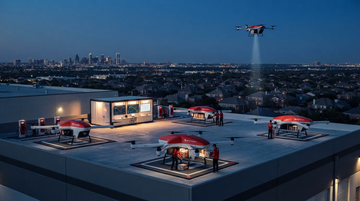
DoorDash announced that DoorDash Labs “has earned the Federal Aviation Administration Part 135 air carrier certification” and is launching “DoorDash Air,” an in-house drone-delivery program. DoorDash explicitly frames the certification as making it “authorized to operate as an air carrier,” and it positions the program as a deeply integrated “full stack” system that spans ground infrastructure, drones, and handoff systems.
Primary-source essentials
Announcement date
Jul 29, 2026
DoorDash Air news release date
Regulatory basis
FAA 14 CFR Part 135 air carrier certification
DoorDash Labs certificate claim
Operational stance
In-house “DoorDash Air” vertical stack
Ground infrastructure + drones + handoff systems
Mechanism
In-house Part 135 changes unit economics: fewer “middleware” margins, more asset + compliance costs—and more control over utilization
Partnership models (Wing/Flytrex/Manna) generally push margin and execution risk into the drone operator’s economics. By contrast, DoorDash’s “runs on top of DoorDash’s network” positioning suggests it intends to keep the orchestration layer while internalizing the carrier/operator layer for its drone product.
- DoorDash can capture partner margin currently embedded in per-delivery drone fees by owning the operator layer it says it can legally operate under Part 135.
- DoorDash must bear higher fixed costs from operator certification, hubs, and maintenance programs because Part 135 requires an operator certification process and compliance artifacts.
- DoorDash can improve utilization by routing drone-eligible orders through a single matching layer because it says its Autonomous Delivery Platform matches every order with the most effective method in real time.
Supply-chain map (upstream → DoorDash Air → downstream)
Full delivery stack ownership reorders the supply chain: DoorDash controls handoff + routing, while still relying on local infrastructure
DoorDash’s announcement repeatedly emphasizes integration across “ground infrastructure,” the “drone itself,” and “handoff systems,” including drive-throughs, rooftops, or merchant back doors. Even with in-house operator capability, downstream delivery still depends on local merchant readiness and defined delivery zones—DoorDash’s consumer help page confirms drone delivery availability is currently limited to eligible areas and addresses.
| Layer | What DoorDash says it builds/controls | Why it matters to unit economics | What still constrains throughput |
|---|---|---|---|
| Marketplace orchestration | Order matching and integration into DoorDash network | Reduces coordination cost vs. stitching multiple external operators | Demand density and geo eligibility |
| Handoff systems | “Universal handoff systems” for multiple site types | Improves pickup/drop consistency, lowering failure/redo rates | Merchant back-door/rooftop/drive-through readiness |
| Operator / carrier layer (Part 135) | Operating as a certified air carrier via DoorDash Labs | Shifts per-delivery economics away from third-party operator fees | Regulatory compliance + maintenance program costs |
| Local delivery zones | Address-based eligibility with support intake | Creates a scalable rollout mechanism tied to operational constraints | Community/local requirements and hub siting |
Evidence DoorDash is already learning (not just announcing)
DoorDash cites measurable pilot effects and delivery-time performance—use these as the benchmark for future in-house scaling
Avg drone delivery time (2025)
25 min
DoorDash estimate in DoorDash Air announcement
Pilot order-volume lift
≈30%
Observed at some participating locations; sustained for 9 weeks
Share of orders traveling 3–5 miles (2025)
>20%
DoorDash estimate for 2025 order travel distribution
Time penalty vs shorter deliveries
≈25% longer
DoorDash estimate for 3–5 mile orders
These metrics matter because they define the “run-rate” inputs an in-house operator must hit: delivery time consistency, sustained incremental order volume, and an ability to handle a meaningful share of medium-mile orders. If DoorDash Air can translate pilot lift into repeatable, geographically scalable volume, the fixed-cost burden of Part 135 certification is easier to rationalize.
Regulatory moat
Part 135 can be a capacity barrier: certification steps, hub requirements, and NEPA/community obligations shape who can scale
FAA’s Part 135 “Package Delivery by Drone” guidance describes a certification path that includes preapplication (concept of operations), evidence of aircraft airworthiness (or petitions/exemptions), compliance with CFR, and an environmental assessment under NEPA/CEQ before receiving an air carrier/operating certificate. It also notes operators must establish hub and delivery infrastructure and respond to public inquiries about operations.
- DoorDash can benefit from being “on the inside” of the operator certification timetable because Part 135 requires multi-phase evidence and validation steps before operations.
- DoorDash must navigate NEPA and community-related mitigations as volume expands, which can slow or limit certain geographies compared with purely software-led delivery choices.
- DoorDash’s in-house model can reduce reliance on external operator selection and allocation bottlenecks by internalizing the carrier/operator role it is certified to perform.
Implications for DoorDash’s financial capacity
DoorDash has operating cash flow to fund experimentation—but the market will watch whether drone capex crowds out profitability
DoorDash has generated positive operating cash flow and free cash flow in the last two fiscal years in the dataset, even though earnings have been volatile. That matters because in-house drone operations imply additional fixed investments (aircraft fleets, hubs, maintenance programs, safety systems) and regulatory compliance spend—so investors will likely judge whether DoorDash Air can become a margin-accretive differentiator instead of a cash burn driver.
DoorDash free cash flow (FY)
Use as a rough “funding runway” reference for experimentation; drone economics will depend on how much fixed capex scales with deployment.
Unit: USD
2023
Free cash flow
1,349,000,000
2024
Free cash flow
1,802,000,000
2025
Free cash flow
2,174,000,000
FY2025 revenue
$13.7B
Income statement total revenue (FY ending 2025-12-31)
FY2025 net income
$0.94B
Income statement net income (FY ending 2025-12-31)
FY2025 operating cash flow
$2.43B
Cash flow statement net cash from operating activities (FY ending 2025-12-31)
FY2025 free cash flow
$2.17B
Cash flow statement free cash flow proxy (operating cash flow minus capex)
Who wins and who feels pressure
If DoorDash can internalize operator margin, it compresses the advantage of “drone delivery as a partner feature” for rivals
- DoorDash can press rivals’ drone partnerships by offering tighter integration within the same marketplace network, because it says DoorDash Air runs on top of DoorDash’s platform.
- If DoorDash uses Part 135 to scale faster, it can force competitors (including retailers trying drone fulfillment) to compete on geography + utilization, not just pilots because Part 135 expansion is not purely a software problem.
- Downstream sellers may prefer DoorDash Air once it consistently handles handoff and routing across merchant site types, aligning with DoorDash’s claimed universal handoff systems.
Note: This article does not quantify Uber Eats, Walmart GoLocal, or Amazon Prime Air unit economics from primary sources here; their regulatory and partner structure differs by company and is not disclosed in DoorDash’s announcement. The core claim is directional: internalizing the operator layer changes cost structure and rollout control—two levers that rivals who rely on third-party operators cannot fully control.
Horizons
Short-term: pilot validation. Long-term: regulatory + operational scale determines whether drone delivery becomes a durable unit-economics lever
| Horizon | Watch item | What would confirm it | What would break the thesis |
|---|---|---|---|
| Days–quarters | Geographic rollout beyond current eligible areas | More “drone delivery available” zones and growing order share through the drone option | Stalled deployments or repeated limitation to pilot cities |
| Days–quarters | Consistency of delivery-time performance and order take-rate | Sustained performance comparable to DoorDash’s ~25-minute average and continued order lift | Performance degradation or limited repeat demand |
| 1–3 years | Deployment density vs. hub build-out | Evidence that hub/infrastructure and fleet utilization track with increased order volume | Capex and compliance costs rising faster than drone-order volume |
| 1–3 years | Operator compliance maturation across sites | Expansion of handoff coverage (merchant back doors/rooftops/drive-throughs) without higher failure rates | Operational constraints at merchant/site level limiting scaling |
Listed market connections most likely to feel or hedge the impact
- DoorDash can capture more of the drone-delivery margin by owning the Part 135 operator layer it says it is certified to operate.
- DoorDash’s in-house stack can turn pilot lift (~30% for nine weeks) into repeatable run-rate if utilization rises with zone expansion.
- DoorDash may risk margin dilution if fixed costs (hubs + compliance) scale without matching drone-order volume.
- Alphabet’s Wing relationship becomes less “exclusive” to the extent DoorDash internalizes operator capability instead of relying on partner execution.
- Any near-term negative for Wing is likely offset by the continued presence of DoorDash’s partner model, since DoorDash still lists Wing/Flytrex/Manna partnerships for drone delivery help support.
- Over 1–3 years, Alphabet could benefit if DoorDash Air integration standards expand partners beyond Wing, since DoorDash says partners can integrate as it extends into the air.
- Amazon’s drone strategy may face greater competitive pressure on geography rollout if DoorDash can scale in-house certified operations faster.
- If DoorDash internalization lowers per-delivery drone costs, Amazon could see lower willingness to subsidize drone pilots relative to delivery method optimization.
- Over 1–3 years, Amazon’s advantage depends on matching utilization and compliance execution—DoorDash’s Part 135 posture raises the bar.
- Uber’s delivery economics for drone-enabled markets could compress if DoorDash offers tighter, potentially cheaper drone fulfillment through an in-house operator layer.
- Near-term impact is uncertain because Uber’s drone approach may be partner-based and not disclosed here; thus this is a watch for relative conversion and order take-rate shifts where drones appear.
- Over 1–3 years, Uber’s risk is being structurally outmatched in regulatory scaling if DoorDash’s Part 135 model becomes the rollout template.