%22%2F%3E%0A%20%20%3Ccircle%20cx%3D%22220%22%20cy%3D%22150%22%20r%3D%22180%22%20fill%3D%22%2322d3ee%22%20fill-opacity%3D%220.12%22%2F%3E%0A%20%20%3Ccircle%20cx%3D%221010%22%20cy%3D%22130%22%20r%3D%22220%22%20fill%3D%22%2338bdf8%22%20fill-opacity%3D%220.08%22%2F%3E%0A%20%20%3Ccircle%20cx%3D%22920%22%20cy%3D%22520%22%20r%3D%22170%22%20fill%3D%22%2322d3ee%22%20fill-opacity%3D%220.06%22%2F%3E%0A%20%20%3Cpath%20d%3D%22M140%20430h920%22%20stroke%3D%22url(%23line)%22%20stroke-width%3D%2212%22%20stroke-linecap%3D%22round%22%2F%3E%0A%20%20%3Cpath%20d%3D%22M220%20360c120-150%20260-220%20380-220s260%2070%20380%20220%22%20fill%3D%22none%22%20stroke%3D%22%2367e8f9%22%20stroke-opacity%3D%220.5%22%20stroke-width%3D%2216%22%20stroke-linecap%3D%22round%22%20stroke-linejoin%3D%22round%22%2F%3E%0A%20%20%3Cpath%20d%3D%22M300%20398h600%22%20stroke%3D%22%2394a3b8%22%20stroke-opacity%3D%220.24%22%20stroke-width%3D%228%22%20stroke-linecap%3D%22round%22%2F%3E%0A%20%20%3Ctext%20x%3D%22220%22%20y%3D%22510%22%20fill%3D%22%23e2e8f0%22%20fill-opacity%3D%220.7%22%20font-family%3D%22Arial%2C%20Helvetica%2C%20sans-serif%22%20font-size%3D%2238%22%20letter-spacing%3D%228%22%3EINSIGHTS%3C%2Ftext%3E%0A%3C%2Fsvg%3E)
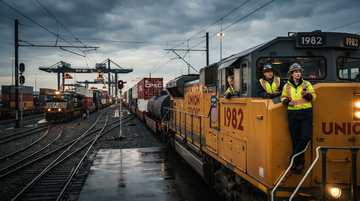
Policy & labor cost mechanics
The rule’s structure removes the “automation-only” escape hatch
FRA’s two-person crew requirement is not simply a headcount mandate—it’s a process constraint on when railroads can legally run certain one-person operations. In the rule, FRA keeps a general minimum of two crewmembers, but allows limited one-person operation categories only through narrow exceptions and a tightly bounded approval/notice framework.
| Rule feature | What FRA requires | Why this matters for cost control |
|---|---|---|
| General baseline | Two crewmembers minimum (§ 218.123) | Prevents broad labor reduction; any one-person path must fit an exception |
| Legacy one-person freight (Class II/III) | May continue only if established at least two years before effective date, and the railroad files required written notice; otherwise barred beyond 90 days (§ 218.129(a)(1)) | Limits how fast operators can “switch modes” based on staffing economics |
| Initiating a new one-person operation (Class II/III) | Only via written notice pathway and limited scope; must comply immediately, and is limited from certain hazardous-material moves (§ 218.129(a)(2)) | Cuts off the fast, universal conversion railroads would want for PSR-style cost flexing |
| Special approval path | For operations not covered by exceptions, FRA requires special approval using a risk assessment standard (“as safe or safer”) (§ 218.131 / § 218.133) | Turns “technology investment” into an approval burden; creates time/cost friction and a hard safety justification requirement |
Verified business impact for major rail operators
Class I economics: a labor-cost floor hits operating leverage when freight volumes recover unevenly
Public railroad investors have been trained to model operating leverage as freight demand and pricing recover. Precision Scheduled Railroading (PSR) also relies on productivity improvements. But with the two-person rule holding, productivity has to come from reliability, network moves, and asset utilization—not from a broad step-down in crew size via one-person operations.
UNP revenue (TTM)
$25.41B
TTM through Jun 30, 2026, reported Jul 23, 2026
CP revenue (TTM)
$15.45B
TTM through Jun 30, 2026, reported Jul 30, 2026
CSX revenue (TTM)
$14.51B
TTM through Jun 30, 2026, reported Jul 22, 2026
NSC revenue (TTM)
$12.54B
TTM through Jun 30, 2026, reported Jul 23, 2026
That matters because the crew-size rule is effectively a structural constraint on a major cost category. In practical investor terms, it can limit how quickly operating margins can expand during cyclical upswings, especially if volume recovery is strong enough to raise utilization but not strong enough to fully absorb higher labor per train.
Short-term vs long-term horizons
Near-term: hiring/retention costs become harder to offset; long-term: automation still helps, but via narrower channels
- In the next quarters, higher crew staffing requirements can delay margin recovery even when revenue improves, because the rule reduces flexibility to run fewer qualified crew members per move.
- In the medium term, railroads can still pursue remote/automation, but the benefits must clear the rule’s exception scope and FRA risk-approval framework, which can slow rollout and increase compliance overhead.
- For freight-cycle recovery models, labor-cost certainty can raise the “floor” on cash costs, making equity multiple support more dependent on demand strength than on staffing optimization.
Supply-chain ripples (truck-to-rail conversion still matters)
Demand backdrop remains supportive, but the margin story changes
Even with a labor-cost floor, rail should still benefit from supply-chain rebalancing when customers actively shift freight modes (especially where service reliability and cost competitiveness improve). The policy change mainly alters how much of that revenue can drop to the bottom line rather than removing the demand tailwind entirely.
| Bull-case pillar | Before: easier PSR margin math | After: what’s different |
|---|---|---|
| Cost reduction channel | More room to cut labor per train via one-person operations | Cost cuts become bounded by FRA exceptions/approvals and notice timelines |
| Operating leverage | Margins could expand faster during freight strength | Margins can still expand, but less of the expansion can come from crew-count reductions |
| Role of automation | Automation expected to replace/justify staffing reductions more directly | Automation must be paired with rule-compliant operation categories and safety/risk frameworks |
Fundamental context for the specific rails
How each Class I railroad is positioned to absorb the floor
To translate this policy into investment implications, investors should watch each carrier’s ability to (1) sustain pricing, (2) protect operating expense efficiency elsewhere, and (3) manage labor transition without service degradation. Financial reporting already provides the baseline scale of revenues and earnings power, which is what ultimately determines how much a crew-cost floor can pressure per-share earnings.
UNP net income (TTM)
$7.33B
TTM through Jun 30, 2026, reported Jul 23, 2026
CP net income (TTM)
$4.20B
TTM through Jun 30, 2026, reported Jul 30, 2026
CSX net income (TTM)
$3.22B
TTM through Jun 30, 2026, reported Jul 22, 2026
NSC net income (TTM)
$2.64B
TTM through Jun 30, 2026, reported Jul 23, 2026
What to watch next
Three catalysts that decide whether the floor becomes “lived-in” or “painful”
- FRA implementation details and any expansion/clarification of exceptions: if approvals tighten further, the cost floor becomes stickier and near-term margins are pressured more.
- Labor agreements and hiring throughput: if carriers have to “catch up” on qualified crew staffing, cash and operating expense discipline faces a harder test during the next volume cycle.
- Service reliability and train plan execution: if railroads maintain quality while absorbing the staffing constraint, pricing power can offset part of the margin hit.
Where the ruling likely transmits into listed equities
- Faces a structural labor constraint that can slow PSR-style margin expansion during upswings, even as freight volumes recover.
- Revenue scale supports absorption, but net income is the buffer that can be pressured if operating expense efficiency elsewhere slips.
- Over 1–3 years, automation still helps, but must fit the FRA exception/risk framework to reduce crew-count risk.
- Higher crew staffing requirements can raise per-train cost, making pricing and mix more important for earnings durability.
- Because CP’s earnings base is smaller than the largest US peers, operating expense slippage can hit margins faster in the near term.
- Over 1–3 years, compliance-safe operational redesign can protect earnings quality even if crew-count reductions remain constrained.
- Labor-cost floor reduces flexibility to optimize crew economics, which can cap margin expansion in the next freight upswing.
- Net income provides a buffer, but expense discipline becomes the swing factor versus demand recovery strength.
- Over 1–3 years, automation gains likely shift toward service and scheduling productivity rather than direct crew-count cuts.
- The ruling can delay operating leverage because crew-count flexibility is constrained by FRA’s exception structure.
- If labor transition costs rise, near-term earnings sensitivity increases relative to peers with stronger expense offsets.
- Over 1–3 years, the outcome depends on whether NSC can hold pricing while improving cost elsewhere under the policy.