Industrials
Order books, backlogs and factory economics
Capex cycles, freight rates, automation and labour, followed through the machinery, transport and construction names that price them first.
2026-07-29
%22%2F%3E%0A%20%20%3Ccircle%20cx%3D%22220%22%20cy%3D%22150%22%20r%3D%22180%22%20fill%3D%22%2322d3ee%22%20fill-opacity%3D%220.12%22%2F%3E%0A%20%20%3Ccircle%20cx%3D%221010%22%20cy%3D%22130%22%20r%3D%22220%22%20fill%3D%22%2338bdf8%22%20fill-opacity%3D%220.08%22%2F%3E%0A%20%20%3Ccircle%20cx%3D%22920%22%20cy%3D%22520%22%20r%3D%22170%22%20fill%3D%22%2322d3ee%22%20fill-opacity%3D%220.06%22%2F%3E%0A%20%20%3Cpath%20d%3D%22M140%20430h920%22%20stroke%3D%22url(%23line)%22%20stroke-width%3D%2212%22%20stroke-linecap%3D%22round%22%2F%3E%0A%20%20%3Cpath%20d%3D%22M220%20360c120-150%20260-220%20380-220s260%2070%20380%20220%22%20fill%3D%22none%22%20stroke%3D%22%2367e8f9%22%20stroke-opacity%3D%220.5%22%20stroke-width%3D%2216%22%20stroke-linecap%3D%22round%22%20stroke-linejoin%3D%22round%22%2F%3E%0A%20%20%3Cpath%20d%3D%22M300%20398h600%22%20stroke%3D%22%2394a3b8%22%20stroke-opacity%3D%220.24%22%20stroke-width%3D%228%22%20stroke-linecap%3D%22round%22%2F%3E%0A%20%20%3Ctext%20x%3D%22220%22%20y%3D%22510%22%20fill%3D%22%23e2e8f0%22%20fill-opacity%3D%220.7%22%20font-family%3D%22Arial%2C%20Helvetica%2C%20sans-serif%22%20font-size%3D%2238%22%20letter-spacing%3D%228%22%3EINSIGHTS%3C%2Ftext%3E%0A%3C%2Fsvg%3E)

Defense backlogs are not “capacity”—fixed-price contract structure and supply-chain + labor execution decide which primes (and suppliers) actually monetize demand
Across Lockheed Martin and Northrop Grumman, the filings show that backlog growth can coexist with contract-level cost and margin pressure under fixed-price development/early-production risk. Investors should treat backlog as a demand signal—but value conversion hinges on labor availability, supply-chain performance, and how much profit/loss risk sits inside the contract terms.
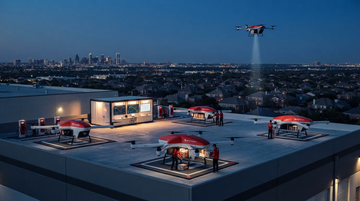
DoorDash's Part 135 move turns drone delivery from a partnership add-on into a regulated, asset-heavy moat
DoorDash says its DoorDash Labs unit earned FAA Part 135 air-carrier certification on Jul 29, 2026, and is launching an in-house “DoorDash Air” vertical stack. That changes the economics of last-mile drone delivery because DoorDash can amortize its own aircraft + hub setup while shifting integration away from Wing/Flytrex/Manna partners—while Part 135 certification acts like a regulatory capacity barrier.

Ford's truck profit engine can’t run forever on “wealthy buyers” alone—its 2026 EBIT lift is also a math problem
Ford raised its 2026 adjusted EBIT outlook to $10–$11B, explicitly citing strong pricing/product mix and truck-led demand even as EV losses continue. The durable question for investors is whether North American truck affordability pressure can stay contained without eroding the very margin bridge that is offsetting Ford’s Model e losses.

General Dynamics' backlog conversion is already showing up in cash—now the question is whether that production curve can keep up
General Dynamics is printing classic backlog-to-execution signals: a 2-to-1 book-to-bill in Q1 2026 and operating cash conversion of 192% of net earnings. The risk for investors isn’t demand—it’s whether delivery pacing (especially in aerospace) can sustain as backlog rises, without margin or cash quality slipping.

Pentair turns a $1.4B Taco deal into a bet on hydronics (not pool pumps)
While Pentair is absorbing pool-equipment destocking headwinds, its $1.4B acquisition of Taco is structured to shift earnings power toward HVAC/hydronics and other commercial/industrial water infrastructure. The economics (about 10.5x 2026E EBITDA, ~$30M run-rate cost synergies, and $0.10–$0.15 accretion in FY2027) matter because they pay you to wait out pool cyclicality while consolidating distribution-ready “water systems” across categories.
2026-07-28

The US is building a “Chinese humanoid” procurement firewall—so the next physical-AI winners are the suppliers of access control, not just robots
A bipartisan proposal in the US Congress would bar federal agencies from procuring and operating unmanned ground vehicles made by foreign adversaries, citing “backdoors” and “remote-hijacking” risks—explicitly covering humanoid robots. Because the rule is procurement- and operation-focused (not a blanket tech ban), it creates a supply-chain “compliance moat” that favors US/system integrators and domestically sourced BOMs more than it favors any single robot startup.

UPS’s Q2 Print Tests Whether E-Commerce Demand Is Holding Up—And Whether Tariff Shocks Are Getting Priced as Freight
UPS’s July 28, 2026 Q2 release is the first big parcel-logistics read-through before the hyperscaler earnings stack, so the market will treat its volume/mix and margin commentary as a macro signal. The key question isn’t “package demand” but whether UPS’s reported performance shows tariff-driven routing and de minimis changes translating into pricing power or cost pressure—with implications for how Amazon’s fulfillment model and B2B freight turn are behaving.
2026-07-27

Baker Hughes's backlog is growing—but it doesn't yet prove LNG is more durable than oilfield services
Baker Hughes ended 1Q26 with $36.1B of remaining performance obligations (RPO), including $33.1B in industrial-and-energy technology (IET)—yet the company does not disclose a backlog “duration” metric in the primary filings we reviewed. That means investors still have to validate how much of the LNG-weighted backlog converts into revenue on a timeline that actually beats oilfield-services cyclicality.
Baker Hughes’ LNG backlog looks like a counter-cyclical shock absorber—Q2 shows $37.1B IET RPO even as oil drilling economics soften
Baker Hughes’ latest filings show IET orders and remaining performance obligations (RPO/backlog) staying elevated through mid-2026, with IET RPO reaching record levels. That matters for the oilfield-service cycle because backlog visibility can mute crude-driven demand swings—but the oil rig count still provides an early warning that oil jobs can fade faster than LNG projects book.
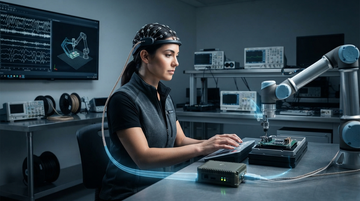
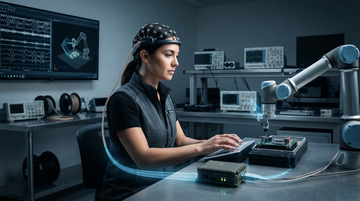
Brain-to-Robot Interfaces Won’t Win on Models—They’ll Win on the Sensor-to-Edge Stack
For physical AI, the key shift from “camera + commands” to “neural intent” creates a new bottleneck: who controls the real-time sensor decoding chain and edge compute that turns EEG/BCI signals into robot-safe actions. The investable winners are likely the listed edge-compute and low-latency interface infrastructure providers, but the exact public financial linkage is not yet fully verifiable from primary sources in this run.

Enigma’s $71M “Robotics Volume Knob” Bet: The UX Control Layer Is Becoming the Real Startup Surface Area
Enigma’s disclosed $70M–$71M seed-scale push frames robot control as a consumer-grade interface problem, not a hardware-only problem. If robotics shifts from “engineering to operate” toward “anyone can command,” the value capture moves to whoever standardizes the control layer—meaning today’s safety/compute and robot makers may be downstream of a new UX wedge.

Pentagon’s “years behind Ukraine” drone admission turns into a stock-picker’s map: who gets the bridge contracts (and who gets stuck with legacy scale)
The Pentagon has publicly acknowledged that U.S. industry is still years away from matching Ukraine’s wartime drone output, reframing the U.S. drone push as an industrial-capacity gap problem—not just software or tactics. For investors, the immediate read-through is a procurement bridge: winners should be the firms that can scale production and backlog conversions fast under DoD funding momentum, while legacy primes face slower ramp and execution risk even if their total defense budgets benefit.
2026-07-26

monday.com's “AI efficiency” cuts reframe SaaS: layoffs are the offset that makes capex narrative cash-neutral
In a July 22, 2026 filing, monday.com disclosed a plan to reduce headcount by ~20% while it restructures around its AI work platform—quantifying the “AI productivity” story as a labor-cost trade. With the company running on ~1.30B of TTM revenue and ~326M of operating cash flow, the key question for the sector becomes whether similar AI-driven restructurings keep compressing labor dollars enough to fund AI investments without breaking growth targets.

FAA’s $2.2B Airline Retrofit Rebate Quietly Turns the Altimeter Upgrade into a 2027 Supply-Chain Price War
The FAA is tying part of the C-band wireless proceeds to a radio-altimeter upgrade schedule by offering up to $2.2B in rebates to eligible airlines that retrofit to withstand 5G interference. That converts what looked like an aviation-safety compliance cost into a structured, time-bounded industrial-policy transfer—creating a near-2027 decision fight between airlines’ fleet replacement plans and avionics upgrade timing, while boosting demand visibility for airframe OEM and avionics suppliers.

Boring Co. didn’t “just raise” — its $20B valuation chatter is a test of who’s subsidizing Musk’s tunnel-to-AI infrastructure
The Boring Company has documented its last priced round (a $675M Series C) and its current tunnel portfolio, but the new “$20B round” appears to be unclosed valuation talk. That gap matters: if the capital stack truly comes from Musk-linked public entities, the implicit subsidy would re-rate how investors underwrite Tesla/AI/SpaceX capex spillovers—especially when the private valuation ceiling accelerates faster than disclosed projects.

A single Northern Virginia line fault made PJM absorb a 3 GW “AI load step” — and it instantly made backup power a grid-reliability business
On July 22, a Northern Virginia transmission line fault triggered hyperscale data centers to automatically transfer load to backup power, while PJM recorded a sudden drop of more than 3 GW (~3% of demand at the time). The event reframes “backup power” from a discretionary reliability feature into an underwriting-grade requirement for AI capacity—turning power-management, switching, and generator/energy systems into the true beneficiaries of AI scaling.

U.S. tariff “emergencies” are becoming a permanent import tax—and the pass-through floor is now an earnings risk
The new tariff layers announced around the July 24 expiry window are built on authorities that cover nearly all U.S. imports and can be extended, turning tariff cost into a recurring P&L input rather than a one-off shock. The sectors most exposed are the ones that (1) rely on contract pricing, (2) face long receivables cycles, and (3) have limited leverage to reprice without demand destruction—so pass-through eventually breaks, not instantly.

The Grid Reliability Cap Starts at 100°F: Why AI’s Power Boom Is Forcing Utilities to Reprice Delivery Risk
A single PJM disturbance that dropped “more than 3 gigawatts” after a transmission-line fault shows how tightly today’s grid margins are being used up by data-center load. Layer that with GE Vernova’s surge in electrification demand and you get a new investment reality: the limiting factor is no longer just generation—it’s transformer/dispatchability delivery under hotter, more volatile peak weather.

When Uber stops distributing Waymo, robotaxi unit economics shift from “demand rental” to “pricing owned”—and that matters more than the driverless tech
The Uber-Waymo Phoenix robotaxi partnership ended on June 29, 2026, with Waymo vehicles re-integrated into its own Phoenix fleet while remaining on Uber’s app in Austin and Atlanta. This split stress-tests robotaxi economics: if margin survives when the platform loses Uber’s demand funnel, the “full-stack” margin path becomes real—otherwise robotaxis become an asset-heavy utility that needs distribution partners to monetize utilization.
2026-07-25

What to expect
Evidence-first notes with a visible point of view.
This section collects sharp takes on earnings, shareholder meetings, and market structure. Each new piece should make the thesis, the facts, and the implications obvious within the first few screens.
Expect direct analysis, not generic commentary.
Expect the data to be explicit and the argument to be easy to follow.
Plutux is not an investment adviser. Market data and AI-generated analysis are for information and education only, not investment advice. Disclaimer