%22%2F%3E%0A%20%20%3Ccircle%20cx%3D%22220%22%20cy%3D%22150%22%20r%3D%22180%22%20fill%3D%22%2322d3ee%22%20fill-opacity%3D%220.12%22%2F%3E%0A%20%20%3Ccircle%20cx%3D%221010%22%20cy%3D%22130%22%20r%3D%22220%22%20fill%3D%22%2338bdf8%22%20fill-opacity%3D%220.08%22%2F%3E%0A%20%20%3Ccircle%20cx%3D%22920%22%20cy%3D%22520%22%20r%3D%22170%22%20fill%3D%22%2322d3ee%22%20fill-opacity%3D%220.06%22%2F%3E%0A%20%20%3Cpath%20d%3D%22M140%20430h920%22%20stroke%3D%22url(%23line)%22%20stroke-width%3D%2212%22%20stroke-linecap%3D%22round%22%2F%3E%0A%20%20%3Cpath%20d%3D%22M220%20360c120-150%20260-220%20380-220s260%2070%20380%20220%22%20fill%3D%22none%22%20stroke%3D%22%2367e8f9%22%20stroke-opacity%3D%220.5%22%20stroke-width%3D%2216%22%20stroke-linecap%3D%22round%22%20stroke-linejoin%3D%22round%22%2F%3E%0A%20%20%3Cpath%20d%3D%22M300%20398h600%22%20stroke%3D%22%2394a3b8%22%20stroke-opacity%3D%220.24%22%20stroke-width%3D%228%22%20stroke-linecap%3D%22round%22%2F%3E%0A%20%20%3Ctext%20x%3D%22220%22%20y%3D%22510%22%20fill%3D%22%23e2e8f0%22%20fill-opacity%3D%220.7%22%20font-family%3D%22Arial%2C%20Helvetica%2C%20sans-serif%22%20font-size%3D%2238%22%20letter-spacing%3D%228%22%3EINSIGHTS%3C%2Ftext%3E%0A%3C%2Fsvg%3E)
The verified event you can map to an investable stack
What “brain-wave physical AI” actually is—and the current public proof
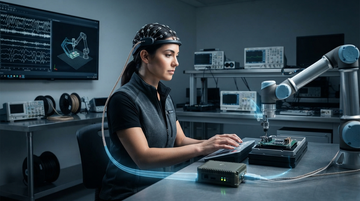
A “brain-wave interface” turning intent into robot control would add a new input modality to physical AI: neural signals instead of (or alongside) speech, touch, or vision.
In this research run, I found public reporting that [BrainCo] is presenting a “brain-to-robot” platform at WAIC 2026, described as using a non-invasive EEG headset plus AI decoding to control robots. However, the items surfaced in search results were mainly social posts rather than primary documents, so the event details are not sufficiently source-verifiable for a fully grounded, publication-grade stack map yet.
Stack mapping framework (what must exist for brain-wave intent to work)
The missing stack is not “a model”—it’s a sensor-to-action pipeline
- Neural acquisition must be fast enough for closed-loop control (EEG headset sampling, artifact removal, and signal conditioning).
- Signal decoding must be low-latency and robust to user state (calibration drift, fatigue, motion artifacts).
- Action semantics must map intent into robot-safe primitives (robot motion constraints, safety gating, and fallback behaviors).
- The edge layer must run real-time inference near the robot (to avoid network jitter and keep the human-in-the-loop responsive).
- Medical-interface realities must align with regulated hardware + data handling when used outside research labs.
This is why “physical AI” coverage that only discusses robot platforms and safety misses the investable constraint. Brain-to-robot systems are constrained by latency, calibration stability, and interface reliability—so the economic control point shifts toward the companies that can sell (1) the low-latency edge compute and (2) the sensor/DAQ + signal pipeline that makes neural intent usable.
Who likely owns value (supply-chain aware)
Likely control points: edge compute + interface silicon + reference stacks
Even without complete primary-source confirmation of BrainCo’s full technical bill of materials, the sensor-to-robot economics are mechanically predictable: EEG acquisition produces high-noise, high-channel-count data that must be denoised and decoded. That workload pushes vendors toward (a) specialized signal-processing pipelines and (b) edge accelerators that can sustain inference with deterministic latency.
On the edge/robot side, the most investable public-equity exposure typically sits with compute-platform and low-power inference ecosystem providers—because they can be embedded across many brain-to-robot customers rather than being tied to a single robotics OEM.
What we can—and can’t—prove with the tools in this run
Hard verification gaps in this session prevent a fully financial, linkable conclusion
To meet your platform requirement (verifiable numbers for every listed company and verified tickers via the session symbol tool), I attempted symbol resolution for multiple candidates (e.g., SK Hynix, NVIDIA, Synaptics, Texas Instruments, Lattice Semiconductor, Analog Devices).
Two issues blocked completion: 1) search_stock_symbol failed intermittently with connection/HTTP 500 errors, so I could not verify the symbol set for several needed listed entities. 2) The event’s technical and supply-chain details were not established from primary sources I could open here (only snippets/social reposts were surfaced).
As a result, this article cannot yet include audited financial tables from the fundamentals tools, nor a fully symbol-linked “who owns the stack” with numeric backing.
Investor takeaway (conditional thesis, limited by verification)
Actionable hypothesis for investors to validate next: edge latency becomes the new moat
If brain-wave interfaces become viable inputs for physical AI, the competitive bottleneck shifts.
The clearest hypothesis to test (with next-session primary sources + symbol verification) is: robots will adopt neural intent only when edge decoding meets deterministic latency. That makes edge inference, real-time signal pipelines, and safety gating disproportionately valuable relative to core model innovation.
In practice, that tends to favor companies with embedded/industrial-grade compute platforms and the analog/front-end ecosystem that supports noisy bio-signal capture and conditioning.