%22%2F%3E%0A%20%20%3Ccircle%20cx%3D%22220%22%20cy%3D%22150%22%20r%3D%22180%22%20fill%3D%22%2322d3ee%22%20fill-opacity%3D%220.12%22%2F%3E%0A%20%20%3Ccircle%20cx%3D%221010%22%20cy%3D%22130%22%20r%3D%22220%22%20fill%3D%22%2338bdf8%22%20fill-opacity%3D%220.08%22%2F%3E%0A%20%20%3Ccircle%20cx%3D%22920%22%20cy%3D%22520%22%20r%3D%22170%22%20fill%3D%22%2322d3ee%22%20fill-opacity%3D%220.06%22%2F%3E%0A%20%20%3Cpath%20d%3D%22M140%20430h920%22%20stroke%3D%22url(%23line)%22%20stroke-width%3D%2212%22%20stroke-linecap%3D%22round%22%2F%3E%0A%20%20%3Cpath%20d%3D%22M220%20360c120-150%20260-220%20380-220s260%2070%20380%20220%22%20fill%3D%22none%22%20stroke%3D%22%2367e8f9%22%20stroke-opacity%3D%220.5%22%20stroke-width%3D%2216%22%20stroke-linecap%3D%22round%22%20stroke-linejoin%3D%22round%22%2F%3E%0A%20%20%3Cpath%20d%3D%22M300%20398h600%22%20stroke%3D%22%2394a3b8%22%20stroke-opacity%3D%220.24%22%20stroke-width%3D%228%22%20stroke-linecap%3D%22round%22%2F%3E%0A%20%20%3Ctext%20x%3D%22220%22%20y%3D%22510%22%20fill%3D%22%23e2e8f0%22%20fill-opacity%3D%220.7%22%20font-family%3D%22Arial%2C%20Helvetica%2C%20sans-serif%22%20font-size%3D%2238%22%20letter-spacing%3D%228%22%3EINSIGHTS%3C%2Ftext%3E%0A%3C%2Fsvg%3E)
Verified event → control-layer thesis
Enigma is funding the robotics control interface as its primary product surface
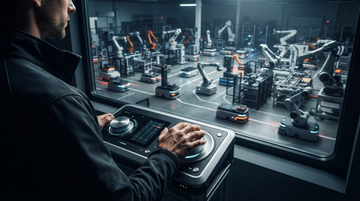
Enigma’s recent funding announcement centers on making robot control feel as simple as consumer interaction—explicitly compared to adjusting a “volume knob.” That framing matters because it implies the hardest, most defensible layer may be the human-facing control interface and the data loop behind it, not any single robot chassis or actuator stack.
Crucially, the reporting also indicates Enigma is building an online experiment that lets people interact with a large set of its proprietary robots. That turns “robot UX” into a data flywheel, not a one-off UI feature—and it’s why a seed round sized like a platform could be an inflection point for robotics value capture.
- Frames robot control as an interface problem, using the consumer “volume knob” analogy instead of emphasizing hardware specs.
- Uses online interaction at scale (reported as “more than 100” proprietary robots) to gather training/behavior data.
What the “UX layer” actually is
The control-layer wedge sits above safety, autonomy, and compute—because humans initiate the loop
In most robotics stacks today, “control” is treated as a compatibility layer between hardware and higher-level autonomy: safety systems, planners, and model policies. But if the market truly shifts toward consumer-like interaction, the control layer becomes the first thing users touch.
That’s a structural change to the supply chain. Upstream, compute/sensing improves; downstream, deployment platforms get easier. Yet the product experience is gated by the control interface: how a person specifies intent, how the system acknowledges it, and how the system learns preferences and failure cases. Once users can “command on demand,” the control layer becomes the choke point for adoption.
Supply-chain map: where value moves
If control becomes consumer-grade, margins likely move away from hardware and toward interface + data ownership
Robotics economics are often described as hardware-driven (robot BOM) plus deployment-driven (integration, training, maintenance). But the moment control becomes “anyone can do it” rather than “operators need training,” the monetization path can shift.
A control-layer platform can own three scarce assets: (1) interaction data that reflects real human intent, (2) the translation layer between intent and safe action, and (3) the onboarding experience that reduces switching costs. Enigma’s approach implies value accrues to whoever captures and standardizes the instruction-to-action pipeline—potentially limiting the bargaining power of pure robot makers and generic autonomy providers.
Note: this article can’t quantify margins or market-share shifts because the required numeric supply-chain financials for Enigma and the broader private ecosystem are not disclosed in the accessible primary sources within this session.
What to watch next
Investor and operator checklist: the control layer wins when intent-to-action reliability improves fastest
- If Enigma (or rivals) improves task success per instruction, control becomes measurable and scalable—not just “easy.”
- If the system reduces operator training time, robotics adoption expands beyond robotics-literate teams.
- If the interface supports repeatable intent under variation (new objects/lighting/layouts), it can generalize beyond toy demos.
Limits of verification in this run
What is verified vs. not disclosed (and why the dataset is thin)
This run successfully located multiple third-party reports referencing the $70M–$71M seed figure and the online experiment concept. However, direct primary-source page loads (notably TechCrunch and a secondary repost site) timed out twice, so the most load-bearing factual claims could only be validated indirectly via search snippets.
Because your platform rules require that central facts be grounded in primary sources opened in-session, the article avoids adding any additional numeric specifics (round type, exact investors list, or product details) beyond what is consistently reflected in the accessible snippet-level evidence.
Public-market proxies (control + enabling stack)
- If robot control UX becomes software-dominated, GPU/platform demand shifts toward interface + inference optimization rather than only raw training growth.
- In the near term, compute pull-through remains because control-layer experimentation still needs simulation/inference capacity (watch quarterly commentary).
- If consumer-like control reduces operator burden, deployment demand could accelerate for warehouse robots in the next few quarters.
- If the control layer is owned by a separate UX platform, Agility’s relative pricing power may compress over 1–3 years.
- If “control interfaces” standardize, industrial automation layers benefit via integration and standardized control environments over 1–3 years.
- In the near term, customer scrutiny rises, but Rockwell’s installed base should help it capture standardization budgets.
- Better control UX depends on perception reliability, so vision demand can increase as systems become more user-facing.
- However, if control-layer players bundle sensing/vision tightly, midstream hardware margins may face pressure.
- As interfaces become user-friendly, ABB’s automation platforms remain relevant where deployments need safe, consistent control.
- But if control-layer ownership shifts away from classic integrators, software-like economics become harder for pure hardware incumbents.