%22%2F%3E%0A%20%20%3Ccircle%20cx%3D%22220%22%20cy%3D%22150%22%20r%3D%22180%22%20fill%3D%22%2322d3ee%22%20fill-opacity%3D%220.12%22%2F%3E%0A%20%20%3Ccircle%20cx%3D%221010%22%20cy%3D%22130%22%20r%3D%22220%22%20fill%3D%22%2338bdf8%22%20fill-opacity%3D%220.08%22%2F%3E%0A%20%20%3Ccircle%20cx%3D%22920%22%20cy%3D%22520%22%20r%3D%22170%22%20fill%3D%22%2322d3ee%22%20fill-opacity%3D%220.06%22%2F%3E%0A%20%20%3Cpath%20d%3D%22M140%20430h920%22%20stroke%3D%22url(%23line)%22%20stroke-width%3D%2212%22%20stroke-linecap%3D%22round%22%2F%3E%0A%20%20%3Cpath%20d%3D%22M220%20360c120-150%20260-220%20380-220s260%2070%20380%20220%22%20fill%3D%22none%22%20stroke%3D%22%2367e8f9%22%20stroke-opacity%3D%220.5%22%20stroke-width%3D%2216%22%20stroke-linecap%3D%22round%22%20stroke-linejoin%3D%22round%22%2F%3E%0A%20%20%3Cpath%20d%3D%22M300%20398h600%22%20stroke%3D%22%2394a3b8%22%20stroke-opacity%3D%220.24%22%20stroke-width%3D%228%22%20stroke-linecap%3D%22round%22%2F%3E%0A%20%20%3Ctext%20x%3D%22220%22%20y%3D%22510%22%20fill%3D%22%23e2e8f0%22%20fill-opacity%3D%220.7%22%20font-family%3D%22Arial%2C%20Helvetica%2C%20sans-serif%22%20font-size%3D%2238%22%20letter-spacing%3D%228%22%3EINSIGHTS%3C%2Ftext%3E%0A%3C%2Fsvg%3E)
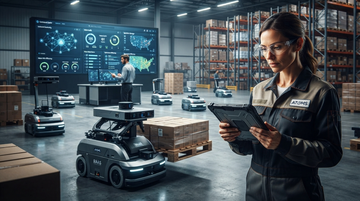
Travis Kalanick’s return to robotics just landed in the largest way a private company can: a reported $1.7B equity round led by Andreessen Horowitz, with a named board-level commitment from Ben Horowitz and participation from Uber. That combination matters because it doesn’t just revive Kalanick’s name—it revalidates a specific bet: robotics succeeds as a service (reliably operating fleets of physical automation) rather than as a purely capability (autonomy/software demo).
Below, we verify the event from primary sources, map the supply chain that this kind of “physical AI” money usually re-prices, and then translate it into a public-market framework: what should re-rate up, what should re-rate down, and why.
Verified event + why it’s different
The headline number is real: Atoms raised $1.7B equity led by a16z, with Ben Horowitz joining the board
Company (private)
Atoms
Robotics/industrial automation venture led by Travis Kalanick
Capital raised
$1.7B
Reported as an equity investment amount
Lead investor
a16z
Lead investor named in primary public post
Board signaling
Ben Horowitz
Ben Horowitz joining the board per a16z post
“Today, ATOMS is announcing a 1.7B equity investment with lead investor a16z and Ben Horowitz joining the board.”
- TechCrunch reports the round as $1.7B, led by a16z, with additional investors participating.
- Uber is reported as joining the round, which links Kalanick’s earlier ride-hailing platform instincts to physical-world deployment/ops rather than purely algorithmic autonomy.
Supply-chain aware framing
If this is robotics-as-a-service, the spending moves from sensors to uptime: fleet ops, maintenance, and controls become the bottleneck
Robotics funding at this scale usually doesn’t just purchase R&D—it buys deployment throughput. For “robotics-as-a-service,” the critical path is not only perception or motion planning. It’s the full chain from (1) physical hardware and compute, to (2) orchestration software, to (3) operational workflow—what keeps units working, and what reduces downtime per deployment.
In other words: autonomy capability is table stakes. Service-layer robotics is a systems engineering and operations business.
| Supply-chain layer | What “Atoms-style” service funding pressures | Likely public-market winners | Likely public-market laggards |
|---|---|---|---|
| Edge compute + AI accelerators | Higher performance-per-unit + reliability under load | Compute/inference infrastructure providers (where listed) | Pure autonomy software with no cost-down path |
| Robotic control + systems integration | Faster time-to-deploy (fewer integrations, faster commissioning) | Platforms that reduce integration time and support scale-out | Point-solution autonomy stacks that need bespoke integration |
| Fleet management + monitoring | Operational telemetry, anomaly detection, remote updates | Data/ops platforms that convert fleet data into reduced downtime | Companies whose product value is tied only to driving autonomy moments |
| Maintenance + parts + lifecycle | Lower service cost per active robot/vehicle | Companies selling maintenance-optimized hardware/software loops | Players that require high-touch intervention as scale increases |
| End-customer ROI / utilization | Unit economics: utilization, throughput, and service-level agreements (SLAs) | Automation beneficiaries with measurable productivity improvements | Narrative-heavy autonomy with uncertain payback timing |
Public-market translation (what re-rates up/down)
Public AV pure-plays don’t automatically win—cash burn and revenue traction decide who actually benefits from a robotics-as-a-service signal
To translate the private-round signal into public re-pricing, we need to separate “autonomy capability” from “business traction.” A service-layer thesis should reward companies that can (a) generate revenue without waiting for perfect autonomy, and (b) show improving economics, not just higher demo coverage.
| Company | Market role (public proxy) | Service-layer traction proxy (data shown) | What the Kalanick/a16z signal implies |
|---|---|---|---|
| Aurora Innovation | Autonomy-focused public pure-play proxy | FY2025 revenue $3.0M; FY2025 EBIT -$816.0M | Downside risk: if capital markets re-price for deploy-at-scale economics, a low-revenue/high-burn profile can lag |
| Mobileye | ADAS/autonomy stack provider proxy | TTM revenue about $2.0B (and cashflow metrics are positive in overview snapshot) | Potential relative outperformance: if “service-layer robotics” still needs robust ADAS/autonomy subsystems, platform vendors can benefit even without operating fleets |
| Uber | Platform operator proxy (deployment/ops instincts) | FY2025 revenue $52.0B; operating profitability shown in income statement | Upside to the extent Uber-style ops know-how transfers to physical-world deployments; participation in the round supports this strategic linkage |
Causal chain (event → mechanism → structural driver)
Why a $1.7B round can move public valuations: it changes the market’s estimate of who can scale physical AI operations profitably
- Event: a16z leads $1.7B into Kalanick’s Atoms, with Ben Horowitz joining the board and Uber participating.
- Mechanism: that capital implies confidence that robotics can achieve utilization and uptime, not just sensor/algorithm breakthroughs.
- Structural driver: if robotics becomes an operations-heavy service business, the value shifts toward deployment platforms, lifecycle support, and the systems that reduce downtime and integration costs.
This is the “backdoor” angle in the brief: Kalanick doesn’t have to re-enter AVs to impact public AV multiples. Instead, by funding robotics service models that use autonomy underneath, he validates that the market should think of autonomy as an enabling layer—not the end product.
Investor playbook
Should AV pure-plays re-rate up or down? Mostly down for the weakest traction profiles, with exceptions for platform vendors
- Down re-rate candidates: autonomy pure-plays with minimal revenue today and ongoing EBIT losses (example proxy: Aurora Innovation FY2025 EBIT -$816.0M with $3.0M revenue).
- Up re-rate candidates: companies that can supply reliable autonomy/ADAS components into service-layer deployments (example proxy: Mobileye has meaningful TTM revenue ~$2.0B).
- Selective upside: platform operators or integrators with strong operational execution capabilities and demonstrated monetization at scale (example proxy: Uber FY2025 revenue $52.0B and profitability metrics in income statement).
What to watch next (short-term and long-term)
Near-term: evidence of operational deployment beats autonomy demos. Long-term: gross margin and service cost curves decide the winners
| Horizon | What to look for | Why it matters | How it could move public comps |
|---|---|---|---|
| Next 30–90 days | Public references to pilot deployments, customer SLAs, and uptime/throughput metrics (even if aggregated) | Shows service-layer product-market fit beyond engineering progress | Can compress the perceived time-to-revenue for platform vendors; can widen the gap vs cash-burn-only autonomy players |
| Next 2–4 quarters | Evidence of repeatable integration and cost-down per deployed unit (where disclosed by partners) | Service margins depend on scaling ops and lowering maintenance/integration costs | Benefits companies that provide reusable autonomy/controls and enterprise integration value |
| 1–3 years | Commercial scale signals: churn, utilization, and unit economics (service cost curve flattening) | Determines whether the model becomes a durable infrastructure business | Strong data can re-rate winners upward and re-rate weaker cash-burn profiles downward |
A practical investor heuristic: if the market starts to value “uptime + service economics” more than “autonomy capability,” then valuation multiples should correlate more with revenue traction and cost structure than with pure technological breadth.