Policy & Trade
Tariffs, export controls, and who absorbs them
Rulings, sanctions and trade negotiations traced to the companies that pay for them — margin by margin, route by route.
2026-08-10
%22%2F%3E%0A%20%20%3Ccircle%20cx%3D%22220%22%20cy%3D%22150%22%20r%3D%22180%22%20fill%3D%22%2322d3ee%22%20fill-opacity%3D%220.12%22%2F%3E%0A%20%20%3Ccircle%20cx%3D%221010%22%20cy%3D%22130%22%20r%3D%22220%22%20fill%3D%22%2338bdf8%22%20fill-opacity%3D%220.08%22%2F%3E%0A%20%20%3Ccircle%20cx%3D%22920%22%20cy%3D%22520%22%20r%3D%22170%22%20fill%3D%22%2322d3ee%22%20fill-opacity%3D%220.06%22%2F%3E%0A%20%20%3Cpath%20d%3D%22M140%20430h920%22%20stroke%3D%22url(%23line)%22%20stroke-width%3D%2212%22%20stroke-linecap%3D%22round%22%2F%3E%0A%20%20%3Cpath%20d%3D%22M220%20360c120-150%20260-220%20380-220s260%2070%20380%20220%22%20fill%3D%22none%22%20stroke%3D%22%2367e8f9%22%20stroke-opacity%3D%220.5%22%20stroke-width%3D%2216%22%20stroke-linecap%3D%22round%22%20stroke-linejoin%3D%22round%22%2F%3E%0A%20%20%3Cpath%20d%3D%22M300%20398h600%22%20stroke%3D%22%2394a3b8%22%20stroke-opacity%3D%220.24%22%20stroke-width%3D%228%22%20stroke-linecap%3D%22round%22%2F%3E%0A%20%20%3Ctext%20x%3D%22220%22%20y%3D%22510%22%20fill%3D%22%23e2e8f0%22%20fill-opacity%3D%220.7%22%20font-family%3D%22Arial%2C%20Helvetica%2C%20sans-serif%22%20font-size%3D%2238%22%20letter-spacing%3D%228%22%3EINSIGHTS%3C%2Ftext%3E%0A%3C%2Fsvg%3E)

Fisher’s AI-Infrastructure Crowding Trade Is Real—But It’s the “Grid-to-Aircraft-to-Network” Link That Should Matter for Investors
Fisher Asset Management’s latest 13F (quarter ended June 30, 2026) shows aggressive positioning across AI’s “real economy” buildout—power and electrification via GE Vernova, aerospace platforms via GE Aerospace, and enterprise/data-center connectivity via Cisco Systems, alongside the usual AI compute core. The investable takeaway is not that AI exists—it’s that Fisher is paying up for the bottlenecks and replacement cycles that sit between AI demand and the supply chain that fulfills it.

The Trade Desk's real Q2 2026 ad-tech stress test wasn’t the 3% growth—it was executing a C-suite reset while guiding lower
In Q2 2026, The Trade Desk reported $715M revenue and non-GAAP EPS of $0.34—both short of what markets were looking for—and simultaneously disclosed an executive-leadership rebuild across CFO, CMO, and Chief Commercial roles. The key investor question isn’t whether growth missed; it’s whether the company can re-stabilize go-to-market and measurement execution as CTV/programmatic competition tightens.
2026-08-09
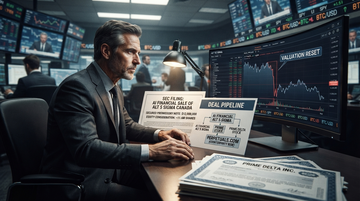
AI Financial's $12M exit implies “meme-to-impairment” contagion for crypto-linked payments and Perpetuals.com’s deal pipeline
When AI Financial sold its payments unit (ALT 5 Sigma Canada) for a $12M secured promissory note plus Prime Delta stock, the structure looked less like “growth strategy” and more like a liquidity/valuation reset. For investors watching Trump-linked fintech/crypto narratives, this matters because it converts prior upside hype into a concrete impairment-style event and turns counterparties like Perpetuals.com into the next holder of that risk.
The “AI Safety Test” Is Turning into a Security & Disclosure Liability
When governments and frontier labs rely on opaque evaluation/test pathways, the act of testing can create new cyber and reporting attack surfaces. The compliance stack is being forced to move from “did we test?” to “how do we safely disclose, coordinate, and audit the tests themselves?”
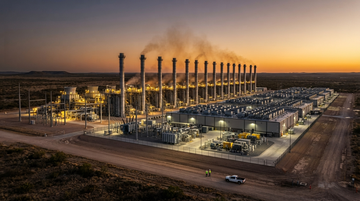
Amazon's Pecos County gas plant permit implies ~33M tons CO2/year—so AI data-center siting is starting to behave like a carbon-forward power project
A planned Amazon-powered AI data-center campus in Pecos County, Texas is tied to an on-site natural-gas power plant permitted to emit up to 33 million tons of CO2 per year. That shifts the hyperscaler AI-capex trade from “compute demand vs. electricity availability” toward a carbon-cost and regulatory-liability problem that can change project economics well before the campus starts full operations.

Anthropic’s “global affairs” hire is the clearest proof frontier AI is being regulated like a geopolitical asset
Anthropic’s first Chief Global Affairs Officer, former California Supreme Court justice Mariano-Florentino “Tino” Cuéllar, formalizes something markets usually underwrite implicitly: government access and compliance bargaining. The appointment matters because it reframes frontier AI risk as a relationship-and-contract problem—after Anthropic has already faced export-control actions and helped shape California’s frontier-AI rules like SB 53.

Apple's CXMT test isn’t a price story—it’s a sanctions-and-qualification story that can *stabilize Apple’s bill or strengthen SK hynix and Samsung’s pricing power
Apple is reported to have progressed to qualification testing of [CXMT] PRC DRAM for iPhone/Mac devices sold in China, while also engaging US policy for clearance. The first-order market implication is that CXMT can’t credibly undercut pricing yet, so the substitution “math” likely sharpens near-term leverage for SK Hynix and Samsung Electronics while raising a binary compliance risk for Apple’s sourcing pipeline.

China’s inflation cooled just as the Iran oil shock faded—creating the cleanest disinflation cross-current the market is still mispricing
China’s inflation slowdown is showing up right when the Iran-related energy impulse is unwinding, pulling commodity and energy-cost pressure off the table. For global markets, that matters because it weakens the “energy keeps inflation sticky” leg of the hawkish Fed narrative—especially when US goods deflation and energy-import-cost relief are moving in the same direction.
CLARITY Act’s 12-month slip pushes crypto regulation into a “fee-and-rail” trade: Coinbase waits on revenue, Circle waits on redemption rules, and Solana ETF math rolls to 2027
When the U.S. Senate effectively defers the CLARITY Act into 2027, the market doesn’t just delay “clarity”—it delays the stablecoin redemption/market-structure plumbing that determines who earns fees and who must re-architect rails. The result is a near-term Coinbase/Circle split (timing of exchange revenue vs. stablecoin reserve/redemption economics), while Solana ETF approval expectations migrate into a later regulatory window.

KOSPI volatility ebbed—but the AI-memory trade is now a different risk asset after leveraged flush
South Korea’s volatility gauge has fallen to a two-month low after forced liquidations and regulatory tightening on single-stock leveraged ETFs. The key implication for investors isn’t “risk-on returns”—it’s that the AI-memory complex’s tape is now shaped more by de-leveraging mechanics than by momentum alone.

Public support for age checks turns social-media compliance into a likely recurring Meta/Snap/Alphabet cost—58% just moved it closer to law
A Reuters/Ipsos poll found 66% backing laws that require age-verification tools, with 74% of Republicans supporting that specific mechanism. That demand-side political cover shifts age assurance from “mostly litigation risk” toward a more predictable balance-sheet line item for major platforms—especially where youth access is structurally large.

Sila’s $1.4B OSC conditional loan turns silicon-anode industrial policy into a direct, materials-led Pentagon procurement lever
On Aug 7, 2026 the U.S. Office of Strategic Capital (OSC) announced a $1.4B conditional loan commitment to Sila Nanotechnologies tied to expanding silicon‑carbon (Si/C) anode production and building lithium‑ion cell capacity. The strategic signal is that DoD/OSC is funding the next energy-storage stack at the materials bottleneck—before cells and primes—so investors should map winners to silicon-anode scaling, electrolyte/lithium refining, and US cell manufacturing.

SK hynix’s 18-Month Insider Sentence Doesn’t Target HBM—It Forces a New Audit Standard Across the Entire Memory Toolchain
An Aug 9, 2026 appeals-court ruling upheld an 18-month jail sentence for a former SK hynix engineer who leaked classified semiconductor manufacturing information to a Chinese firm. Even though the leaked technology described in the primary report concerns CMOS image-sensor manufacturing (not HBM specifically), the verdict functionally raises the compliance-and-audit bar for any memory supplier whose customer share depends on “trust.”
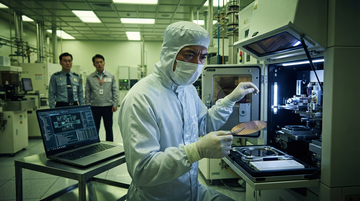
SK Hynix's 18-month jail ruling signals a new personnel-sensitive trade-secret standard for Samsung, Micron—and the AMAT/KLA/LRCX field-toolchain
A Seoul court sentenced an ex-SK Hynix employee to 18 months in jail for leaking semiconductor trade secrets to a Chinese firm, and the decision (as reported) explicitly rejects “light treatment” of leak crimes. The bigger investor takeaway is indirect: this case hardens how South Korea treats dual-use engineering knowledge—including off-site resumes/prints/photos—so tool vendors that embed with fabs must expect tougher export-control-by-personnel friction around memory/AI process data.

S&P 500’s Record +29% EPS Surprise Was Cyclicals-Driven—So the “AI Capex = Future Earnings” Trade No Longer Works the Same
The S&P 500’s biggest earnings beat on record (+29.2% vs estimates) can’t be explained by just the AI hyperscalers—removing Alphabet and Amazon cuts the surprise to 10.9%. That shift means the market’s next re-rating question is whether cyclicals can sustain earnings and cash flow without AI acting as the dominant growth narrative.

The DFC’s $3B minerals push is less about “materials” and more about buying 2027–2028 capacity blocks—MP Materials, USA Rare Earth, Energy Fuels, and Lithium Americas are the clearest US order-book fits
A verified Aug 7, 2026 package around critical minerals financing links to defense supply-chain bottlenecks, but the publicly accessible primary materials we can confirm name only a partial set of project participants. Using that confirmed deal/map plus listed-company capacity economics, the clearest “funding-to-offtake” winners are the US incumbents that can plausibly monetize demand under a 2027–2028 commissioning window—MP Materials, USA Rare Earth, Energy Fuels, and Lithium Americas—while the defense OEM names (e.g., Lockheed Martin and RTX) mainly matter as anchor buyers of qualifying downstream output.
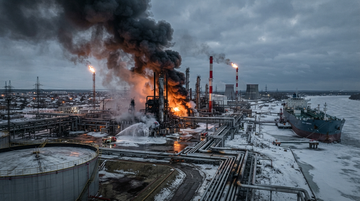
Ukraine’s drone strike on Russian refineries shifts the diesel story from “Iran/Hormuz risk” to hard supply destruction
By hitting two Russian refineries in a coordinated drone attack, Ukraine has targeted the part of the system that converts crude into diesel—tightening product availability and strengthening diesel crack spreads through lost runs. For refiners with product-heavy exposure, the investment implication is not just “war risk premium,” but whether incremental outages persist long enough to translate into sustained margins.

OFAC’s Aug 7 Shelbit Sanction Turns “UAE Iran-Crypto Compliance” Into a Bankable Risk Premium for Exchanges
Treasury’s Aug 7 OFAC action against Dubai’s SHELBIT GENERAL TRADING LLC frames a new enforcement surface: crypto “rails” used to support the IRGC and Nobitex. The second-order read-through is that any U.S.-facing exchange, wallet, or stablecoin on/off-ramp touching UAE OTC liquidity chains must treat “Iran-linked geo-compliance” as a material, tradable risk—not a reputational afterthought.
2026-08-08

Apple turns Alibaba Qwen into a China Mac distribution channel—iPhone was the pilot
Reuters says Apple’s China rollout lets eligible Mac users connect to Alibaba’s Qwen service via a macOS extension (macOS 26.6+), routing Qwen through Siri and Writing Tools for more detailed responses. That shifts the “Qwen for Apple Intelligence in China” story from a mobile-only monetization channel to desktop/enterprise workflows—raising the odds that Alibaba captures more downstream AI usage time (and thus higher Cloud/enterprise pull) alongside Apple’s China Services stickiness.

Treasury’s bond-auction mechanics don’t care about talking points—but they do re-route the 30Y buyer base
The clearest “backfire” signal in the next-30Y auction isn’t a headline yield; it’s the auction’s demand split. In the latest 30Y sale around the Aug 2026 window, non-dealers took 85% of accepted competitive bids, implying the marginal buyer is shifting away from traditional dealer behavior even when the accepted yield clears in a narrow band.
What to expect
Evidence-first notes with a visible point of view.
This section collects sharp takes on earnings, shareholder meetings, and market structure. Each new piece should make the thesis, the facts, and the implications obvious within the first few screens.
Expect direct analysis, not generic commentary.
Expect the data to be explicit and the argument to be easy to follow.
Plutux is not an investment adviser. Market data and AI-generated analysis are for information and education only, not investment advice. Disclaimer