%22%2F%3E%0A%20%20%3Ccircle%20cx%3D%22220%22%20cy%3D%22150%22%20r%3D%22180%22%20fill%3D%22%2322d3ee%22%20fill-opacity%3D%220.12%22%2F%3E%0A%20%20%3Ccircle%20cx%3D%221010%22%20cy%3D%22130%22%20r%3D%22220%22%20fill%3D%22%2338bdf8%22%20fill-opacity%3D%220.08%22%2F%3E%0A%20%20%3Ccircle%20cx%3D%22920%22%20cy%3D%22520%22%20r%3D%22170%22%20fill%3D%22%2322d3ee%22%20fill-opacity%3D%220.06%22%2F%3E%0A%20%20%3Cpath%20d%3D%22M140%20430h920%22%20stroke%3D%22url(%23line)%22%20stroke-width%3D%2212%22%20stroke-linecap%3D%22round%22%2F%3E%0A%20%20%3Cpath%20d%3D%22M220%20360c120-150%20260-220%20380-220s260%2070%20380%20220%22%20fill%3D%22none%22%20stroke%3D%22%2367e8f9%22%20stroke-opacity%3D%220.5%22%20stroke-width%3D%2216%22%20stroke-linecap%3D%22round%22%20stroke-linejoin%3D%22round%22%2F%3E%0A%20%20%3Cpath%20d%3D%22M300%20398h600%22%20stroke%3D%22%2394a3b8%22%20stroke-opacity%3D%220.24%22%20stroke-width%3D%228%22%20stroke-linecap%3D%22round%22%2F%3E%0A%20%20%3Ctext%20x%3D%22220%22%20y%3D%22510%22%20fill%3D%22%23e2e8f0%22%20fill-opacity%3D%220.7%22%20font-family%3D%22Arial%2C%20Helvetica%2C%20sans-serif%22%20font-size%3D%2238%22%20letter-spacing%3D%228%22%3EINSIGHTS%3C%2Ftext%3E%0A%3C%2Fsvg%3E)
Verified event → quantified regulatory liability → why it changes the AI-capex math
The load-bearing fact isn’t the data center—it’s the permitted emissions of its on-site power
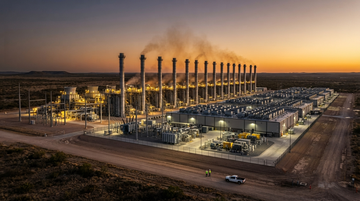
The most decision-relevant detail in the recent reporting is that Amazon’s planned West Texas AI data-center campus is backed by an on-site natural-gas power plant with a Texas air permit that can allow emissions of up to 33 million tons of CO2 per year.
This is why the story matters to investors: it’s not just an “indirect” footprint from electricity generation. It is a single-site, permit-bounded emissions event that can translate into compliance costs, reputational risk, and—if policy tightens—hard carbon price exposure for the specific campus power architecture.
Permitted emissions rate (on-site plant)
33M
Texas permit described as up to 33 million tons of CO2 per year (Pecos County / GW Ranch).
Plant configuration (reported in follow-on coverage)
35
Coverage describes 35 natural-gas turbines delivering ~7.65 GW to power the campus.
Supply chain mapping
Full transmission chain: AI campus demand → on-site gas → permit envelope → carbon price sensitivity
- AI compute capacity increases electricity demand at the site, so the sponsor (hyperscaler) often locks in power via contracts or on-site generation to manage delivery risk.
- In this case, Amazon’s campus is paired with an on-site natural-gas power plant whose permit envelope sets an upper bound for annual CO2 emissions at that project location.
- That permit envelope makes the campus behave like a power-asset investment: it is subject to air-permitting scrutiny and, as climate policy evolves, it becomes more exposed to carbon-cost assumptions embedded in lenders, insurers, and counterparties.
- Once carbon costs are “pricing-relevant,” they can propagate into the hyperscaler’s project hurdle rate, capex phasing, and ultimately the timing of earnings contributions (and write-down risk if policy or permitting tightens).
Mechanism with numbers
Why this can change the hyperscaler capex/earnings trade: carbon cost becomes a project-level cash-flow line
A permit-bounded emissions rate doesn’t automatically mean cash costs will equal 33M tons. But it does change what’s modelable.
Once a project has an emissions cap set by permitting and a known combustion source (on-site gas), lenders and counterparties can attach carbon-price scenarios or compliance-cost ranges to the project cash flows—before the rest of the corporate footprint does. That matters for earnings timing because AI campuses are multi-year build/qualification programs: the earlier you price carbon, the more likely you are to alter capex phasing, contractual terms, or the mix of generation technologies you pursue (e.g., gas-first with later transition vs. immediate carbon-free sourcing).
Below, I anchor the “ability to absorb” using verified income-statement data: Amazon reported FY2025 operating income of about $79.98B and FY2025 net income of about $77.67B, which frames how much margin absorption it could theoretically tolerate versus its cash flow investment needs.
| Company | FY2025 Revenue | FY2025 Operating Income | FY2025 Net Income | Source |
|---|---|---|---|---|
| Amazon | $716.9B | $79.98B | $77.67B | Income statement (annual FY) |
| Microsoft | $245.1B | $110.7B | $88.14B | Income statement (annual FY) |
| Alphabet | $402.96B | $158.83B | $132.17B | Income statement (annual FY) |
| Meta Platforms | $200.97B | $85.93B | $60.46B | Income statement (annual FY) |
Data-center economics + policy trade
What the permit-driven liability changes in practice (short-term vs. long-term)
Short term (days–quarters): the first price reaction is usually risk premia—i.e., investors start to assign a wider range of outcomes to new campus announcements tied to high-emissions combustion assets. Even before carbon taxes or caps arrive, permitting volatility and compliance expectations can move discount rates.
Long term (1–3 years): project selection can shift. If carbon policy tightens (or even just carbon disclosure and permitting enforcement tightens), sponsors will have stronger incentives to move from “gas-as-backbone” toward architectures that reduce emissions exposure during the permit life (more carbon-free generation, more grid-connected service, or earlier retirement/offset structures). The key is that carbon sensitivity becomes site-specific rather than averaged across global corporate operations.
Supply-chain beneficiaries & losers
Who benefits (and who gets squeezed) when carbon becomes part of the siting spreadsheet
- Positive case: sponsors that can credibly supply or integrate low-carbon power (or make high-emissions generation financeable under tighter rules) can win contracts or project roles as peers face higher underwriting hurdles.
- Squeeze case: turbine-equipment and gas-generation ecosystems face a bifurcation—near-term demand for build-outs may remain, but long-term risk rises if new campuses increasingly require carbon-reducing pathways to clear permitting and financing thresholds.
- Contracting impact: as carbon becomes a priced input, power purchase agreements and interconnection arrangements can gain carbon clauses (e.g., lifecycle emissions accounting, transition milestones).
Investor translation
Synthesis: treat large AI campuses like carbon-exposed power projects, not just data-asset builds
The verified “reset” here is simple: the Amazon Pecos County plan is tied to an on-site gas power plant permitted to emit up to 33 million tons of CO2 per year. This makes carbon-cost and permitting risk closer to the front of the deal than many investors have been modeling for AI infrastructure.
For the AI-capex cycle, the implication is not that demand stops. It’s that the capex/earnings trade now depends on how quickly sponsors can de-risk emissions at the specific site—through power sourcing, transition timelines, and financeable compliance strategies—without letting project-level carbon liabilities overwhelm the payback window.
Related listed stocks with evidence-backed linkages to carbon-liability in AI data-center power projects
- Amazon’s Pecos County setup is tied to a permit allowing up to 33M tons CO2/year, increasing site-level carbon/policy risk in new-campus underwriting.
- Amazon’s FY2025 operating income was about ~$79.98B, giving absorption capacity, but a carbon-cost line item can still pressure margin at build-out scale.
- Microsoft earns in cloud; if power contracts embed carbon-sensitive clauses, new capacity economics can tighten even if cloud demand stays strong.
- Microsoft’s FY2025 revenue was about $245.1B, supporting investment flexibility while the carbon-cost pass-through question remains unresolved.
- Alphabet’s cloud capex depends on power availability; permit-linked emissions can raise project hurdle rates for incremental regions and campuses.
- Alphabet’s FY2025 operating income was about $158.83B, which helps absorption, but it doesn’t remove site-specific emissions financing risk.
- Meta builds compute-heavy workloads; if carbon clauses rise in power procurement, campus rollout timing becomes a near-term variable for earnings visibility.
- Meta’s FY2025 net income was about $60.46B, so carbon-cost shocks matter less than operational shocks—but timing effects can still be material.
- If gas turbine supply remains needed for fast AI power build-outs, GEV can still see near-term equipment demand—but policy-driven carbon de-risking can limit long-duration gas exposure.
- GEV’s fundamentals show profitability but not carbon-specific metrics here; the key uncertainty is whether permits increasingly require transition pathways, not just output capacity.