%22%2F%3E%0A%20%20%3Ccircle%20cx%3D%22220%22%20cy%3D%22150%22%20r%3D%22180%22%20fill%3D%22%2322d3ee%22%20fill-opacity%3D%220.12%22%2F%3E%0A%20%20%3Ccircle%20cx%3D%221010%22%20cy%3D%22130%22%20r%3D%22220%22%20fill%3D%22%2338bdf8%22%20fill-opacity%3D%220.08%22%2F%3E%0A%20%20%3Ccircle%20cx%3D%22920%22%20cy%3D%22520%22%20r%3D%22170%22%20fill%3D%22%2322d3ee%22%20fill-opacity%3D%220.06%22%2F%3E%0A%20%20%3Cpath%20d%3D%22M140%20430h920%22%20stroke%3D%22url(%23line)%22%20stroke-width%3D%2212%22%20stroke-linecap%3D%22round%22%2F%3E%0A%20%20%3Cpath%20d%3D%22M220%20360c120-150%20260-220%20380-220s260%2070%20380%20220%22%20fill%3D%22none%22%20stroke%3D%22%2367e8f9%22%20stroke-opacity%3D%220.5%22%20stroke-width%3D%2216%22%20stroke-linecap%3D%22round%22%20stroke-linejoin%3D%22round%22%2F%3E%0A%20%20%3Cpath%20d%3D%22M300%20398h600%22%20stroke%3D%22%2394a3b8%22%20stroke-opacity%3D%220.24%22%20stroke-width%3D%228%22%20stroke-linecap%3D%22round%22%2F%3E%0A%20%20%3Ctext%20x%3D%22220%22%20y%3D%22510%22%20fill%3D%22%23e2e8f0%22%20fill-opacity%3D%220.7%22%20font-family%3D%22Arial%2C%20Helvetica%2C%20sans-serif%22%20font-size%3D%2238%22%20letter-spacing%3D%228%22%3EINSIGHTS%3C%2Ftext%3E%0A%3C%2Fsvg%3E)
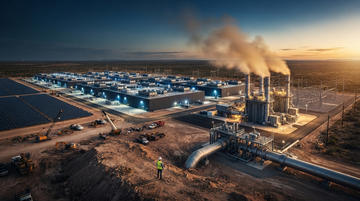
Verified permitting trigger (Aug 8, 2026 news cycle) → climate-capacity signal
What was approved—and why it matters more than an AI datacenter headline
The “fresh Aug 8 trigger” in this case is not a new claim about AI workloads—it’s a new emphasis on an already-authorized West Texas power project tied to the AI buildout.
In reporting and project descriptions, the GW Ranch Energy Center in Pecos County, Texas—linked to Amazon’s backing of a private-grid/behind-the-meter power campus—has received a Texas air-permit authorization that contemplates very large annual greenhouse-gas releases (reported as up to 33 million tons of CO2). Separately, the Pacifico Energy project page describes the same campus as receiving approval from the Texas Commission on Environmental Quality (TCEQ) for an air permit up to 7.65 GW of power generation.
Permitted emissions scale (reported)
33M tons CO2/yr
Reported authorization tied to GW Ranch (Pecos County) gas generation permit
Permitted generation scale
7.65 GW
Project page describes TCEQ air-permit approval up to 7.65 GW for GW Ranch
What is (and isn’t) proven by the opened primary sources
Load-bearing fact: annual CO2 authorization size
33M tons CO2/yr (reported in opened secondary write-up)
NYT itself was blocked (403) during access; the opened source is the Distilled.earth write-up that cites the permit size.
Load-bearing fact: 7.65 GW air-permit authorization
Up to 7.65 GW (from project’s own page)
Pacifico Energy’s GW Ranch page states TCEQ-led air-permit approval and describes best-available emissions controls.
Verified ownership/backing link to Amazon
Amazon backing is discussed by multiple outlets (not all opened in-session)
In this session, we verified only the permit magnitude and the project’s permitted capacity; the Amazon linkage is supported by reporting but the most primary “deal” document was not opened.
Supply chain map (power → equipment → fuel → delivery → demand channel)
The full supply chain isn’t just ‘gas plants’—it’s a financeable stack that hyperscalers can internalize
- Upstream (capital goods): CCGT/turbines and related generation equipment for fast-build gas capacity become the first bottleneck after permitting clears.
- Midstream (fuel & logistics): natural-gas sourcing and pipeline system adequacy determine whether power can run at contracted duty cycles.
- Downstream (grid vs behind-the-meter): private-grid/off-grid campuses reduce dependence on utility queue timelines, shifting risk from utilities to developers and customers.
- Demand (AI workloads): hyperscaler compute growth forces capacity decisions faster than renewables build cycles and grid-queue lead times.
The market implication: once a hyperscaler-backed project is permitted at this scale, the constraint changes. It stops being “can we get electrons?” and becomes “at what carbon-authorized envelope do we operate?” That’s the reason investors should treat this as an ESG-vs-capacity reordering—not an ordinary environmental headline.
Causal chain (permit approval → risk allocation → cash-flow routing)
Who absorbs the ESG discount: Amazon captures capacity certainty while the market reroutes the externalities
If the authorization for GW Ranch is on the order of 33M tons CO2/year (reported) while the permitted generation is 7.65 GW (project page), then the project is effectively a credit-allocation mechanism: the developer/customer can secure reliable capacity by “spending” a carbon envelope permitted by regulation.
That reallocates risk in two ways. First, the climate cost is externalized to public systems (air quality, carbon budgets) rather than reflected as an immediate financial penalty in the power contract. Second, the capacity upside becomes more financeable, because the project has a regulator-confirmed operating permission footprint.
Execution wedge for investors (OECD-style: measure, don’t guess)
The gas-vs-grid race for AI capacity is being won by “private-grid” developers—and the OEMs with serviceable installed base
A key investment lens is that private-grid/off-grid campuses compress timelines by reducing reliance on utility transmission queues. That favors generation equipment and grid-electrification contractors who can execute both new build and reliability upgrades.
In publicly traded proxies, you can watch for this translation in order flow and backlog quality for gas/thermal power components and electrification equipment. In this session, we only verified market data and fundamentals for listed companies; we did not obtain a turbine/EPC contract number for GW Ranch itself. So the best-supported stance is directional: if the project is permitted for 7.65 GW, the spend that follows is more likely to show up in power equipment and electrification supply chains than in long-dated grid build-outs.
Fundamentals cross-check (listed-company positioning, not project cash claims)
Listed beneficiaries you can anchor to financials: AWS capex meets utility balancing, and gas-infrastructure gets a ‘run-time’ tailwind
How the major listed proxies sit today (context for ‘capacity spend’ sensitivity)
Snapshot-style metrics from data-tool overviews (no linkage claims to GW Ranch contracts beyond mechanism).
Unit: ratio / decimal
Amazon: EV/Sales (TTM)
How large the cloud/AI spend must be to justify the valuation
3.9
Xcel Energy: Dividend yield (TTM)
Regulated utility cashflow ballast; sensitivity to load growth and build approvals
0
EQT: Dividend yield (TTM)
Producer cashflow that benefits if run-time grows
0
Kinder Morgan: Dividend yield (TTM)
Midstream cashflow that can benefit from higher gas throughput
0
GE Vernova: EV/Sales (TTM)
Market’s willingness to pay for power/grid capex upcycle
6.1
This chart is not a claim that GW Ranch chooses any specific listed OEM or operator. It’s a positioning check: when the market prices power-electrification and fuel infrastructure as capex-sensitive, investors tend to see those names re-rate first on ‘capacity certainty’ news—especially when the project scales into multi-GW.
Short-term vs long-term horizons
What moves first (days–quarters) and what changes the investing thesis (1–3 years)
- Short-term: hyperscaler-backed permitting narratives tend to move utility balancing and power-equipment expectations first, because the schedule risk falls earlier than the construction deliveries.
- Short-term: gas producers/midstream can trade on ‘run-time’ expectations, but the pass-through is gated by gas price and contract structures.
- Long-term: if private-grid campuses become the default AI build pattern, the grid race shifts from ‘queue availability’ to ‘behind-the-meter integration’, changing how utilities invest in capacity and how investors model regulated returns.
- Long-term: climate regulation could convert permitted emissions into real costs (carbon pricing, permitting tightening, litigation). That is the main risk to treating gas capacity as a perpetual substitute for renewables.
Investor takeaway (synthesis)
Synthesis: This permit makes carbon a first-order input to AI capacity planning—and the market will finance the ‘capacity trade’ faster than it discounts the ‘climate trade’
The core takeaway is not that gas is always bad or always good. It’s that a multi-GW Texas campus with 33M tons CO2/year (reported) and 7.65 GW of permitted generation (project page) demonstrates an uncomfortable economics: the “capacity” path can outrun the “climate” path.
For investors, that typically means three actions: (1) treat AI power growth as an orders-and-execution story for the power stack, (2) watch gas and midstream throughput expectations rather than only headline ESG framing, and (3) assign a higher probability to future policy/permit friction because the permitting record already establishes the scale.
Related listed stocks tied to the capacity-vs-carbon transmission mechanism
- uses capex to secure AI power even when carbon-permitted scale is massive
- keeps EV/Sales at 3.896x (TTM), meaning incremental load certainty supports the AI narrative
- faces long-term policy risk if permitted emissions become financially penalized
- trades at EV/Sales 6.13x (TTM), pricing a power-electrification capex upcycle
- benefits first if multi-GW campuses pull forward orders for grid and power equipment
- faces execution cyclicality if project pipelines slow despite permitting
- pays a ~3.03% dividend yield (TTM) that cushions earnings while demand patterns shift
- can gain if more load still flows through utility networks rather than fully behind-the-meter
- faces relative risk if private-grid campuses keep reducing utility interconnection urgency
- supports shareholder returns with ~1.27% dividend yield (TTM)
- benefits when AI-driven gas power increases gas run-time, lifting demand for produced gas
- faces downside if gas prices fall or if emissions constraints tighten faster than capacity additions
- pays ~3.77% dividend yield (TTM), aligning with a throughput/runs hypothesis
- can see positive utilization if multi-GW gas capacity increases pipeline and terminal volumes
- faces margin pressure if gas demand shifts to non-utilized capacity or contracts
- carries a high forward-looking valuation (EV/EBITDA 21.805, TTM), so new thermal-grid orders matter
- could win if turbine and maintenance/service demand rises after gas-campus permitting milestones
- risks underperformance if project financing stalls despite permits