%22%2F%3E%0A%20%20%3Ccircle%20cx%3D%22220%22%20cy%3D%22150%22%20r%3D%22180%22%20fill%3D%22%2322d3ee%22%20fill-opacity%3D%220.12%22%2F%3E%0A%20%20%3Ccircle%20cx%3D%221010%22%20cy%3D%22130%22%20r%3D%22220%22%20fill%3D%22%2338bdf8%22%20fill-opacity%3D%220.08%22%2F%3E%0A%20%20%3Ccircle%20cx%3D%22920%22%20cy%3D%22520%22%20r%3D%22170%22%20fill%3D%22%2322d3ee%22%20fill-opacity%3D%220.06%22%2F%3E%0A%20%20%3Cpath%20d%3D%22M140%20430h920%22%20stroke%3D%22url(%23line)%22%20stroke-width%3D%2212%22%20stroke-linecap%3D%22round%22%2F%3E%0A%20%20%3Cpath%20d%3D%22M220%20360c120-150%20260-220%20380-220s260%2070%20380%20220%22%20fill%3D%22none%22%20stroke%3D%22%2367e8f9%22%20stroke-opacity%3D%220.5%22%20stroke-width%3D%2216%22%20stroke-linecap%3D%22round%22%20stroke-linejoin%3D%22round%22%2F%3E%0A%20%20%3Cpath%20d%3D%22M300%20398h600%22%20stroke%3D%22%2394a3b8%22%20stroke-opacity%3D%220.24%22%20stroke-width%3D%228%22%20stroke-linecap%3D%22round%22%2F%3E%0A%20%20%3Ctext%20x%3D%22220%22%20y%3D%22510%22%20fill%3D%22%23e2e8f0%22%20fill-opacity%3D%220.7%22%20font-family%3D%22Arial%2C%20Helvetica%2C%20sans-serif%22%20font-size%3D%2238%22%20letter-spacing%3D%228%22%3EINSIGHTS%3C%2Ftext%3E%0A%3C%2Fsvg%3E)
Policy → permitting mechanics → site selection economics
The congressional letter is less about xAI’s “turbine count” than about how the turbines were framed to evade permits
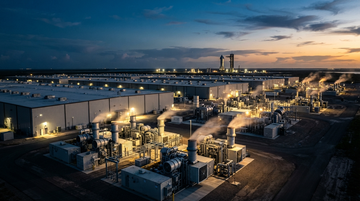
The House Energy & Commerce ranking-member letter dated July 29, 2026 targets SpaceXAI (Elon Musk) over air-permitting and Clean Air Act compliance for its Colossus data-center power strategy. The load-bearing part for investors is not the headline allegation—it is the compliance theory the letter quotes/relies on: SpaceXAI is described as attempting to treat trailer-mounted turbines as “mobile sources,” potentially allowing operation without the kind of permit coverage regulators would normally expect for large on-site generation.
That framing matters because it converts a siting/permit dispute into a broader federal oversight problem—especially for projects using many parallel turbines over multi-year buildouts.
What the letter actually demands (primary source)
Document scope
All turbine inventories + emissions/power/water analyses
Letter requests listings of all turbines used/planned through end-2028 and all analyses tied to emissions, power consumption, and water usage.
Regulatory evidence
Communications with state/federal agencies
Requests communications/records with Shelby County Health Department, City of Memphis, Tennessee, Mississippi DEQ, EPA/DOE/DOC/White House, and DOJ-related items.
On-the-ground verification
Requests site visit dates
The press release indicates staff will reach out to schedule visits to Colossus 1 and 2 sites.
Verified allegations in the letter
Pallone’s letter alleges Colossus turbine rollout reached “at least 60” operating without air permits—and calls it regulatory “cobbled together” infrastructure
In the July 2026 letter (primary source), Pallone lays out an escalating timeline for Colossus 1 and Colossus 2 turbine deployment and asserts that the turbines were operating without the air permitting/controls that would typically be required.
For Colossus 2 specifically, the letter describes a plan for 16 temporary turbines that “exploded into at least 60 turbines, all operating without air permits”. Separately for Colossus 1, the letter asserts turbines accumulated to 35 and that there is insufficient clarity—per the letter—on the authority or exemption used to operate them.
| Facility | Alleged turbine scale | Letter’s permit/compliance assertion | What the letter ties to permitting mechanics |
|---|---|---|---|
| Colossus 1 (Shelby County, Tennessee) | Accumulated to 35 natural-gas turbines (timeline described in letter) | Operating without “air permits or protections,” alleged Clean Air Act violation | Claims regulators/information about exemption/authority are unclear in the letter |
| Colossus 2 (Mississippi, near Memphis border) | “At least 60” turbines by the letter’s framing (timeline described) | “Operating without air permits” | Letter frames a temporary-turbine approach as a workaround via “mobile sources” theory |
Why investors should care: Title V thresholds create a quantitative trigger for “blast radius”
Once turbine fleets look like “major sources,” Title V coverage becomes the compliance backstop—and the letter’s scale description is exactly how major-source risk emerges
Title V operating permits are required when a facility is a “major source” of air pollutants. EPA’s Title V applicability guidance states that the default major-source threshold is 100 tons/year of an air pollutant (with lower thresholds in non-attainment areas).
Even without the letter giving a single calculated tonnage number, the investor takeaway is structural: when hyperscalers deploy many turbines in parallel (and keep them online for long periods), they increase both actual and potential emissions—raising the likelihood that the aggregate operation should be permitted under Title V frameworks. The congressional letter effectively spotlights that risk by forcing document disclosure for turbine-by-turbine operation, emissions controls, monitoring, and timing.
Default Title V “major source” threshold
100 tpy
EPA Title V guidance: default major source threshold for any air pollutant is 100 tons/year.
Non-attainment thresholds
Lower by pollutant/region
EPA guidance: lower thresholds apply in non-attainment areas (e.g., VOC/NOx can fall to 50 tpy or 25 tpy depending on severity).
Letter’s compliance test
Turbine-by-turbine documentation
Letter requests inventories, permitting application details, emissions monitoring, and whether turbines are discontinued/relocated after 12 months.
What changes under scrutiny
Permitting strategy becomes a federal oversight story
Letter demands communications with EPA/DOJ and White House-related parties, linking local siting disputes to national process risk.
Full supply-chain view: turbines are the “visible” unit, but the bottleneck is permitting + grid/power delivery contracting
The permitting fight reshapes the power supply-chain: from behind-the-meter gas delivery to utility PPAs/nuclear procurement
- If a hyperscaler’s on-site gas plan is challenged, the schedule risk shifts from engineering into permitting discovery and agency review.
- Turbine “fleet” approaches make emissions aggregation harder to ignore, so the compliance burden scales with turbine count rather than single-unit exceptions.
- Procurement alternatives (utility PPAs, firm capacity contracts, nuclear pathways) reduce reliance on “temporary/mobile source” arguments, so site selection tilts toward regions with faster, scalable power contracting.
This is the behind-the-meter regulatory arbitrage problem. The supply chain is not only the turbine OEM; it is (1) fuel logistics and interconnection, (2) environmental permitting data packages, and (3) the contract structure that allocates liability.
When Congress asks for communications with agencies and analyses of emissions/power/water usage, that disclosure pressure tends to propagate back into contracting: counterparties (utilities, EPCs, developers) demand clearer regulatory pathways and risk-sharing language—because the new failure mode is not just a fine; it is a stalled or forced redesign.
Fundamentals overlay (for listed utilities/power counterparties)
The “winners” are not turbine makers—they are utilities that sell permitted capacity and can absorb compliance into regulated tariff frameworks
Utility-scale power providers operate within regulated air-permitting and compliance programs. If hyperscalers reduce on-site “turbine loophole” exposure, the incremental megawatts are more likely to flow toward permitted generation portfolios and contracted capacity.
To ground the idea in fundamentals for listed power counterparties, here are recent revenue figures from the financial data tool for each utility candidate in the related-stocks view.
| Company | Fiscal year revenue (USD) | Source |
|---|---|---|
| Duke Energy | $32.24B | Data tool income statement (FY 2025) |
| WEC Energy Group | $9.80B | Data tool income statement (FY 2025) |
| NextEra Energy | $27.48B | Data tool income statement (FY 2025) |
Short-term + long-term horizons investors can trade on
Near-term: document pressure and site-access requests. Long-term: hyperscalers re-rate power strategy toward contracted capacity that avoids permitting interpretation risk
Over 1–3 years, the structural consequence is portfolio selection. If “mobile source” arguments do not reliably insulate hyperscaler buildouts, then development teams will prefer:
1) utility PPAs with firm capacity delivery, 2) projects that fit established air-permitting pathways, or 3) nuclear-related procurement where air-permitting risk is categorically different.
The market implication is that utilities and grid-connected capacity providers gain bargaining power because they are the parties with predictable compliance processes.
Listed market linkages: utilities most directly exposed to a hyperscaler shift from behind-the-meter gas toward contracted capacity
- Duke’s contracted power model can capture incremental hyperscaler MW as permitting interpretation risk increases for “temporary/mobile” turbine approaches at data centers.
- Over 2–4 quarters, document-driven scrutiny can delay behind-the-meter commissioning and pull demand toward available utility capacity.
- Duke reported $32.24B revenue in FY 2025, so even modest demand reallocation can materially support utilization and cash flow versus smaller generators.
- If hyperscalers reduce on-site gas exposure, WEC can benefit from capacity contracting where power can be delivered with established permitting processes.
- Over days-to-quarters, Pallone-style information demands can increase scheduling uncertainty for gas-centric sites, increasing PPA preference.
- WEC’s FY 2025 revenue was $9.80B, so incremental load stability can support earnings visibility even without new large projects.
- A shift away from on-site gas could increase long-duration demand for clean/firm capacity, which supports NextEra’s development optionality.
- Over 1–2 years, if hyperscalers instead overbuild gas and expand utility-scale gas, clean-capex demand could be delayed relative to the base case.
- NextEra’s FY 2025 revenue was $27.48B; changes in AI power sourcing can move market expectations for renewable/nuclear capacity monetization.