%22%2F%3E%0A%20%20%3Ccircle%20cx%3D%22220%22%20cy%3D%22150%22%20r%3D%22180%22%20fill%3D%22%2322d3ee%22%20fill-opacity%3D%220.12%22%2F%3E%0A%20%20%3Ccircle%20cx%3D%221010%22%20cy%3D%22130%22%20r%3D%22220%22%20fill%3D%22%2338bdf8%22%20fill-opacity%3D%220.08%22%2F%3E%0A%20%20%3Ccircle%20cx%3D%22920%22%20cy%3D%22520%22%20r%3D%22170%22%20fill%3D%22%2322d3ee%22%20fill-opacity%3D%220.06%22%2F%3E%0A%20%20%3Cpath%20d%3D%22M140%20430h920%22%20stroke%3D%22url(%23line)%22%20stroke-width%3D%2212%22%20stroke-linecap%3D%22round%22%2F%3E%0A%20%20%3Cpath%20d%3D%22M220%20360c120-150%20260-220%20380-220s260%2070%20380%20220%22%20fill%3D%22none%22%20stroke%3D%22%2367e8f9%22%20stroke-opacity%3D%220.5%22%20stroke-width%3D%2216%22%20stroke-linecap%3D%22round%22%20stroke-linejoin%3D%22round%22%2F%3E%0A%20%20%3Cpath%20d%3D%22M300%20398h600%22%20stroke%3D%22%2394a3b8%22%20stroke-opacity%3D%220.24%22%20stroke-width%3D%228%22%20stroke-linecap%3D%22round%22%2F%3E%0A%20%20%3Ctext%20x%3D%22220%22%20y%3D%22510%22%20fill%3D%22%23e2e8f0%22%20fill-opacity%3D%220.7%22%20font-family%3D%22Arial%2C%20Helvetica%2C%20sans-serif%22%20font-size%3D%2238%22%20letter-spacing%3D%228%22%3EINSIGHTS%3C%2Ftext%3E%0A%3C%2Fsvg%3E)
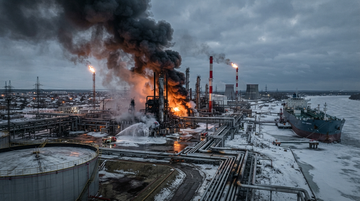
Supply chain shock (diesel runs) rather than geopolitical pricing (crude routes)
The key difference vs. Iran/Hormuz is that refineries are the bottleneck being damaged
The Bloomberg-reported episode is a coordinated drone attack in which Ukraine says it struck two Russian oil refineries. The market-relevant mechanism is straightforward: when refineries are damaged, Russia cannot convert as much crude into distillates like diesel and gasoil, so the diesel market tightens even if crude supply is unchanged.
What we can verify from accessible sources (and what we can’t)
Event verification
Verified as a “two refinery” attack (Ukraine claim) via secondary reporting search results.
Bloomberg primary page was blocked (403) in this session, so we rely on accessible search results text rather than quoting Bloomberg directly.
Exact refinery names + downtime
Not fully verified from primary pages in this session.
Some accessible secondary results mention specific refinery names, but without openable primary pages here, the article treats names as not disclosed.
Transmission mechanism
How the strike propagates: lost Russian runs → higher distillate availability pressure → wider cracks for downstream refiners
- Damage to refineries reduces Russia’s distillate output, tightening local and exportable product supply even if crude exports continue.
- Tight supply pushes diesel and gasoil benchmarks higher relative to crude, widening refining crack spreads that benefit product-focused refiners.
- Sanctions and export frictions slow re-routing and inventory balancing, so the first-order effect is speed (days) and the second-order effect is persistence (weeks-to-months).
This is why the event’s “cleanest read-through” is not only to refiners, but to refiners whose business model is robust when product spreads improve. Valero, Marathon Petroleum, and Phillips 66 all have meaningful refining/marketing revenue bases in the U.S. market, which is structurally exposed to global distillate pricing.
Who wins and who pays
Upstream/downstream supply-chain effects (layer-by-layer)
| Layer | Entity type | Likely first-order effect | Investor watch-item |
|---|---|---|---|
| Upstream | Crude producers and crude transport | Less immediate effect if crude flows continue; localized disruptions depend on storage and export controls | Crude differentials vs. refined product benchmarks |
| Core choke point | Refiners (Russia), plus global refining utilization | Lower Russian refining runs tighten diesel availability and increase product scarcity premiums | Global refinery utilization and product inventory trends |
| Downstream (demand) | Diesel-dependent industries and retail distributors | Higher costs may shift timing (less consumption), but near-term pass-through can be incomplete | Retail pump margins vs. wholesale distillate costs |
| Downstream (trade) | Product importers/marketers | Higher import parity values increase willingness to pay for cargoes | Regional basis spreads (diesel vs. crude) |
The core “new information” of this event is that it attacks the conversion asset itself. In a war where many headlines focus on routes (crude transport) or geopolitical premiums, refinery destruction changes the economics of refining rather than just the pricing of feedstocks.
Investor relevance via fundamentals (U.S. refiners)
Why the refiners named in the brief make sense: their income statements are already scaling with a refining cycle
Valero revenue (FY2025)
$122.7B
Income statement revenue (annual).
Valero net income (FY2025)
$2.25B
Income statement net income.
Marathon Petroleum revenue (FY2025)
$132.7B
Income statement revenue (annual).
Marathon Petroleum net income (FY2025)
$4.04B
Income statement net income.
Phillips 66 revenue (FY2025)
$132.2B
Income statement revenue (annual).
Phillips 66 net income (FY2025)
$4.40B
Income statement net income.
Across these companies, reported revenue levels are large enough that even moderate margin improvement from a distillate tightness shock can show up meaningfully at the operating line. For investors, the practical question is not whether cracks can move—war can do that—but whether the shock persists long enough to improve earnings cadence rather than spiking spreads briefly.
War financing linkage (what we can verify here)
The $750B “recovery plan / funding” framing is not the same as war-budget math, but the asset-immobilization mechanism is real
The brief links the strike to a $750B Ukrainian frozen-asset loan. In this session, what we can verify from a primary-style oversight page is a related mechanism: immobilized Russian assets are described as roughly $300B, and the G7 initiated $50B of Extraordinary Revenue Acceleration (ERA) loans to Ukraine (to be repaid from immobilized assets), with expected repayment on the order of $2.6–$3.2B per year. The key takeaway is not the exact $750B number, but that financing can be structured around immobilized assets—creating incentives to sustain pressure on Russia’s economic capacity, including fuel-production infrastructure.
Horizons
What moves first vs. what matters later
- Short-term (days–weeks): markets reprices diesel spreads faster than it reprices refinery run-rate, so equity moves can front-run physical outages.
- Short-term: refiners with marketing exposure may benefit even before full utilization metrics are visible, because cargo pricing reacts to expected scarcity.
- Long-term (1–3 years): if refinery repair/maintenance cycles are repeatedly interrupted, the shock can become structural to regional product balances—raising the floor of crack spreads.
- Long-term risk: if the strike effect is contained or Russia reroutes crude/production to compensate, spreads mean-revert and margins compress toward cycle norms.
Synthesis
Bottom line thesis for investors
This attack’s most investable feature is that it targets the conversion node, not just the shipping lane. For U.S. listed refiners, that means the scenario to model is not “geopolitics adds a premium,” but “diesel tightness persists enough to lift crack economics and earnings visibility.” In other words, the signal is supply destruction of refining capacity—and that’s a different earnings path than risk-premium-only narratives.
Listed names with evidence-backed linkage to diesel-tightness refining economics
- Short-term, spread repricing can lift Valero’s refining profitability if diesel/gasoil tightness persists.
- Medium-term, continued outages support higher distillate pricing relative to crude, sustaining margin structure.
- Short-term, better crack economics tend to flow through MPC’s earnings cadence given its large refining & marketing revenue base.
- Longer-term, repeated refinery run disruptions raise the probability of sustained product tightness.
- Short-term, higher distillate parity can improve PSX’s refining/marketing margins faster than utilization data.
- If the shock persists, PSX should maintain a higher earnings floor via spread-driven profitability.
- Short-term, global product tightness can benefit integrated refining margins, but crude exposure can offset.
- Watch for whether the market shift translates into sustained downstream cash generation rather than transient mark-to-market.
- Short-term, XOM’s refining is smaller than pure-play refiners, so spreads may not dominate earnings direction.
- Long-term, structural diesel tightness could support downstream earnings stability if it persists.