%22%2F%3E%0A%20%20%3Ccircle%20cx%3D%22220%22%20cy%3D%22150%22%20r%3D%22180%22%20fill%3D%22%2322d3ee%22%20fill-opacity%3D%220.12%22%2F%3E%0A%20%20%3Ccircle%20cx%3D%221010%22%20cy%3D%22130%22%20r%3D%22220%22%20fill%3D%22%2338bdf8%22%20fill-opacity%3D%220.08%22%2F%3E%0A%20%20%3Ccircle%20cx%3D%22920%22%20cy%3D%22520%22%20r%3D%22170%22%20fill%3D%22%2322d3ee%22%20fill-opacity%3D%220.06%22%2F%3E%0A%20%20%3Cpath%20d%3D%22M140%20430h920%22%20stroke%3D%22url(%23line)%22%20stroke-width%3D%2212%22%20stroke-linecap%3D%22round%22%2F%3E%0A%20%20%3Cpath%20d%3D%22M220%20360c120-150%20260-220%20380-220s260%2070%20380%20220%22%20fill%3D%22none%22%20stroke%3D%22%2367e8f9%22%20stroke-opacity%3D%220.5%22%20stroke-width%3D%2216%22%20stroke-linecap%3D%22round%22%20stroke-linejoin%3D%22round%22%2F%3E%0A%20%20%3Cpath%20d%3D%22M300%20398h600%22%20stroke%3D%22%2394a3b8%22%20stroke-opacity%3D%220.24%22%20stroke-width%3D%228%22%20stroke-linecap%3D%22round%22%2F%3E%0A%20%20%3Ctext%20x%3D%22220%22%20y%3D%22510%22%20fill%3D%22%23e2e8f0%22%20fill-opacity%3D%220.7%22%20font-family%3D%22Arial%2C%20Helvetica%2C%20sans-serif%22%20font-size%3D%2238%22%20letter-spacing%3D%228%22%3EINSIGHTS%3C%2Ftext%3E%0A%3C%2Fsvg%3E)
What just changed (verified, not inferred)
The EU didn’t seize “more money”—it monetised the yield and pushed it into Ukraine support channels
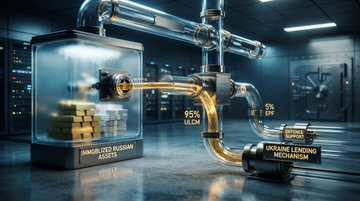
On 02 April 2026, the EU received €1.4 billion in windfall profits generated by the interest on cash balances originating from immobilised Russian Central Bank assets. The EU then stated that 95% of these proceeds would be used via the Ukraine Loan Cooperation Mechanism (ULCM), with 5% going through the European Peace Facility (EPF) for Ukraine’s pressing military/defence needs.
Windfall proceeds delivered
€1.4B
EU reported receiving €1.4B in additional profit generated by interest on immobilised Russian Central Bank assets (02 Apr 2026).
Channel split (Ukraine Loan Cooperation Mechanism)
95%
EU states 95% of the proceeds are used to support Ukraine via ULCM.
Channel split (European Peace Facility)
5%
EU states 5% of proceeds are used via EPF for defence support.
The template underneath the headline
This is (at least) a two-step template: immobilise the asset, then treat the interest as a financing input
The April delivery is only the visible part. The EU’s earlier structural design for a larger “reparations-loan” style instrument is built to keep the underlying Russian assets immobilised while using contractual/financial arrangements around interest and proceeds as the financing basis.
In the Regulation establishing the “Reparations Loan to Ukraine,” the EU describes an instrument where the loan’s interest due by the Union is linked to the interest owed to the Central Bank of Russia under the relevant arrangements for the immobilised assets (referenced in the regulation’s parameters), and where the loan is repaid upon defined triggers tied to Russia’s war reparations settlements.
| Time horizon | Financial variable | EU’s control right now | EU’s repayment/settlement dependence later |
|---|---|---|---|
| Immediate / recurring | Interest/profits earned on immobilised RSB-linked cash balances | EU can route proceeds into Ukraine support channels (e.g., ULCM/EPF) as they arise | Not required for the April €1.4B delivery itself |
| Later | Loan repayment | EU maintains an instrument framework that is designed to trigger repayment based on settlement outcomes | Repayment is tied to receipt of reparations/settlement triggers (per regulation repayment trigger logic) |
Full supply-chain awareness (financial plumbing, not widgets)
The “supply chain” here is post-trade infrastructure: custodian/CSD cash management → interest accrual → routing to policy accounts → Ukraine spending
- Upstream “plumbing”: immobilised Russian Central Bank-linked assets are held in market infrastructure arrangements that cause interest/cash returns to accrue.
- The money-conversion step: the EU’s approach treats those returns as monetisable proceeds, rather than requiring immediate conversion of the underlying assets into confiscated principal.
- Downstream allocation: proceeds are routed to defined Ukraine-facing mechanisms—here explicitly ULCM (95%) and EPF (5%)—so spending authorization is institutionally pre-wired.
- Legal-risk management layer: the larger regulatory architecture is designed to structure repayment around reparations triggers instead of relying solely on immediate principal confiscation.
Put simply: the EU is building a “financial plumbing supply chain” where immobilisation creates an operating input (interest), and EU policy accounts convert that input into spending/financing outcomes with less reliance on the messy end-state (principal confiscation).
Why this is the “first template” (the precedence logic)
The April €1.4B delivery is precedent because it proves the model can be repeated and politically partitioned
A template becomes investable/replicable when it clears two tests: (1) it produces real cash proceeds on an ongoing basis, and (2) it routes those proceeds into multiple politically distinct downstream buckets.
The April 2026 delivery clears both tests: it confirms the existence of monetisable yield tied to immobilised RSB-linked cash balances, and it confirms the EU can immediately partition the proceeds—with most going to ULCM and a defined slice going to EPF.
Data-backed research angles you can actually trade
What to watch next: execution risk, yield size, and the “who bears which balance-sheet risk” question
- Yield stability angle: watch whether future quarterly/annual interest/profits on immobilised balances produce proceeds at a consistent level, because that determines how “funding-like” this becomes versus “headline-like.”
- Legal/settlement angle: track whether the reparations-loan regulatory triggers (repayment conditions) become easier or harder to activate—because that affects whether yield-funded financing can scale into a larger balance-sheet posture.
- Institutional routing angle: confirm whether the EU keeps using ULCM for most proceeds and EPF for defence slices; changes would signal a shift in political priority weighting.
- Balance-sheet exposure angle: the design includes external guarantees and assigned revenue concepts in the regulation; changes in guarantee structure or costs would change the economic burden on the EU and member states.
Some of these angles require additional data (e.g., forward yield projections or guarantee economics) that are not disclosed in the primary pages opened for this session. Where not disclosed, I label it as not available rather than guessing.
Horizons: near-term catalysts vs. 1–3 year structural implications
Near-term: confirmation of cash routing; long-term: expansion pressure on frozen-asset yield models
In the next days-to-quarters, the market signal is whether the EU continues to deliver proceeds as interest accrues and whether the routing stays stable (ULCM vs EPF). That’s the “execution proof” stage.
Over 1–3 years, the structural implication is whether the EU and partners treat this as a scalable funding method for larger Ukraine financing frameworks. If so, the geopolitical ordering question—whose money funds whose war—shifts from moral/political debate into repeatable financial operations.
Synthesis for investors
The trade isn’t “confiscation vs. not”—it’s whether frozen-asset yields become the dominant financing lever
My core thesis is narrow and mechanism-specific: the EU’s April 2026 €1.4B delivery demonstrates that frozen sovereign asset yield streams can be turned into real, partitioned financing inputs for Ukraine-related lending and defence support.
That matters because yield monetisation is likely to be the first part of the architecture that becomes routine. Once routine, political pressure increases to extend the same logic to additional income streams and, potentially, to larger loan volumes under the regulatory framework.
Listed market links (what this article can and can’t map to tickers)
- Euroclear is not a listed issuer in this dataset; this article can’t link the pipeline to a verified ticker without a session-verified listing symbol.