%22%2F%3E%0A%20%20%3Ccircle%20cx%3D%22220%22%20cy%3D%22150%22%20r%3D%22180%22%20fill%3D%22%2322d3ee%22%20fill-opacity%3D%220.12%22%2F%3E%0A%20%20%3Ccircle%20cx%3D%221010%22%20cy%3D%22130%22%20r%3D%22220%22%20fill%3D%22%2338bdf8%22%20fill-opacity%3D%220.08%22%2F%3E%0A%20%20%3Ccircle%20cx%3D%22920%22%20cy%3D%22520%22%20r%3D%22170%22%20fill%3D%22%2322d3ee%22%20fill-opacity%3D%220.06%22%2F%3E%0A%20%20%3Cpath%20d%3D%22M140%20430h920%22%20stroke%3D%22url(%23line)%22%20stroke-width%3D%2212%22%20stroke-linecap%3D%22round%22%2F%3E%0A%20%20%3Cpath%20d%3D%22M220%20360c120-150%20260-220%20380-220s260%2070%20380%20220%22%20fill%3D%22none%22%20stroke%3D%22%2367e8f9%22%20stroke-opacity%3D%220.5%22%20stroke-width%3D%2216%22%20stroke-linecap%3D%22round%22%20stroke-linejoin%3D%22round%22%2F%3E%0A%20%20%3Cpath%20d%3D%22M300%20398h600%22%20stroke%3D%22%2394a3b8%22%20stroke-opacity%3D%220.24%22%20stroke-width%3D%228%22%20stroke-linecap%3D%22round%22%2F%3E%0A%20%20%3Ctext%20x%3D%22220%22%20y%3D%22510%22%20fill%3D%22%23e2e8f0%22%20fill-opacity%3D%220.7%22%20font-family%3D%22Arial%2C%20Helvetica%2C%20sans-serif%22%20font-size%3D%2238%22%20letter-spacing%3D%228%22%3EINSIGHTS%3C%2Ftext%3E%0A%3C%2Fsvg%3E)
Verified event • 2026-07-30
The EU just made “sovereign AI compute” a contestable SKU
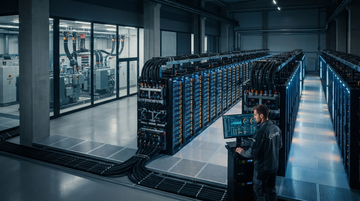
The EU’s executive branch has disclosed a public-financed program offering €10 billion to fund firms to erect seven AI gigafactories, framed as a way to close Europe’s AI compute gap versus the U.S. and China.
This matters because AI gigafactories are not “AI apps” or “policy pilots.” They are upstream compute capacity—GPU-heavy training infrastructure—where hyperscalers previously had structural pricing and availability advantages in EU-region workloads.
Public funding
€10B
EU offering to fund firms to erect seven AI gigafactories (AP summary of EU executive statement).
Project count
7
“seven AI gigafactories” in the disclosed funding package.
EuroHPC-linked spend (context)
€10B (2021–2027 period)
EU states investments in supercomputing/AI Factories reach €10B through EuroHPC JU over 2021–2027 (background context for the broader AI Factory program).
What the program actually buys
The capacity spec is the competitive weapon: >100,000 advanced AI processors per gigafactory
EU documentation on AI Factories defines AI Gigafactories as facilities dedicated to the development/training of next-generation models with trillions of parameters, and states that their compute is over 100,000 advanced AI processors.
That specification is the link in the chain to hyperscaler influence. If you can reliably access large-scale training compute locally, you can reduce dependence on third-party region capacity and renegotiate workload placement from “availability-limited” to “contract-and-capex optimized.”
| Layer | EU-defined target | Competitive implication |
|---|---|---|
| Compute | Over 100,000 advanced AI processors per AI Gigafactory | Shifts ordering power for GPU-heavy training from hyperscalers toward EU-hosted capacity. |
| Workload intent | Development/training of next-generation models | Increases the share of spend that must be won at the infrastructure level, not just through cloud subscriptions. |
| Public finance | €10B offered for firms to erect seven AI gigafactories | Reduces customer “wait risk” for capacity and forces EU-region pricing competition. |
Causal chain • policy → supply chain → earnings
Why this is a counter-bid to US hyperscaler dominance (not a parallel project)
- When customers can procure capacity locally, they can shift training workloads from “best-effort cloud region” to contracted EU-hosted capacity—which compresses hyperscaler pricing power.
- If public funding reduces downtime/availability uncertainty, the EU can shorten the time-to-first-usable-weights for EU buyers, raising the share of project budgets allocated to infrastructure rather than only managed services.
- Gigafactory build-outs pull forward long-lead spend on power hosting, cooling, and electrical integration—raising near-term demand for grid equipment providers before GPU utilization ramps.
Supply chain map • who benefits upstream and downstream
A full supply-chain view: GPUs → systems integrators → power-grid interconnect
Think of the gigafactory as a three-part bill:
1) Compute stack (advanced AI processors and the systems that wrap them). 2) Build + integration (data center engineering and enterprise delivery—where large IT services firms commonly sit). 3) Power-grid enablement (hosting capacity, substations, switching, and grid reinforcement—where utilities and power-electrification suppliers sit).
The EU’s explicit public underwriting targets exactly these components, and the bottleneck sequence is typically power/integration first, utilization later.
Supply-chain entities most exposed to the EU sovereign compute push
Upstream compute vendor exposure
[NVIDIA](nvda) sells the advanced AI processor ecosystem used by AI compute builds.
Exposure is directional and depends on which suppliers the tenders specify; EU documentation confirms the processor scale target but does not name vendors.
Systems / enterprise delivery exposure
[Accenture](acn) and [Cognizant](ctsh) are positioned to deliver enterprise AI infrastructure programs for regulated EU buyers.
This is a market-structure linkage: they are frequently prime contractors for enterprise IT modernization.
Power-grid equipment exposure
[Schneider Electric](su) is a proxy for power-electrification demand from new data center and industrial electrification.
The article’s verification for the EU’s €10B and processor scale does not specify the electrical integrator mix.
Data-backed market proxies (listed) • what to watch in fundamentals
Investor-facing read-through: what moves first in public markets
Because this is a multi-year infrastructure program, near-term listed-market signals are unlikely to be “€ revenue from AI gigafactories” inside one quarter. The faster-moving impacts are typically:
- Guidance language changes around data center capex and regional deployment.
- Working-capital and capex commentary for power and infrastructure supply chains.
- Contracting appetite from enterprise systems integrators and managed cloud services.
To ground the analysis with hard fundamentals: NVIDIA reports TTM revenue of $253.491B and TTM operating margin of 65.6%, reflecting the high-margin compute stack it supplies to AI compute builds globally.
Revenue scale (TTM) for major compute/cloud proxies touched by a sovereign compute shift
Directional exposure proxy: these totals are not “EU gigafactory revenue,” but they anchor potential second-order demand/margin effects through cloud and AI spend.
Unit: USD
Short-term vs long-term • what should change in days vs quarters
The two tests: pricing margin (cloud) and interconnect feasibility (power)
- Short-term (days–quarters): look for EU-region capacity/contracting narratives to shift toward “local supply”, because that’s when procurement cycles react to sovereign availability.
- Short-term: power and electrical-integration lead times become a headline risk for any gigafactory that cannot secure grid hosting quickly, even if processor supply is available.
- Long-term (1–3 years): if utilization rises above the initial ramp, sovereign compute can sustain a structural share of enterprise training workloads, forcing hyperscalers to defend EU pricing and workload locality.
- Long-term: grid reinforcement spend scales non-linearly when you move from pilot AI clusters to gigafactory-class loads, which is where power-electrification suppliers can see durable demand.
Conclusion • one thesis for investors
This is not “EU catching up.” It’s a margin counter-bid with grid risk baked in.
The EU’s disclosure of €10B to fund seven AI gigafactories, combined with its definition of gigafactories as facilities with over 100,000 advanced AI processors, turns sovereign compute into an infrastructure product that enterprises can contract.
So the trade implication is straightforward: if contracted EU capacity grows faster than utilization requirements, hyperscalers face a pricing and workload-location margin test. At the same time, the grid is the gating item; when interconnect feasibility slips, build-out delays hit everyone—publicly subsidized sovereign providers included.
Listed stocks most plausibly linked to the sovereign gigafactory demand shock
- Advanced AI processor demand stays a ceiling constraint, so EU gigafactory contracting can support GPU volume if EU procurement specifies NVDA-class stacks.
- Utilization-driven EU training demand can lag for 1–3 years, so any revenue impact should be watched via data center AI guidance rather than immediate quarter prints.
- EU sovereign capacity can redirect some workloads away from Azure region dependency, which may pressure local pricing power (directional until deal terms are known).
- Azure can still benefit if sovereign builds run on partner stacks, so the net effect is likely mixed depending on procurement architecture over the next 1–3 years.
- Local EU contracting options can shift some enterprise training spend that would otherwise flow through AWS region consumption.
- Competitive pressure should show first in workload allocation, not headline revenue, so monitor EU cloud demand commentary over coming quarters.
- Sovereign AI programs increase enterprise infrastructure implementation budgets, expanding consulting/engineering pipelines for large systems integrators.
- 2–4 quarter deal cycles can pull forward backlog recognition if EU buyers prioritize sovereign deployments for regulated sectors.
- Enterprise sovereign compute creates demand for AI modernization delivery, which can support Cognizant’s application and data/AI transformation services.
- Workload governance and compliance requirements can increase managed service attachment as EU buyers adopt local training infrastructure.
- Gigafactory-scale builds raise the need for grid-ready power equipment, supporting longer-duration demand tied to new data center electrification.
- Power infrastructure bottlenecks can extend contracting windows, potentially benefiting electrical equipment suppliers over 1–3 years.