%22%2F%3E%0A%20%20%3Ccircle%20cx%3D%22220%22%20cy%3D%22150%22%20r%3D%22180%22%20fill%3D%22%2322d3ee%22%20fill-opacity%3D%220.12%22%2F%3E%0A%20%20%3Ccircle%20cx%3D%221010%22%20cy%3D%22130%22%20r%3D%22220%22%20fill%3D%22%2338bdf8%22%20fill-opacity%3D%220.08%22%2F%3E%0A%20%20%3Ccircle%20cx%3D%22920%22%20cy%3D%22520%22%20r%3D%22170%22%20fill%3D%22%2322d3ee%22%20fill-opacity%3D%220.06%22%2F%3E%0A%20%20%3Cpath%20d%3D%22M140%20430h920%22%20stroke%3D%22url(%23line)%22%20stroke-width%3D%2212%22%20stroke-linecap%3D%22round%22%2F%3E%0A%20%20%3Cpath%20d%3D%22M220%20360c120-150%20260-220%20380-220s260%2070%20380%20220%22%20fill%3D%22none%22%20stroke%3D%22%2367e8f9%22%20stroke-opacity%3D%220.5%22%20stroke-width%3D%2216%22%20stroke-linecap%3D%22round%22%20stroke-linejoin%3D%22round%22%2F%3E%0A%20%20%3Cpath%20d%3D%22M300%20398h600%22%20stroke%3D%22%2394a3b8%22%20stroke-opacity%3D%220.24%22%20stroke-width%3D%228%22%20stroke-linecap%3D%22round%22%2F%3E%0A%20%20%3Ctext%20x%3D%22220%22%20y%3D%22510%22%20fill%3D%22%23e2e8f0%22%20fill-opacity%3D%220.7%22%20font-family%3D%22Arial%2C%20Helvetica%2C%20sans-serif%22%20font-size%3D%2238%22%20letter-spacing%3D%228%22%3EINSIGHTS%3C%2Ftext%3E%0A%3C%2Fsvg%3E)
What happened
Japan is moving from AI enthusiasm to infrastructure commitments that can be measured in chips, megawatts, and delivery dates.
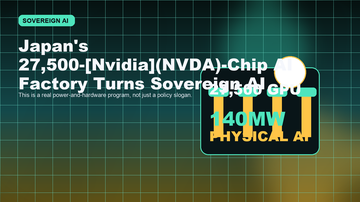
The latest Japan initiative matters because it is concrete. The initial deployment is a specific order for 27,500 Nvidia GPUs, 13,750 CPUs, and 140 megawatts of capacity. That is what a real sovereign-AI buildout looks like when it stops being a policy speech and starts looking like a procurement plan.
Japan is trying to turn its manufacturing, robotics, and industrial automation base into a local AI advantage. In a country with labor shortages and an aging workforce, physical AI is a productivity response.
For Nvidia, this is a reminder that sovereign AI can be a growth vector even when hyperscaler spending gets debated.
Why it matters
Sovereign AI becomes investable only when it has a power budget and a deployment schedule.
Power is the constraint that turns AI strategy into capex strategy. Once a nation commits to a load of that size, it creates a chain reaction for GPUs, networking, cooling, and facility engineering.
The 2028 launch target changes the market's time horizon. Investors can dismiss a vague AI roadmap, but it is harder to ignore a scheduled deployment window tied to real hardware orders.
If this buildout keeps expanding, the market should start valuing AI factory capacity the way it once valued fabs and data centers.
Japan sovereign-AI capex stack
Headline buildout figures for the Noetra / Japan AI factory program.
Unit: thousand units / MW / year / trillion yen
GPUs
Thousand-unit scale
27.5
CPUs
Thousand-unit scale
13.8
Data-center load (MW)
Power budget
140
Deployment year
Initial launch target
2,028
Long-term budget (T yen)
2040 tech plan
370
Physical AI focus
Industrial automation is the point
1
Read-through
Sovereign AI is a new capex class because it pulls demand through semiconductors, power, and robotics at the same time.
The clean read-through is to Nvidia, but the better read-through is broader. Every sovereign-AI program adds demand for chip packaging, power delivery, liquid cooling, storage, networking, and deployment services.
Japan is trying to industrialize AI inside an existing manufacturing ecosystem, not just build a cloud narrative. That could make the physical-AI chain more durable because the demand is tied to factories, robots, and supply-chain automation.
If this buildout keeps expanding, 'AI factory capacity' will start looking like a true industrial asset class.
| Item | Headline figure | Why it matters |
|---|---|---|
| GPUs | 27,500 | Large enough to matter for quarterly supply and backlog |
| CPUs | 13,750 | Shows this is a full-stack infrastructure order |
| Power | 140MW | Makes the buildout a real utility and cooling story |
| Timeline | 2028 | Adds visibility and reduces 'AI hype' ambiguity |
| Policy horizon | 2040 | Signals multi-cycle capital allocation |