Latest
The day's market news, with the argument attached
New notes every trading day on earnings, policy and market structure. Each one opens with the conclusion, then the evidence, then the companies it hits.
2026-07-26
%22%2F%3E%0A%20%20%3Ccircle%20cx%3D%22220%22%20cy%3D%22150%22%20r%3D%22180%22%20fill%3D%22%2322d3ee%22%20fill-opacity%3D%220.12%22%2F%3E%0A%20%20%3Ccircle%20cx%3D%221010%22%20cy%3D%22130%22%20r%3D%22220%22%20fill%3D%22%2338bdf8%22%20fill-opacity%3D%220.08%22%2F%3E%0A%20%20%3Ccircle%20cx%3D%22920%22%20cy%3D%22520%22%20r%3D%22170%22%20fill%3D%22%2322d3ee%22%20fill-opacity%3D%220.06%22%2F%3E%0A%20%20%3Cpath%20d%3D%22M140%20430h920%22%20stroke%3D%22url(%23line)%22%20stroke-width%3D%2212%22%20stroke-linecap%3D%22round%22%2F%3E%0A%20%20%3Cpath%20d%3D%22M220%20360c120-150%20260-220%20380-220s260%2070%20380%20220%22%20fill%3D%22none%22%20stroke%3D%22%2367e8f9%22%20stroke-opacity%3D%220.5%22%20stroke-width%3D%2216%22%20stroke-linecap%3D%22round%22%20stroke-linejoin%3D%22round%22%2F%3E%0A%20%20%3Cpath%20d%3D%22M300%20398h600%22%20stroke%3D%22%2394a3b8%22%20stroke-opacity%3D%220.24%22%20stroke-width%3D%228%22%20stroke-linecap%3D%22round%22%2F%3E%0A%20%20%3Ctext%20x%3D%22220%22%20y%3D%22510%22%20fill%3D%22%23e2e8f0%22%20fill-opacity%3D%220.7%22%20font-family%3D%22Arial%2C%20Helvetica%2C%20sans-serif%22%20font-size%3D%2238%22%20letter-spacing%3D%228%22%3EINSIGHTS%3C%2Ftext%3E%0A%3C%2Fsvg%3E)
2026-07-25
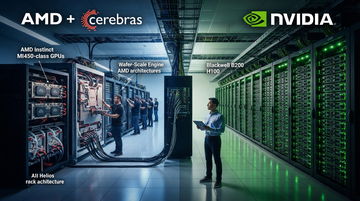
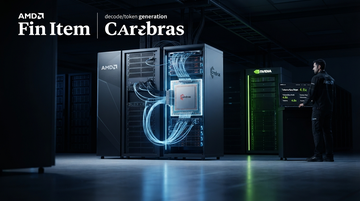
AMD's Cerebras deal proves inference disaggregation sells—yet it also confirms why NVIDIA still controls the full-stack narrative
AMD and Cerebras publicly position a split-infrastructure inference workflow—AMD Helios plus Cerebras Wafer-Scale Engine—aimed at ultra-low-latency throughput, first via Cerebras Cloud in 2H26. The more interesting signal for investors: AMD’s own SEC disclosure already shows Meta tying up to 6 GW of MI450-class GPUs, so this partnership looks less like a wedge against NVIDIA’s end-to-end moat and more like AMD buying “AI inference credibility” while the real scale still flows through NVIDIA’s platform dynamics.

American Express's 10% Revenue Guide Still Fails to Lift Profit—Because Variable Rewards Costs Rise in Step With Affluent Spend
American Express raised its 2026 revenue growth guidance to ~10% while holding an unchanged profit outlook, widening the gap between card-member spending momentum and issuer economics. In the latest quarter, higher Card Member rewards/benefits drive “variable customer engagement costs” higher even as credit loss metrics stay stable, so profitability is being capped by the rewards cost lag/elasticity rather than by credit normalization.

Anduril’s ~$100B talk is a software-multiple bet—but only if it can manufacture like a defense prime
A reported round in which Anduril could be valued at about $100B would test whether investors will underwrite defense autonomy on “growth + speed” instead of traditional procurement denominator math. The value hinges on proving repeatable production ramp, durable backlog conversion, and system-level sustainment economics—otherwise the Pentagon’s old guard can defend share by slowing adoption and raising integration friction.
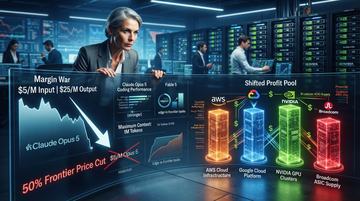
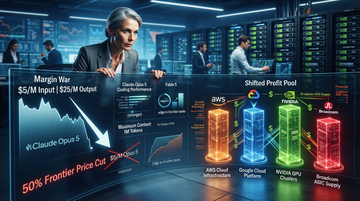
Claude Opus 5 Halves the Frontier Price—and Shifts the Profit Pool to Amazon, Alphabet, and the Chip Stack
Anthropic launched Claude Opus 5 on July 24, 2026 at $5 per million input tokens and $25 per million output tokens, half the price of Fable 5 while claiming comparable overall intelligence and stronger results in coding and knowledge work. The evidence supports a margin war in model APIs, but not full commoditization: Fable retains an edge on some frontier tasks, while distribution, inference efficiency, and agent reliability become more valuable. That shifts bargaining power toward cloud platforms and infrastructure suppliers including Amazon, Alphabet, NVIDIA, and Broadcom.

Bluesky’s Attie Turns the Open Social Graph Into a Research Infrastructure—Not Just Another Feed
Bluesky’s expanded Attie product adds “Quests,” shifting the open AT Protocol from a publishing network into a queryable social-research layer. If enough users and third-party AT Protocol apps adopt it, the capture of value may move away from engagement metrics and toward downstream analytics, decisioning, and model training—while the largest risk is uneven data quality and trust.

Cognition’s Poke Deal Says “Personality” Will Be the New Switch Cost in AI Agents
Cognition is integrating Poke—an AI agent built for everyday “text-first” collaboration—into its Devin coding-agent platform, betting that proactive, human-like interaction can become the retention layer. The move reframes agent competition: when coding capability converges, “personality + memory + interaction design” may determine which agents users keep—and what they can charge.
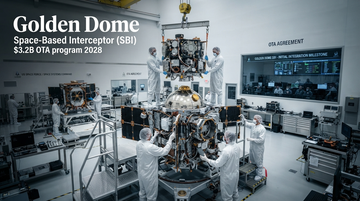
U.S. “Golden Dome” shifts from program hype to a 2028 capacity-and-integration test—timing becomes the real risk
The U.S. Space Force’s Space-Based Interceptor (SBI) awards for Golden Dome lock in a multi-vendor prototype sprint aimed at demonstrating initial capability by 2028. For investors, the key isn’t just who won—it's whether primes and subsystem suppliers can convert those OTA-funded prototypes into integrated, production-relevant capacity as budgets move from planning to deployment.

Embraer’s backlog can’t be a “capacity moat” if suppliers control the delivery clock
Embraer’s backlog hit record levels (total backlog of $32.1B in 1Q26), but the investable question is whether orders convert into near-term deliveries and operating cash. Embraer's cash flow and working-capital profile suggests conversion is possible—but supplier-constrained build slots can still push cash timing out faster than revenue recognition.

Outflows don’t always mean “less risk” — U.S. equity-fund selling can be earnings-caution expressed as repositioning, not de-grossing
For the week through July 15, 2026, long-term U.S. equity funds recorded estimated outflows of $18.10B—an acceleration versus the prior week’s $9.66B. The key market-structure read-through is that this kind of two-week divergence can reflect “risk moving off-exchange” (cash/derivatives hedging or rotating within index/ETF baskets) rather than earnings-risk being fully removed.

FDA’s Split Vote Points to a Winner-Take-Most Compounding Market for Six Peptides—If Safety and Sourcing Controls Stay the Barrier
The FDA’s Pharmacy Compounding Advisory Committee (PCAC) reviewed seven unapproved peptides for potential inclusion on the 503A Bulks List during July 23–24, 2026, with a narrow split that effectively grants a “six-peptide opening” rather than an all-clear. For investors, the real battleground is not demand; it’s who can operationalize compliant sourcing, manufacturing disclosure discipline, and telehealth-adjacent marketing risk controls without running afoul of FDA enforcement.

“Higher Again” Is the Tail: Which Bank Balance Sheets Get Hit First If a Fed Hike Reappears
Recent Fed advocacy turns an expected hold into a non-trivial “renewed-tightening” tail risk, and the balance-sheet transmission path is not linear across lenders. Using bank balance sheet and Fed stress-test design, the key fragility is not just mark-to-market; it’s how quickly funding costs reprice versus how slowly assets run off, which is why large, diversified deposit franchises can look fundamentally safer than duration-lean, funding-sensitive books.

Midjourney just bought Co–Star—because consumer AI needs a habit loop, not just a better model
Midjourney’s acquisition of personalized social astrology app Co–Star signals a shift from “model quality” competition to “retention system” building—identity, context, and interaction loops tied to an ongoing subscription or credit flow. Co–Star already runs on freemium in-app purchases and uses an AI+human workflow to keep users returning with personalized daily/compatibility content, giving Midjourney an engagement layer it didn’t have in its image-generation-first product.

Moody’s Turns AI Capex Into a Credit Risk: Amazon, Meta, and Alphabet Are Now Rated for How Fast They Can Print Free Cash Flow
Moody’s framed the 2026 AI buildout as a shift from “asset-light” to “asset-heavy,” warning it can erode free cash flow and raise balance-sheet risk for major cloud hyperscalers—explicitly including Amazon, Meta, and Alphabet. The market’s real discipline is no longer earnings guidance; it’s the bond market’s willingness to fund capex when cash generation lags construction cycles.
Open-Weight AI’s Next Fight Isn’t About Chips—It’s About Model Vetting as Regulation
At a U.S.-China summit, NVIDIA, Microsoft, and Meta publicly pushed back on “premature restrictions” on open-weight models, arguing that broad limits will push innovation overseas rather than reduce risk. The policy battleground is moving from regulating access to regulating who can run, inspect, and verify weights—because “closed-only” safety claims don’t hold up when models can still be breached or misused.

OpenAI’s Codex Micro Makes a Case for “AI-Native” Input—And It Could Rewire Peripherals Economics
OpenAI’s Codex Micro (a $230, 13-key mechanical keypad) is built to control AI coding agents through agent/status keys, a workflow joystick, and a “reasoning” dial—paired to the ChatGPT desktop app. The financial edge isn’t the first limited-run hardware; it’s whether specialized controls reduce agent workflow friction enough to create a durable peripheral category that shifts device margin and distribution leverage toward platform-linked hardware makers and ecosystem integrators.

Prentis isn’t trying to beat frontier compute—it’s trying to beat venture ROI on “computer-use” labor
Prentis is reportedly in talks to raise ~$100M at a ~$1B valuation, despite being a brand-new AI lab launched in April 2026. The evidence from the fundraising materials and signed contracts points to a very specific bet: it can win enterprise value by lowering the cost of routine white-collar tasks rather than matching hyperscalers’ frontier scale.

UAE gets license-free access to “advanced computing” under EAR—potentially repricing the compliance premium across chip and server supply chains
The U.S. reclassified the UAE under the EAR to Country Group A:5 and expanded license-free/STA eligibility for “advanced computing items,” including AI chips and servers, effective July 10, 2026. For investors, the key question isn’t whether demand rises—it’s whether compliance friction drops fast enough to shorten lead times, shift inventory risk, and compress the “safe routing” discount that sellers used to price into contracts.

Micron’s 2H26 signal suggests AI-memory may be shifting from “scarce bottleneck” toward “managed surplus”
Micron’s latest guidance ties a still-tight DRAM/NAND backdrop to slowing the rate of price increases, which is the first “loosening” hint investors can underwrite against AI infrastructure demand. Using Micron’s own inventory-tightness and pricing-change disclosures, the article frames how upstream (wafer-capacity + HBM/DRAM packaging) and downstream (server memory build cycles) transmit from pricing into capex and margins over 2H26 and beyond.

Starship’s “pause-to-prove” moment reframes the US launch complex’s next-3-year valuation math around cadence, not just cost
Starship’s latest “market-watching” step isn’t a new performance claim—it’s a test of whether the US launch complex can sustain sub-monthly tempo without hidden reliability drag. For listed suppliers of launch hardware and mission assurance, the investment question shifts from theoretical reusability to whether launch providers can win contracts that require repeatable schedules and liability/insurance confidence.
What to expect
Evidence-first notes with a visible point of view.
This section collects sharp takes on earnings, shareholder meetings, and market structure. Each new piece should make the thesis, the facts, and the implications obvious within the first few screens.
Expect direct analysis, not generic commentary.
Expect the data to be explicit and the argument to be easy to follow.
Plutux is not an investment adviser. Market data and AI-generated analysis are for information and education only, not investment advice. Disclaimer