%22%2F%3E%0A%20%20%3Ccircle%20cx%3D%22220%22%20cy%3D%22150%22%20r%3D%22180%22%20fill%3D%22%2322d3ee%22%20fill-opacity%3D%220.12%22%2F%3E%0A%20%20%3Ccircle%20cx%3D%221010%22%20cy%3D%22130%22%20r%3D%22220%22%20fill%3D%22%2338bdf8%22%20fill-opacity%3D%220.08%22%2F%3E%0A%20%20%3Ccircle%20cx%3D%22920%22%20cy%3D%22520%22%20r%3D%22170%22%20fill%3D%22%2322d3ee%22%20fill-opacity%3D%220.06%22%2F%3E%0A%20%20%3Cpath%20d%3D%22M140%20430h920%22%20stroke%3D%22url(%23line)%22%20stroke-width%3D%2212%22%20stroke-linecap%3D%22round%22%2F%3E%0A%20%20%3Cpath%20d%3D%22M220%20360c120-150%20260-220%20380-220s260%2070%20380%20220%22%20fill%3D%22none%22%20stroke%3D%22%2367e8f9%22%20stroke-opacity%3D%220.5%22%20stroke-width%3D%2216%22%20stroke-linecap%3D%22round%22%20stroke-linejoin%3D%22round%22%2F%3E%0A%20%20%3Cpath%20d%3D%22M300%20398h600%22%20stroke%3D%22%2394a3b8%22%20stroke-opacity%3D%220.24%22%20stroke-width%3D%228%22%20stroke-linecap%3D%22round%22%2F%3E%0A%20%20%3Ctext%20x%3D%22220%22%20y%3D%22510%22%20fill%3D%22%23e2e8f0%22%20fill-opacity%3D%220.7%22%20font-family%3D%22Arial%2C%20Helvetica%2C%20sans-serif%22%20font-size%3D%2238%22%20letter-spacing%3D%228%22%3EINSIGHTS%3C%2Ftext%3E%0A%3C%2Fsvg%3E)
Opus 5 input price
$5/M
Per million input tokens on Anthropic's global API pricing, launched July 24, 2026.
Opus 5 output price
$25/M
Per million output tokens, versus $50/M for Fable 5.
Maximum context
1M
One million input tokens on Google Cloud; maximum output is 128,000 tokens.
Price discount to Fable 5
50%
Applies to both input and output list prices.
The verified event
Anthropic Cut Price, Not the Opus Brand
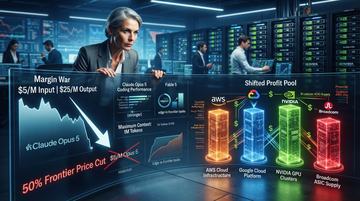
Anthropic released Claude Opus 5 on July 24, 2026 across its own platform, Amazon Bedrock, and Alphabet's Google Cloud. At $5 per million input tokens and $25 per million output tokens, the model cuts Fable 5's list price by 50% while Anthropic describes its overall intelligence as close to Fable 5.
| Model | Input | Output | Output-heavy workload: 1M input + 3M output | What the comparison establishes |
|---|---|---|---|---|
| Claude Fable 5 | $10 | $50 | $160 | Anthropic's higher-priced frontier reference |
| Claude Opus 5 | $5 | $25 | $80 | halves the same workload bill |
| Claude Sonnet 5, promotional through Aug. 31 | $2 | $10 | $32 | Scale tier remains 60% cheaper than Opus 5 |
| Claude Sonnet 5, standard from Sept. 1 | $3 | $15 | $48 | Scale tier remains 40% cheaper than Opus 5 |
Unit economics
A 50% Token Cut Requires Twice the Volume—or Much Lower Inference Cost
At unchanged token consumption, Opus 5 produces half the API revenue of Fable 5. Anthropic therefore needs approximately 2× the paid token volume merely to preserve revenue, before accounting for any difference in serving cost; the price reset raises the utilization hurdle to 2×.
Revenue-preserving token volume after a 50% price cut
Indexed calculation holding workload mix constant; this is an inference from published prices, not company guidance.
Unit: index
Fable 5 baseline volume
Revenue index 100 at Fable pricing
100
Opus 5 required volume
Required to preserve revenue at half the per-token price
200
- If Opus 5 costs roughly half as much to serve, Anthropic can defend gross profit per token despite the price cut; Anthropic has not disclosed model-level inference costs.
- If serving cost falls by less than 50%, each migrated workload compresses gross profit unless lower prices unlock enough incremental usage.
- Long-running agents can generate many more tokens than chat. Lower prices may therefore expand total compute demand despite lower unit revenue.
- Prompt caching and model routing can reduce effective cost further, weakening the importance of headline list price alone.
What becomes commoditized
Intelligence Is Compressing, but Reliability and Distribution Still Carry a Premium
The launch compresses the premium for broadly useful frontier intelligence. It does not make every model interchangeable: Anthropic still positions Fable 5 above Opus 5 overall, while Opus 5 is explicitly not the state of the art for some risky dual-use capabilities. The pricing move commoditizes more everyday frontier work than frontier capability itself.
Where differentiation moves next
Agent reliability
Hours to overnight
AWS says Opus 5 can sustain long-running tasks, recover from errors, and work around obstacles.
Context capacity
1M input / 128K output
Google Cloud's documented limits allow large codebases and document-heavy workflows.
Enterprise controls
Zero data retention
Default on Bedrock and available by request on Claude Platform on AWS.
Cloud reach
AWS and Google Cloud
Day-one availability reduces enterprise procurement friction.
Safety routing
Fallback possible
AWS says higher-risk cyber requests may fall back to Opus 4.8.
- Short term: competitors face pressure to offer credits, routing discounts, or lower list prices before enterprise renewals.
- Over one to three years: model vendors need proprietary workflows, distribution, or measurable task success to defend premium pricing.
- A model that completes a task in fewer retries can remain cheaper even at a higher token price; task economics supersede token price as the durable benchmark.
- The premium tier survives where safety, latency, tool use, or the final few points of accuracy change the economic outcome.
Full supply chain
The Price War Pushes Value Upstream to Compute and Downstream to Cloud Distribution
Anthropic says it trains and runs Claude across Amazon Trainium, Alphabet TPUs, and NVIDIA GPUs; it also expanded its compute partnership with Alphabet and Broadcom. Lower model prices can stimulate token demand, so infrastructure suppliers gain when elasticity lifts total inference volume, even as model-layer revenue per token falls.
| Layer | Company | Verified linkage | Latest operating evidence | Investor transmission |
|---|---|---|---|---|
| Upstream accelerator | NVIDIA | Anthropic names its GPUs as one of Claude's compute platforms | Q1 FY2027 data-center revenue was $75.246B, up 92%; gross margin was 74.9% | More tokens support accelerator demand, but custom chips pressure share and pricing |
| Upstream custom silicon | Broadcom | Named in Anthropic's expanded Google compute partnership | Quarterly semiconductor revenue reached $15.009B, up 79%; consolidated gross margin was 69% | Custom accelerators become more valuable as model vendors optimize cost per token |
| Cloud and Trainium | Amazon | Opus 5 launched on Bedrock; Anthropic uses Trainium | Q1 AWS sales were $37.587B and operating income was $14.161B | Bedrock captures distribution and compute even if Anthropic's own API margin tightens |
| Cloud and TPU | Alphabet | Opus 5 launched on Google Cloud; Anthropic uses TPUs | Q2 Cloud revenue was $24.768B and operating income was $8.814B | Cloud monetizes Claude while TPU deployment improves infrastructure utilization |
| Competing cloud | Microsoft | Azure distributes rival frontier models rather than Opus 5 in the cited launch | Azure revenue grew 40%; Intelligent Cloud revenue reached $34.681B | Lower rival prices pressure Azure's model economics but broaden enterprise AI usage |
| Downstream AI buyer | Meta Platforms | Large-scale AI deployer and frontier-model competitor | Q1 revenue rose 33% to $56.311B; 2026 capex guidance is $125B–$145B | Cheaper frontier intelligence lowers application costs but raises the bar for proprietary models |
Public-company fundamentals
Cloud Vendors Have Margin Cushions; Infrastructure Suppliers Have Concentration Risk
Amazon's AWS generated a 37.7% operating margin in Q1 2026, while Alphabet's Cloud produced a 35.6% margin in Q2. Those margins give both platforms room to bundle models, commit capacity, or absorb temporary price pressure; distribution economics provide more pricing flexibility than a standalone API.
- NVIDIA's 74.9% quarterly gross margin shows the value retained by scarce accelerated-computing supply.
- That strength carries concentration risk: three direct NVIDIA customers represented 21%, 17%, and 16% of quarterly revenue.
- Broadcom's semiconductor growth reflects AI demand, but one distributor represented 42% of quarterly company revenue.
- Alphabet spent $44.9B on capital expenditures in Q2, while Amazon's Q1 cash capex reached $43.2B; the cloud layer is funding the capacity needed for cheaper tokens.
Competitive impact
OpenAI, Alphabet, and Meta Platforms Must Defend More Than Benchmark Scores
The immediate competitive threat is not that every rival must publish an identical $5/$25 rate. It is that buyers now have a credible reference price for high-end coding and knowledge work. Rivals must answer with lower prices, better task completion, faster inference, or tighter product integration; Opus 5 turns undifferentiated benchmark leadership into a weaker pricing moat.
- Alphabet is hedged: Gemini faces price pressure, but Google Cloud and TPUs monetize Anthropic's success.
- Amazon is even more directly aligned because Bedrock distributes Opus 5 and Trainium supplies part of Anthropic's compute base.
- Microsoft benefits from broader AI consumption, yet its filing says AI infrastructure investment and usage already reduced Microsoft Cloud gross margin to 66%.
- Meta Platforms can use cheaper external models as a build-versus-buy benchmark while its $125B–$145B capex plan raises the return hurdle for proprietary AI spending.
- OpenAI is private, so no listed-company fundamentals or verified ticker apply; its pressure is strategic rather than directly investable.
Time horizons
Prices Move First; Architecture and Market Structure Move Later
| Horizon | What should move | Milestone to watch | What would invalidate the thesis |
|---|---|---|---|
| Days to one quarter | Competitor credits, promotional pricing, and router changes | Published API-price responses and enterprise renewal terms | Rivals sustain premiums without losing usage or offering better task economics |
| One to four quarters | Token volume, cloud inference revenue, and utilization | AWS, Google Cloud, and Azure growth versus capex and gross-margin trends | Usage fails to respond enough to lower prices |
| One to three years | Profit shifts toward distribution, custom silicon, and proprietary workflows | Model-level task completion, customer retention, and custom-accelerator adoption | A model vendor rebuilds durable pricing power through unique capability |
The short-term trade is higher price pressure at the model layer and potentially stronger usage across cloud AI platforms. The longer-term thesis requires elasticity: if a 50% price cut causes total paid tokens to more than double, aggregate model revenue can grow; if not, the model layer's economics deteriorate even as infrastructure consumption rises.
Bottom line
This Is a Margin War, but the Casualties Will Not Be Evenly Distributed
Fact: Anthropic halved Fable 5's list price with Opus 5 while claiming near-frontier performance. Inference: high-end model APIs now have less room for benchmark-only premiums, while cloud distribution, custom silicon, and dependable agents gain strategic weight. Speculation: whether the move hurts Anthropic's own margin depends on undisclosed inference cost and demand elasticity; the evidence supports model-layer compression, not industry-wide value destruction.
- Near-term winners: clouds that distribute multiple models and suppliers paid on growing compute volume.
- Near-term pressure points: standalone model providers and premium APIs without measurable task-level superiority.
- Long-term winners: platforms that combine low inference cost, enterprise distribution, and workflow lock-in.
- Core risk: cheaper models may optimize away tokens or shift workloads to custom chips, so NVIDIA volume can grow while accelerator share declines.
Investable Read-Through
- Bedrock distributes Opus 5 while Trainium supplies Claude compute, so Amazon captures both inference and platform demand.
- AWS Q1 sales grew 28% to $37.587B, providing scale for near-term price-led usage growth.
- Over one to three years, cheaper agents can improve utilization; $43.2B of Q1 cash capex makes returns on capacity the key risk.
- Google Cloud hosts Opus 5 and Anthropic runs Claude on TPUs, so Alphabet monetizes Claude even when Gemini loses a workload.
- Q2 Cloud revenue was $24.768B with a 35.6% operating margin, creating room to compete on price.
- The one-to-three-year risk is capital intensity: Q2 capex reached $44.9B.
- Anthropic uses NVIDIA GPUs, and lower token prices can lift near-term inference demand.
- Q1 FY2027 data-center revenue rose 92% to $75.246B, while gross margin reached 74.9%.
- Over one to three years, custom TPU and Trainium adoption threatens share even as total compute expands.
- Anthropic's expanded partnership with Google and Broadcom links custom silicon directly to Claude's cost curve.
- Quarterly semiconductor revenue rose 79% to $15.009B, and AI demand helped lift consolidated gross margin to 69%.
- Over one to three years, model price pressure accelerates demand for lower-cost custom accelerators; 42% distributor concentration is the counter-risk.
- Azure revenue grew 40%, so broader AI adoption can lift near-term cloud consumption.
- Microsoft Cloud gross margin fell to 66% as AI infrastructure investment and usage increased.
- If Opus 5 resets market prices, rival-model economics compress margins before utilization catches up.
- Cheaper frontier APIs lower the external cost benchmark for Meta Platforms's products.
- Q1 revenue rose 33% to $56.311B, giving the company funding capacity for AI deployment.
- Its $125B–$145B 2026 capex plan faces a higher return hurdle as model prices fall over the next one to three years.