%22%2F%3E%0A%20%20%3Ccircle%20cx%3D%22220%22%20cy%3D%22150%22%20r%3D%22180%22%20fill%3D%22%2322d3ee%22%20fill-opacity%3D%220.12%22%2F%3E%0A%20%20%3Ccircle%20cx%3D%221010%22%20cy%3D%22130%22%20r%3D%22220%22%20fill%3D%22%2338bdf8%22%20fill-opacity%3D%220.08%22%2F%3E%0A%20%20%3Ccircle%20cx%3D%22920%22%20cy%3D%22520%22%20r%3D%22170%22%20fill%3D%22%2322d3ee%22%20fill-opacity%3D%220.06%22%2F%3E%0A%20%20%3Cpath%20d%3D%22M140%20430h920%22%20stroke%3D%22url(%23line)%22%20stroke-width%3D%2212%22%20stroke-linecap%3D%22round%22%2F%3E%0A%20%20%3Cpath%20d%3D%22M220%20360c120-150%20260-220%20380-220s260%2070%20380%20220%22%20fill%3D%22none%22%20stroke%3D%22%2367e8f9%22%20stroke-opacity%3D%220.5%22%20stroke-width%3D%2216%22%20stroke-linecap%3D%22round%22%20stroke-linejoin%3D%22round%22%2F%3E%0A%20%20%3Cpath%20d%3D%22M300%20398h600%22%20stroke%3D%22%2394a3b8%22%20stroke-opacity%3D%220.24%22%20stroke-width%3D%228%22%20stroke-linecap%3D%22round%22%2F%3E%0A%20%20%3Ctext%20x%3D%22220%22%20y%3D%22510%22%20fill%3D%22%23e2e8f0%22%20fill-opacity%3D%220.7%22%20font-family%3D%22Arial%2C%20Helvetica%2C%20sans-serif%22%20font-size%3D%2238%22%20letter-spacing%3D%228%22%3EINSIGHTS%3C%2Ftext%3E%0A%3C%2Fsvg%3E)
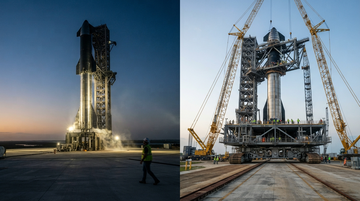
Verified event • reliability/tempo • investment transmission mechanism
The market-watching signal is not “another test”—it’s the credibility of launch tempo
When investors obsess over rockets, they usually start with cost per flight. But pricing power, slot value, and contract eligibility in the US launch complex depend on something harder to model: repeatable cadence that survives mishaps.
What we can verify about the latest “market-watching” moment
Cadence constraint
7-month gap since last flight
ArsTechnica reports Starship “has not flown in seven months.” (Primary source opened)
Why the market watches anyway
Next steps target a faster operating rhythm
Same report frames the program’s tempo goal and how commercial customers are waiting on availability windows.
Immediate mechanism to monitor
Whether integration readiness produces stable outcomes
The report ties prior setbacks to schedule/availability, making “tempo without hidden failures” the investable variable.
In other words, this isn’t about whether Starship can reach orbit once—it’s about whether it can reach orbit often enough, on time often enough, that downstream customers will sign multi-launch plans that assume predictable launch availability.
Facts first • what happened • why it matters
Reliability history turned “tempo” into the binding variable the US launch complex prices
ArsTechnica characterizes Starship’s progress as mixed and highlights major setbacks in 2025, including consecutive incidents where control was lost during ascent and both upper stage and Super Heavy failed to return safely on a key flight.
- has not flown for seven months, which forces commercial customers to keep their delivery schedules on legacy assumptions (per ArsTechnica).
- had severe 2025 setbacks that created multi-month standdowns, making “schedule as a risk” more important than any single success (per ArsTechnica).
- SpaceX’s plan to raise cadence is acknowledged, but the US market has to wait for cadence proof, not cadence announcements (per ArsTechnica’s context on 2025 cadence goals and commercial availability expectations).
Supply-chain map • upstream ↔ downstream • where “cadence” transmits
How tempo flows through the launch supply chain (and why it changes equity repricing)
Cadence shows up first in procurement behavior: if a provider believes the rocket will fly more often, it buys hardware and services for throughput, not one-off integration. If it’s uncertain, it buys “wait-and-see,” which delays order timing, margin expansion, and backlog conversion.
| Supply-chain layer | What investors normally track | What cadence actually changes | Investment implication |
|---|---|---|---|
| Upstream propulsion / structures / avionics | Cost-down trajectory per flight | order cadence and qualification throughput (how many vehicles/components are being built/replaced per year) | Backlog quality improves when schedules become repeatable; otherwise projects get pushed. |
| Midstream launch operations / integration sites | Launch capability headlines | Pad readiness tempo (how often the site can cycle without extended downtime) | More consistent operations supports higher utilization assumptions and better margin visibility. |
| Downstream mission assurance / customers | Payload feasibility | Contract eligibility for customers that require predictable schedule windows and fewer schedule-level penalties | Repeatable tempo can shift award decisions toward US providers with assured launch availability. |
| Risk transfer (insurance / liability) | Per-flight insurance premiums (often headline-only) | expected cost of delay and mishap tail risk embedded in contract terms | If insurers and customers regain confidence, the “schedule premium” can compress over time. |
US launch complex context • who benefits when cadence becomes credible
When the market believes tempo, the “slot value” of the US launch complex rises—fast
ArsTechnica’s framing implies commercial customers may not see broad availability until later in the decade—meaning the next investment cycle depends on whether SpaceX’s cadence target can convert from engineering milestones into launch-frequency reality.
Verified tempo gap
7 months
Starship “has not flown in seven months” (ArsTechnica)
Baseline reliability framing
Mixed
ArsTechnica describes a “decidedly mixed record of success” with major setbacks in 2025
Fundamentals • what to check in public comparables • where the data usually misses
For listed launch suppliers, the “Starship cadence” bet shows up in backlog conversion, not just revenue growth
SpaceX is private, so the clean valuation linkage is indirect. The listed-equity way to test the thesis is to watch for: (1) order timing tied to higher integration throughput, (2) margin expansion consistent with utilization, and (3) risk-transfer improvements that let customers commit to multi-launch plans.
- Look for supplier commentary that ties awards to operational tempo requirements, not only payload milestones.
- Watch segment-level backlog conversion: if cadence becomes credible, projects shift from “optionality” to repeatable delivery cadence (more revenue visibility).
- Track quality metrics in risk/mission assurance spend: cadence credibility can reduce schedule penalties, which shows up as lower “expected cost of delay.”
Horizons • short-term vs long-term
Short-term: confirmation that tempo holds after launch integration work; long-term: pricing power shifts from legacy rockets to repeatability
- Near-term (days–quarters): expect headline moves to follow reliability/FAA status and pad/stack readiness logic; market repricing should track reduced schedule uncertainty before it tracks cost-per-kg optimism.
- Long-term (1–3 years): the thesis only survives if cadence becomes “contractable,” i.e., customers can plan multi-launch schedules without building in large schedule buffers. That’s when slot value and utilization assumptions rise across the complex.
Synthesis • the investable thesis
Thesis: Starship’s valuation pressure point is the reliability tail that determines whether cadence becomes financeable
The latest “market-watching” moment changes the valuation math because it forces investors to price a different question: not “can Starship fly,” but can Starship sustain enough successful, timely flights that downstream contracts stop discounting schedule risk.
For the US launch complex, that matters because cadence credibility shifts expected utilization and backlog conversion from “option value” to “committed throughput.” Listed suppliers then re-rate as the market builds confidence that the launch architecture can become a repeatable industrial service rather than a test-flight program.
Listed US equities with credible linkage to US launch-cadence confidence
- If cadence credibility in the US improves, Rocket Lab USA Inc can face more competitive pricing pressure, but backlog can also improve if contract awards require reliable schedules (directional, cadence-driven demand).
- Near-term, mishap-linked schedule uncertainty in the broader market can delay customer commitments; later, repeatable launch availability can stabilize medium-term order flow.
- If Starship reduces schedule risk for commercial users, some demand may shift away from legacy trajectories, pressuring growth assumptions in launch-adjacent offerings.
- If cadence becomes “financeable,” Lockheed Martin Corporation can benefit indirectly through more stable government/commercial integration pipelines, but timing depends on procurement cycles.
- Boeing is sensitive to aerospace program timing; if US launch tempo increases, supplier utilization assumptions can improve but the linkage to Starship cadence is indirect and depends on contracts awarded.
- Near-term repricing likely remains muted until procurement announcements translate into segment backlog; watch for launch-tempo driven contract visibility in disclosures.
- The event is a private-company reliability/tempo signal, so listed proxy data is limited; still, cadence credibility should drive forward valuation expectations as customers can plan repeatable launches.
- Near-term price action (if/when more trading data exists for the proxy) should track whether Starship reduces the probability of further long pauses; the tail risk is the key variable.