%22%2F%3E%0A%20%20%3Ccircle%20cx%3D%22220%22%20cy%3D%22150%22%20r%3D%22180%22%20fill%3D%22%2322d3ee%22%20fill-opacity%3D%220.12%22%2F%3E%0A%20%20%3Ccircle%20cx%3D%221010%22%20cy%3D%22130%22%20r%3D%22220%22%20fill%3D%22%2338bdf8%22%20fill-opacity%3D%220.08%22%2F%3E%0A%20%20%3Ccircle%20cx%3D%22920%22%20cy%3D%22520%22%20r%3D%22170%22%20fill%3D%22%2322d3ee%22%20fill-opacity%3D%220.06%22%2F%3E%0A%20%20%3Cpath%20d%3D%22M140%20430h920%22%20stroke%3D%22url(%23line)%22%20stroke-width%3D%2212%22%20stroke-linecap%3D%22round%22%2F%3E%0A%20%20%3Cpath%20d%3D%22M220%20360c120-150%20260-220%20380-220s260%2070%20380%20220%22%20fill%3D%22none%22%20stroke%3D%22%2367e8f9%22%20stroke-opacity%3D%220.5%22%20stroke-width%3D%2216%22%20stroke-linecap%3D%22round%22%20stroke-linejoin%3D%22round%22%2F%3E%0A%20%20%3Cpath%20d%3D%22M300%20398h600%22%20stroke%3D%22%2394a3b8%22%20stroke-opacity%3D%220.24%22%20stroke-width%3D%228%22%20stroke-linecap%3D%22round%22%2F%3E%0A%20%20%3Ctext%20x%3D%22220%22%20y%3D%22510%22%20fill%3D%22%23e2e8f0%22%20fill-opacity%3D%220.7%22%20font-family%3D%22Arial%2C%20Helvetica%2C%20sans-serif%22%20font-size%3D%2238%22%20letter-spacing%3D%228%22%3EINSIGHTS%3C%2Ftext%3E%0A%3C%2Fsvg%3E)
What changed
A successful military launch is now a cadence story, not a novelty story.
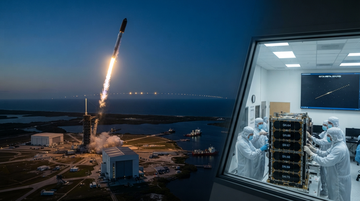
SpaceX launched 21 satellites for the U.S. Space Development Agency's Tranche 1 Transport Layer from Vandenberg on July 16, and the mission took the constellation to roughly half of its planned size.
That is the important part. One launch can be a headline; half a network is a program. Once 63 of 126 satellites are in orbit, the launch provider is increasingly judged on rhythm, reliability, and ability to hit a schedule.
The market implication is simple: cadence is becoming the moat.
Why it matters
The defense stack pays for schedule integrity, not just hardware.
That matters to SpaceX, but it also matters to the satellite builders and defense primes that sit one layer up the chain. Lockheed Martin and Northrop Grumman are part of the buildout, while Rocket Lab has to compete in a market where launch cadence and responsive access are increasingly important procurement features.
It also tells investors that space is not just a story about one-off test flights. The real addressable market is in recurring government payloads, data transport, and integrated orbital services.
For the broader market, this is another reminder that defense and space exposure now looks more like an industrial subscription model than a pure lunar-shot story.
| Layer | What changes | Why investors care |
|---|---|---|
| Launch provider | More launches, more routine | Recurring revenue becomes more visible |
| Satellite builders | More missions to fill | Production planning matters more |
| Defense buyer | More operational coverage | The constellation becomes a service |
| Competitors | Higher bar for schedule | Cadence is hard to replicate |
Read-through
The 21-satellite mission matters because it is one more proof that commercial launch has become infrastructure.
That is why the launch is interesting even beyond the military customer. The market is watching whether launch companies can behave like utility providers: repeatable, schedulable, and integrated with a network rather than a one-off spectacle.
The business model implications spread from launch to constellation management, from satellite manufacturing to downstream data services. In other words, the launch is the first line item in a larger orbital P&L.
And if SpaceX keeps executing like this, public-market investors will keep comparing it not just with other space names, but with the best recurring infrastructure businesses in industrials and defense.
The constellation is now halfway built
The launch numbers are the clearest evidence that cadence, not spectacle, is the moat.
Unit: satellites
Launched satellites
Latest mission
21
Satellites in orbit
Half of the planned network
63
Planned satellites
Full Tranche 1 target
126
Bottom line
SpaceX's edge is no longer just that it can launch. It is that it can keep launching on schedule.
That difference matters for how the market values the space stack.
When launch becomes repeatable, the business starts to look more like industrial infrastructure and less like a single-event trade.
That is the difference between a headline and an operating model.