Latest
The day's market news, with the argument attached
New notes every trading day on earnings, policy and market structure. Each one opens with the conclusion, then the evidence, then the companies it hits.
2026-08-15
%22%2F%3E%0A%20%20%3Ccircle%20cx%3D%22220%22%20cy%3D%22150%22%20r%3D%22180%22%20fill%3D%22%2322d3ee%22%20fill-opacity%3D%220.12%22%2F%3E%0A%20%20%3Ccircle%20cx%3D%221010%22%20cy%3D%22130%22%20r%3D%22220%22%20fill%3D%22%2338bdf8%22%20fill-opacity%3D%220.08%22%2F%3E%0A%20%20%3Ccircle%20cx%3D%22920%22%20cy%3D%22520%22%20r%3D%22170%22%20fill%3D%22%2322d3ee%22%20fill-opacity%3D%220.06%22%2F%3E%0A%20%20%3Cpath%20d%3D%22M140%20430h920%22%20stroke%3D%22url(%23line)%22%20stroke-width%3D%2212%22%20stroke-linecap%3D%22round%22%2F%3E%0A%20%20%3Cpath%20d%3D%22M220%20360c120-150%20260-220%20380-220s260%2070%20380%20220%22%20fill%3D%22none%22%20stroke%3D%22%2367e8f9%22%20stroke-opacity%3D%220.5%22%20stroke-width%3D%2216%22%20stroke-linecap%3D%22round%22%20stroke-linejoin%3D%22round%22%2F%3E%0A%20%20%3Cpath%20d%3D%22M300%20398h600%22%20stroke%3D%22%2394a3b8%22%20stroke-opacity%3D%220.24%22%20stroke-width%3D%228%22%20stroke-linecap%3D%22round%22%2F%3E%0A%20%20%3Ctext%20x%3D%22220%22%20y%3D%22510%22%20fill%3D%22%23e2e8f0%22%20fill-opacity%3D%220.7%22%20font-family%3D%22Arial%2C%20Helvetica%2C%20sans-serif%22%20font-size%3D%2238%22%20letter-spacing%3D%228%22%3EINSIGHTS%3C%2Ftext%3E%0A%3C%2Fsvg%3E)

2026-08-14

Apple's Mac mini Texas shift turns “Made in USA” into a COGS experiment — and it flows through EMS more than patriotism
Apple opened its Houston Advanced Manufacturing Center on Aug. 13, 2026 and tied it to starting Mac mini production “later this year” in Texas, marking the first time the Mac mini is made in the U.S. for sale. The investment matters to margins only if the higher-cost U.S. assembly footprint can be neutralized via supplier localization, logistics control, and tariff-avoidance—an outcome the first steady-state volume run will test.

Apple’s China AI pivot: training its own China model with Alibaba help reframes who captures the iPhone margin
Reuters reports Apple has trained a large language model specifically for China, using Alibaba support—rather than leaning solely on Alibaba’s Qwen. The shift doesn’t remove Qwen; it changes Apple’s leverage in China regulatory clearance, reduces “vendor dependency,” and forces investors to reassess how China AI dollars split between the device platform and the model provider.

Apple turning Siri news into a paid licensing product—shifting the AI news war toward “distribution economics”
A new report says Apple is in talks to pay publishers for current news used by an upgraded Siri, including a proposed variable, per-use style structure. If that becomes real, it validates “assistant licensing” as publisher revenue and reframes competition: premium outlets gain a new direct channel, while Alphabet and Microsoft face a harder content-cost baseline when answers route through Apple devices.

Bending Spoons's FY26 revenue miss turns the leveraged app roll-up into a rates test
After Bending Spoons guided FY2026 revenue to $2.78B–$2.82B, the market treated the first public guidance stress as leverage’s real cost. With interest expense already large versus operating income, the model’s survival depends on keeping organic growth near trend while debt service doesn’t expand faster than operating profit.

Bristol-Myers Squibb's Zenbexus flips the myeloma bet: one MRD endpoint, a 2x-to-41% hurdle
On Aug. 13, 2026, the FDA granted accelerated approval for Bristol-Myers Squibb's iberdomide (Zenbexus) in combination therapy for multiple myeloma, anchored to a major MRD-negative complete response endpoint. For investors, the key question isn’t whether Zenbexus “enters the market”—it’s whether this first CELMoD label can shift the post-Revlimid growth narrative fast enough to matter before market expectations fully price in a crowded daratumumab-centric landscape.
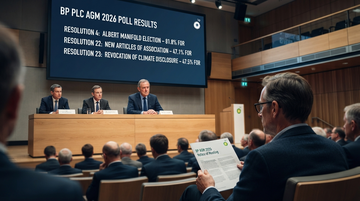
BP’s AGM vote didn’t just reject resolutions—it pressured the company to defend its climate governance and capital discipline trade-off in front of the market
At BP’s AGM on 23 April 2026, shareholders rejected three key contested items (resolutions 22, 23, and 24), including moves tied to climate disclosure and project-level reporting. The pattern matters for investors because it tests whether BP can keep funding shareholder returns while simplifying governance—without losing the institutional consensus that supports supermajor capital-return frameworks.

Broadcom gets repriced because AI capex financing is now leaking into its own backlog math
Investors punished Broadcom because the market started treating customer financing terms as a backlog-quality problem—not just a data-center operator balance-sheet issue. The result is a sharper linkage between chip delivery cadence and how easily customers can fund the next wave of AI hardware, with meaningful implications for 1–3 year revenue timing and near-term order visibility.

The COMEX–LME copper spread is pricing tariff odds months before policy headlines—here’s who reprices first
A niche trade—using the COMEX–LME copper spread to infer U.S. refined-copper tariff expectations—has become a leading “policy gauge” rather than a pure commodity signal. When the spread widens, it compresses arbitrage between U.S.-delivered and London-priced copper, pulling forward capital-market and physical-trade decisions first for copper producers with U.S. exposure and for import-sensitive buyers.

Databricks’ $190B “demand cap” doesn’t look like hype—it looks like a valuation ceiling being negotiated with discipline
Databricks closed a $5B strategic round at a $190B valuation, essentially plateauing versus its prior $188B Coatue-led round weeks earlier. With the company still positioning the raise around multi-AI product execution and “massive customer demand,” the market signal shifts from paying up for scarcity to rationing supply when investor appetite runs ahead of what management actually wants to sell.

DeepSeek’s “Everything is a plugin” move commoditizes the agent-harness layer—at the exact moment coding agents are switching from features to infrastructure
DeepSeek has open-sourced an agent harness (“DeepSeek Harness v0.1”) built on a single abstraction: “Everything is a plugin,” aiming to turn the agent-execution layer into a reusable, swappable framework. That matters to investors because it shifts differentiation away from “which model” and toward orchestration, integrations, and distribution—pressuring the business models of closed, harness-adjacent tooling while accelerating a tooling ecosystem that incumbents can still monetize.

DeepSeek’s V4 Pro GA rollout shifts the price floor—while V4-Flash quietly becomes the default for agent work
DeepSeek moved V4 Pro into general availability with a new peak/off-peak pricing schedule starting Aug. 16, 2026. The twist: the much cheaper V4-Flash is positioned to outperform or match on agent-style evaluations, turning the flagship’s benchmark lull into a monetization reset that favors capacity-efficient, lower-cost inference.

FTC’s Epic probe targets the EHR gatekeeper’s leverage—an interoperability shift that could reprice payer data deals and speed health-AI training timelines
The FTC has opened an antitrust investigation into Epic Systems and is seeking information about how it grants or withholds access to health records. The key investor question is not whether Epic is “pro-” or “anti-” AI—it’s whether enforcement tightens the practical meaning of interoperability, changing bargaining power and data availability for payers and health-data platforms.

GLM-5.3’s “leak” likely proves one thing: China’s open-weight speed collides with Washington’s frontier-model pre-review window
A wave of early GLM-5.3 chatter is surfacing ahead of an Aug. 9–25 window, but Zhipu has not publicly confirmed a GLM-5.3 release or open-weight artifact. The strategic crux is policy timing: the U.S. executive order on frontier AI introduces a federal pre-release access concept described as up to a 30-day window, which would reward labs that can ship and distribute open weights faster than review can be completed.

Goldman’s “quality” call is breaking as AI-capex credit stress peaks: BBBs (not AAs) are where supply pain is landing
Goldman’s Aug 13–14 positioning argues that investors leaning hardest into the “highest-rated” corporate debt bucket may be underestimating spread and duration sensitivity while AI-driven debt supply concentrates issuance pressure. At the same time, Goldman’s AI-credit work shows debt-financed hyperscaler capex is set to rise and peak in 2027—tightening the link between rating quality, refinancing timing, and who actually gets paid in a higher-for-longer regime.

The market just priced the Iran oil-shock “fade.” The US plan due next week re-prices the term premium—and shipping risk—before crude ever fully turns
A White House “economic isolation” approach for Iran—paired with continued pressure at Hormuz—reintroduces an anxiety channel the market already tried to dismiss: higher risk premia in rates and energy transportation costs. The immediate trade is less about another WTI headline and more about whether financial isolation again makes future barrels costlier to move and insure.
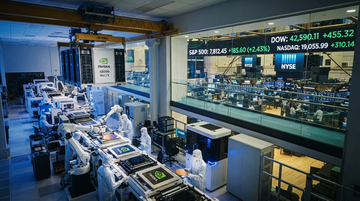
Flat July PPI + the first 7,800 S&P close reset September: the “hawkish-hold” trade dies, but only because AI/tech keeps leading
July CPI held at a 3.4% pace and July PPI was flat, removing the inflation “re-acceleration” trigger markets had been pricing for September. With the S&P 500 closing above 7,800 for the first time, the market’s disinflation rotation reasserted itself—yet the leadership is still concentrated in AI/semiconductor beta, not cyclicals.

Retail sales just posted their first m/m dip in months—turning “slowing, not breaking” into a live September Fed pricing problem
The U.S. retail sales report for July showed total sales falling 0.6% m/m to $763.6B, shifting the macro debate from “cooling demand” to “possible consumer crack.” With one week separating this print from a -23K July payrolls shock, the burden of proof for September rate cuts moves to whether ex-price, ex-inventory strength can reassert quickly—and which consumer names reprice first.

Kontoor’s Denim Rerate: Why UBS’s ~70% Upside Is Betting on a Turn From “Declining Brand” to Higher-Quality Cash Returns
UBS lifted its target on Kontoor Brands to $136, implying roughly mid-to-high 60s% upside from the prior close, arguing the Wrangler and Helly Hansen franchise can grow while margins expand. The market’s bigger question is whether Kontoor is being priced like a mature, fading denim label—or like a simpler apparel cash compounder as Lee is exited and share repurchases accelerate.

Morgan Stanley's gold-to-silver shift reframes the safe-haven trade into an industrial bet
Morgan Stanley says gold is increasingly behaving like a risk asset rather than a portfolio diversifier, while pointing to silver as the metal with “real reasons to rally.” For miners and investors, the implication is a supply-chain rotation: gold hedges face a more saturated macro setup, while silver’s tight multi-year balances and industrial demand (notably solar) can re-price both upstream (silver miners’ cash flows) and downstream hedging demand.
What to expect
Evidence-first notes with a visible point of view.
This section collects sharp takes on earnings, shareholder meetings, and market structure. Each new piece should make the thesis, the facts, and the implications obvious within the first few screens.
Expect direct analysis, not generic commentary.
Expect the data to be explicit and the argument to be easy to follow.
Plutux is not an investment adviser. Market data and AI-generated analysis are for information and education only, not investment advice. Disclaimer