%22%2F%3E%0A%20%20%3Ccircle%20cx%3D%22220%22%20cy%3D%22150%22%20r%3D%22180%22%20fill%3D%22%2322d3ee%22%20fill-opacity%3D%220.12%22%2F%3E%0A%20%20%3Ccircle%20cx%3D%221010%22%20cy%3D%22130%22%20r%3D%22220%22%20fill%3D%22%2338bdf8%22%20fill-opacity%3D%220.08%22%2F%3E%0A%20%20%3Ccircle%20cx%3D%22920%22%20cy%3D%22520%22%20r%3D%22170%22%20fill%3D%22%2322d3ee%22%20fill-opacity%3D%220.06%22%2F%3E%0A%20%20%3Cpath%20d%3D%22M140%20430h920%22%20stroke%3D%22url(%23line)%22%20stroke-width%3D%2212%22%20stroke-linecap%3D%22round%22%2F%3E%0A%20%20%3Cpath%20d%3D%22M220%20360c120-150%20260-220%20380-220s260%2070%20380%20220%22%20fill%3D%22none%22%20stroke%3D%22%2367e8f9%22%20stroke-opacity%3D%220.5%22%20stroke-width%3D%2216%22%20stroke-linecap%3D%22round%22%20stroke-linejoin%3D%22round%22%2F%3E%0A%20%20%3Cpath%20d%3D%22M300%20398h600%22%20stroke%3D%22%2394a3b8%22%20stroke-opacity%3D%220.24%22%20stroke-width%3D%228%22%20stroke-linecap%3D%22round%22%2F%3E%0A%20%20%3Ctext%20x%3D%22220%22%20y%3D%22510%22%20fill%3D%22%23e2e8f0%22%20fill-opacity%3D%220.7%22%20font-family%3D%22Arial%2C%20Helvetica%2C%20sans-serif%22%20font-size%3D%2238%22%20letter-spacing%3D%228%22%3EINSIGHTS%3C%2Ftext%3E%0A%3C%2Fsvg%3E)
Event: consumer electronics reshoring, with a hard COGS test
Apple made “Made in USA” measurable: Mac mini assembly starts in Houston “later this year”
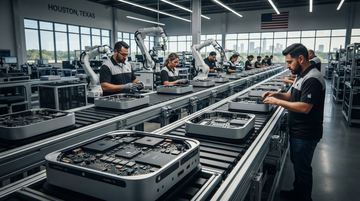
On Aug. 13, 2026, Apple opened its Houston Advanced Manufacturing Center and linked it to new local electronics production. The company said the Houston facility will be where it begins manufacturing Mac mini desktop computers in the U.S. “later this year,” and it positioned the move as part of a broader buildout of U.S. manufacturing operations in Houston.
This is strategically different from smaller, slower pilot runs: the company described a facility expansion and a training component, implying an attempt to scale beyond a one-off assembly trial. Importantly, the announcement timeframe is what makes it an investor-relevant “first run”: once production ramps, the economics show up in reported cost structure and—more immediately—inside the supply chain’s order flows and utilization.
What this implies for margins
The COGS math question: where the tariff relief must land to keep gross margin from slipping
For a desktop like Mac mini, the assembly location changes only a slice of total product cost. Apple’s gross margin is resilient historically, but even modest mix shifts can matter at scale. The key investor question is whether the Texas move reduces the tariff/cost “all-in” burden more than it increases labor, compliance, and overhead per unit in U.S. assembly.
Q3 FY2026 revenue
$109.4B
Apple Form 10-Q (fiscal Q3 FY2026, filed Jul 31, 2026)
Q3 FY2026 cost of revenue
$54.6B
Apple Form 10-Q (fiscal Q3 FY2026, filed Jul 31, 2026)
Q3 FY2026 gross profit
$54.8B
Apple Form 10-Q (fiscal Q3 FY2026, filed Jul 31, 2026)
TTM gross profit margin
48.7%
Computed from Apple trailing totals used in Apple’s latest quarterly/TTM metrics feed shown with the same period context as the most recent balance/income views
The supply-chain lens is decisive: if tariffs are the driver, the benefit must offset the landed cost increase of U.S. assembly. That means any “savings” from tariff avoidance (or tariff uncertainty hedging) has to be large enough compared with incremental U.S. production overhead, plus transition costs while the line ramps.
Full supply chain, not just assembly
Value will concentrate in EMS execution and component logistics, not in the ribbon-cutting
A reshoring benchmark only works if upstream parts procurement and onsite build coordination scale cleanly. The Mac mini bill of materials still depends on semiconductors and core modules that often originate outside the U.S., so the largest immediate “relocation” effect is usually in (1) final assembly/test, (2) subassembly consolidation, and (3) inbound logistics control (faster line-side replenishment reduces safety stock).
- If the Texas site can qualify enough local/near-local subassemblies, the company can improve line-side throughput and reduce work-in-progress as ramp stabilizes.
- If U.S. assembly captures tariff avoidance while key components remain sourced globally, the benefit must come from rules of origin and product classification, not from moving every chip.
- If suppliers can’t lock delivery reliability to the Houston schedule, ramp slips and COGS per unit rises during the ramp window via higher scrap/rework and idle time.
Short-term vs long-term: what to watch next
The first “Made in USA” volume run will show up as (i) utilization and (ii) procurement shift, then (iii) margin stability
Short-term (days to quarters): the early signal won’t be in Apple’s headline gross margin; it will be in whether production starts on schedule, whether supplier orders stick to plan, and whether the Houston site shows stable throughput. Any slip could show up quickly as higher internal costs tied to ramp inefficiency.
Long-term (1–3 years): the durable outcome comes from supplier ecosystem densification. If Apple can deepen U.S. or North America sourcing around the assembled product’s final steps (and/or maintain tariff relief at scale), the reshoring becomes a structural cost advantage instead of a periodic subsidy-funded bet.
Linked public-market beneficiaries
Where the reshoring benchmark should transmit: EMS and contract manufacturing with Apple-grade programs
Apple doesn’t disclose its Mac mini manufacturing partner network in the primary announcement, but the economics of a higher-cost final-assembly location usually flow through contract manufacturers and their supply chains: they bear ramp execution, line balancing, and supplier coordination. The most directly exposed listed plays are EMS providers with the scale and customer-management capability to run complex product builds and scale them reliably.
| Link in the chain | What changes when assembly moves to Texas | Why it matters for listed EMS/contract players |
|---|---|---|
| Final assembly/test | Higher U.S. labor/overhead per unit during ramp, then lower variance if utilization stabilizes | Utilization and yield drive margin; execution quality determines whether contract economics improve |
| Subassembly coordination | Consolidation of intermediate steps to match Houston line takt time | Supplier scheduling and kitting quality shift revenue quality and working-capital needs |
| Inbound logistics | Faster replenishment reduces safety stock and can tighten cash conversion | Improves supply-chain cash efficiency—especially when volumes ramp |
Likely listed beneficiaries to track
- Sanmina benefits if Apple-like programs expand in U.S. final assembly, because EMS share rises with the need for higher-touch manufacturing execution.
- Sanmina stands to gain from ramp stabilization incentives (less scrap, steadier takt), which typically improves contracted service margins within 1–2 quarters.
- If Apple’s Houston ramp creates incremental test/customization work, Sanmina’s U.S. operational complexity demand increases rather than only hardware assembly volume.
- Flex is a proxy for EMS scale benefiting from tariff-driven localization, because programs that shift final assembly need contract capacity and supply-chain coordination.
- If local production raises the importance of logistics and repair/return handling, Flex’s service mix can tilt higher over the next 1–3 years.
- If ramp inefficiency forces rework, Flex could absorb near-term utilization volatility before stabilizing.
- Quanta deserves watch status because Apple’s announced Houston build also covers advanced server operations, and Apple-grade reliability requirements can pull more contract engineering capacity.
- If Apple extends Texas manufacturing beyond Mac mini into additional complex modules, Quanta-like capacity demand could rise over 1–2 years (still unconfirmed in public filings).
- If the Mac mini move stays narrowly tied to final assembly rather than complex module redesign, Quanta’s direct revenue impact may remain limited.
- Foxconn is the closest listed proxy for the Houston assembly execution because the Mac mini Texas plan is described as production moving to a Foxconn facility.
- If throughput reaches steady-state, contract manufacturing revenue quality should improve within quarters via yield and line utilization gains.
- If tariff rules of origin change the economics mid-ramp, Foxconn faces reconfiguration risk before the economics fully stabilize.