%22%2F%3E%0A%20%20%3Ccircle%20cx%3D%22220%22%20cy%3D%22150%22%20r%3D%22180%22%20fill%3D%22%2322d3ee%22%20fill-opacity%3D%220.12%22%2F%3E%0A%20%20%3Ccircle%20cx%3D%221010%22%20cy%3D%22130%22%20r%3D%22220%22%20fill%3D%22%2338bdf8%22%20fill-opacity%3D%220.08%22%2F%3E%0A%20%20%3Ccircle%20cx%3D%22920%22%20cy%3D%22520%22%20r%3D%22170%22%20fill%3D%22%2322d3ee%22%20fill-opacity%3D%220.06%22%2F%3E%0A%20%20%3Cpath%20d%3D%22M140%20430h920%22%20stroke%3D%22url(%23line)%22%20stroke-width%3D%2212%22%20stroke-linecap%3D%22round%22%2F%3E%0A%20%20%3Cpath%20d%3D%22M220%20360c120-150%20260-220%20380-220s260%2070%20380%20220%22%20fill%3D%22none%22%20stroke%3D%22%2367e8f9%22%20stroke-opacity%3D%220.5%22%20stroke-width%3D%2216%22%20stroke-linecap%3D%22round%22%20stroke-linejoin%3D%22round%22%2F%3E%0A%20%20%3Cpath%20d%3D%22M300%20398h600%22%20stroke%3D%22%2394a3b8%22%20stroke-opacity%3D%220.24%22%20stroke-width%3D%228%22%20stroke-linecap%3D%22round%22%2F%3E%0A%20%20%3Ctext%20x%3D%22220%22%20y%3D%22510%22%20fill%3D%22%23e2e8f0%22%20fill-opacity%3D%220.7%22%20font-family%3D%22Arial%2C%20Helvetica%2C%20sans-serif%22%20font-size%3D%2238%22%20letter-spacing%3D%228%22%3EINSIGHTS%3C%2Ftext%3E%0A%3C%2Fsvg%3E)
What changed (verified event)
Bristol Myers is turning “reshoring” into a concrete, finished-goods manufacturing build in Houston
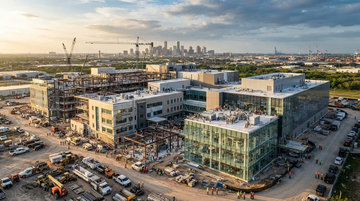
Bristol Myers Squibb Bristol-Myers Squibb Company announced it will invest about ~$2.3B to build a new Houston manufacturing campus, located at Generation Park in Houston, Texas. The company describes the site as a state-of-the-art, multi-modal facility sized at about 600,000 square feet and designed to manufacture multiple medicine modalities—small molecules, biologics, and antibody-drug conjugates—using a modular setup and advanced digital capabilities.
Investment size
~$2.3B
Bristol Myers press release
Campus size
~600,000 sq ft
Bristol Myers press release
Initial skilled jobs
~500
Bristol Myers press release
Build/online window
2027–2030
Indirect job creation timeline and project schedule in release
Why this matters (macro + policy wiring)
This is pharma reshoring under tariff/industrial-policy pressure—so execution quality becomes the differentiator
Reuters’ summary of “global drugmakers” expanding their U.S. footprint frames the reshoring wave as a response to tariff threats and related uncertainty. In that same Reuters account, multiple large pharma companies describe large-scale U.S. commitments spanning manufacturing capacity and supply-chain build-outs, often alongside language about managing “tariff challenges” via planning and inventory dynamics.
So what does that mean for BMS? The Houston build is the part investors should map: pledges become capacity, and capacity becomes leverage against import risk and policy-driven demand for domestic supply.
- The Houston campus’ multi-modality scope targets finished-product flexibility across small molecules, biologics and ADCs—reducing single-modality stranded-capacity risk.
- The 2027–2030 timeline pushes the reshoring payoff into a narrow execution window, so construction, qualification and scale-up performance likely matter more than announcement-stage spending.
- Reuters’ tariff-threat framing makes inventory and routing strategy part of “manufacturing policy”, not just a logistics footnote.
Supply-chain map (upstream ↔ site build ↔ downstream)
The Houston site pulls on a very specific supply chain: engineering + bioprocess systems + downstream CDMO/contract manufacturing capacity
A multi-modal manufacturing campus at this scale is a system-level procurement exercise. While the BMS release does not name specific suppliers, its stated functions—small molecules, biologics, and ADC manufacturing; advanced digital capabilities; modular configuration flexibility—imply a demand stack across (1) engineering and construction, (2) bioprocess and lab instrumentation, and (3) enabling services for tech transfer and manufacturing analytics.
To keep this evidence-grounded, this article uses BMS’ disclosed production scope and schedule as the linkage anchor, then treats upstream beneficiaries as “capacity toolchain” players (based on their business profiles) rather than naming exact vendor awards.
| Layer | What gets bought/expanded | What BMS disclosed in Houston project | Why it transmits to markets |
|---|---|---|---|
| Site build & engineering | EPC services, validation engineering, modular GMP utilities | Campus at Generation Park sized ~600,000 sq ft; schedule 2027–2030 | Large fixed projects create multi-year construction and commissioning demand. |
| Bioprocess & analytical tooling | Upstream/downstream process equipment, monitoring and digital integration | “Modular” manufacturing + “advanced digital capabilities” and multi-modal manufacturing scope | Instrumentation and process analytics are “always-on” for ramp and ongoing batch release. |
| Specialty manufacturing services | Tech transfer, automation, batch execution, process control | Finished goods manufacturing from late development through launch is implied by “support” language | As in-house ramps lag, partners and internal groups must co-execute. |
| Downstream customers (pharma portfolio) | Faster domestication of supply for launch/steady-state demand | Scope across modalities (small molecules, biologics, ADCs) | A broader portfolio reduces procurement bottlenecks that can become politically sensitive. |
Fundamentals sanity-check (can BMS fund reshoring without financial strain?)
BMS has generated enough operating cash flow to sustain buybacks while still funding capex—so Houston looks like “normal reinvestment,” not distressed liquidity
Bristol Myers cash generation vs. capex (annual)
Use as a context check: whether investing ~$2.3B in a multi-year project would require extraordinary liquidity.
Unit: USD
Operating cash flow (FY2021)
Net cash provided by operating activities
16,207,000,000
Operating cash flow (FY2022)
Net cash provided by operating activities
13,066,000,000
Operating cash flow (FY2023)
Net cash provided by operating activities
13,860,000,000
Operating cash flow (FY2024)
Net cash provided by operating activities
15,190,000,000
Operating cash flow (FY2025)
Net cash provided by operating activities
14,156,000,000
Across recent years, Bristol-Myers Squibb Company has repeatedly generated double-digit operating cash flow (e.g., ~\$14.2B in FY2025) and has continued to deploy capital expenditures (capex) on the order of ~\$1.1–\$1.3B annually in this dataset. That doesn’t “prove” the Houston project is already fully pre-funded, but it reduces the probability that the reshoring wave forces a balance-sheet emergency.
- In FY2025, operating cash flow was ~\$14.2B, and capex was ~\$1.3B in the financial dataset used here.
- That cash profile makes it plausible that the Houston spend is spread over multiple years, aligning with the 2027–2030 build window.
Investor angles (what to watch next)
The market will reprice reshoring risk based on ramp credibility, not just project size
- Contractor and equipment lead-time risk: if modular delivery or GMP utility validation slips, utilization delays can push material margins out of the expected cycle.
- Tech-transfer credibility: BMS states multi-modal manufacturing and advanced digital capabilities, so early performance (batch success rates, yields, release timelines) will matter for whether this is “real capacity” or slower ramp.
- Policy sensitivity test: tariff pressure changes the value of domestication—so any additional U.S. regulatory actions that affect manufacturing economics can alter the returns on Houston capex.
Horizons (short-term catalysts + long-term thesis)
Short-term: sector bid for build-out supply chain. Long-term: manufacturing footprint reshapes bargaining power
In the short term (days to quarters), the headline effect is that reshoring announcements create immediate demand for engineering, commissioning, and process automation budgets across the biotech/pharma build-out ecosystem. In the medium term, the market will focus on whether BMS provides further operational milestones (site construction progress, equipment installations, qualification plans, and any early batch timelines).
Over 1–3 years (into 2028–2030), the long-term read-through is more structural: if domestic manufacturing reduces import/tariff friction and improves launch certainty, it can support portfolio continuity and constrain competitors who rely more on cross-border sourcing.
Listed stocks most plausibly tied to the reshoring build-out wave (capacity/toolchain beneficiaries)
- Houston capex adds multi-year execution burden into 2027–2030, which can temporarily pressure margins if ramp delays occur.
- If multi-modal performance is strong, the site reduces supply-disruption risk from tariff-driven import uncertainty over a 1–3 year horizon.
- Recent cash generation supports continued reinvestment (FY2025 operating cash flow ~14.2B; dataset), reducing liquidity stress risk.
- Reuters’ tariff-threat framing puts Pfizer’s U.S. manufacturing and R&D commitments into the same “domestic capacity” value pool, supporting peer multiple narratives.
- Short-term, investors may re-rate U.S. build-out beneficiaries on policy headline sensitivity (Reuters: U.S. investment pledges around tariff management).
- Over 1–3 years, Pfizer’s success depends on whether announced capacity converts into operating output without qualification slips.
- Reuters cites Gilead’s planned U.S. investment; that makes it a proxy for reshoring-driven capex cycle participation.
- Short-term sentiment should tilt toward companies with clear U.S. build plans as the market prices domestic supply continuity.
- Long-term, U.S. footprint strength can protect launch timing and reduce routing risk during policy volatility.
- BMS’ Houston project calls for advanced digital and multi-modal manufacturing; this supports demand for bioprocess, lab and analytical instrumentation ecosystems over construction and commissioning phases.
- Short-term, build-out waves often pull forward purchases for validation and process analytics tools before full-scale production ramps.
- Over 1–3 years, if more sites adopt modular/digital manufacturing, Thermo’s bioproduction toolkit exposure rises versus a world where pharma stays asset-light.