%22%2F%3E%0A%20%20%3Ccircle%20cx%3D%22220%22%20cy%3D%22150%22%20r%3D%22180%22%20fill%3D%22%2322d3ee%22%20fill-opacity%3D%220.12%22%2F%3E%0A%20%20%3Ccircle%20cx%3D%221010%22%20cy%3D%22130%22%20r%3D%22220%22%20fill%3D%22%2338bdf8%22%20fill-opacity%3D%220.08%22%2F%3E%0A%20%20%3Ccircle%20cx%3D%22920%22%20cy%3D%22520%22%20r%3D%22170%22%20fill%3D%22%2322d3ee%22%20fill-opacity%3D%220.06%22%2F%3E%0A%20%20%3Cpath%20d%3D%22M140%20430h920%22%20stroke%3D%22url(%23line)%22%20stroke-width%3D%2212%22%20stroke-linecap%3D%22round%22%2F%3E%0A%20%20%3Cpath%20d%3D%22M220%20360c120-150%20260-220%20380-220s260%2070%20380%20220%22%20fill%3D%22none%22%20stroke%3D%22%2367e8f9%22%20stroke-opacity%3D%220.5%22%20stroke-width%3D%2216%22%20stroke-linecap%3D%22round%22%20stroke-linejoin%3D%22round%22%2F%3E%0A%20%20%3Cpath%20d%3D%22M300%20398h600%22%20stroke%3D%22%2394a3b8%22%20stroke-opacity%3D%220.24%22%20stroke-width%3D%228%22%20stroke-linecap%3D%22round%22%2F%3E%0A%20%20%3Ctext%20x%3D%22220%22%20y%3D%22510%22%20fill%3D%22%23e2e8f0%22%20fill-opacity%3D%220.7%22%20font-family%3D%22Arial%2C%20Helvetica%2C%20sans-serif%22%20font-size%3D%2238%22%20letter-spacing%3D%228%22%3EINSIGHTS%3C%2Ftext%3E%0A%3C%2Fsvg%3E)
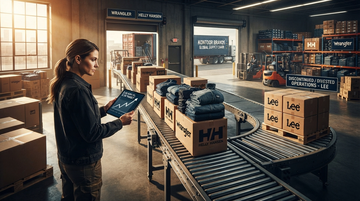
Catalyst under the label-change narrative
UBS’s upside call is a valuation bet: growth + margin expansion + cash returns, not just denim nostalgia
UBS’s message to investors is straightforward: the Wrangler and Helly Hansen setup can produce a higher earnings and cash-return profile than the stock’s recent multiple implies. CNBC reported UBS raised its Kontoor price target to $136 from $131 and framed the move as about ~67% upside from the prior close—a thesis that only works if near-term results continue improving and the company converts that into durable cash flow.
What Kontoor is structurally changing
Lee’s exit simplifies the story: fewer moving parts, more focus on the brands UBS is underwriting
Kontoor is exiting Lee via a sale process that is already treated as discontinued operations. In its Q2 FY2026 filing, the company disclosed it signed a Stock Purchase Agreement on May 20, 2026 to sell the global Lee business to an affiliate of Authentic Brands Group, with consideration of $750 million cash at closing plus up to $250 million in earnouts. From an investor’s perspective, that matters because it reduces brand/story dilution when the market is trying to underwrite the “quality” of Wrangler (and the strategic re-acceleration of Helly Hansen).
- Lee is classified as discontinued operations, so ongoing operating metrics are increasingly about Wrangler, Helly Hansen, and the remaining smaller branded/portfolio items.
- The filing confirms the transaction structure (cash at close + earnout over five years), which supports continuity of value realization rather than a one-time accounting event.
- The company also discloses that Lee had been a separate operating segment prior to Q1 2026, reinforcing that investors are shifting to a different earnings engine.
Channel and mix: where “denim rerating” can actually show up
Channel economics and brand focus are where denim re-rates into margins
UBS’s call implicitly relies on operating leverage. Kontoor’s Q2 FY2026 filing shows continuing-operations segment revenue centered on Wrangler and (now far larger) Helly Hansen. For the quarter ended June 2026, continuing operations were led by Wrangler at $469.0 million and Helly Hansen at $106.8 million. While the filing excerpt also notes a channel mix—U.S. wholesale at 68% of total revenues, international wholesale at 19%, and direct-to-consumer at 13%—the key takeaway is that the “rerate” can still happen without a pure DTC breakout: mix, cost actions, and expense leverage can lift gross margin and operating margin.
| Segment | Three months ended Jun 2026 ($m) | Three months ended Jun 2025 ($m) |
|---|---|---|
| Wrangler | 469.0 | 461.3 |
| Helly Hansen | 106.8 | 26.7 |
| Total continuing operations | 575.9 | 488.0 |
On the “turning point” question, this kind of segment mix change is exactly what can shift investor perception from “heritage denim with weak trajectory” to “a multi-brand apparel platform where Helly Hansen scale and expense leverage matter.” In other words, Helly Hansen’s step-up gives the market a reason to expect better margin durability from the remaining operating base.
Cash returns: the rerate mechanism investors should demand
If the rerate is real, it should show up in cash conversion and buybacks—not just revenue
Using the company’s latest trailing twelve months (TTM) figures from its financial statements, Kontoor generated net cash provided by operating activities of $374.2 million and free cash flow of $361.7 million. At the same time, the cash-flow statement shows it returned capital through common stock repurchases of $125.4 million and dividends of $117.3 million in the TTM period. That combination is the investor-friendly version of “demonstrating the rerate”: the market can pay up for a higher-quality cash profile only if cash turns into equity buybacks (and not just accounting earnings). TTM free cash flow of $361.7M provides the capacity for ongoing shareholder returns if operating momentum holds.
Operating cash flow (TTM)
$374.2M
TTM through reported period ending Jul 4, 2026; reported Aug 12, 2026
Free cash flow (TTM)
$361.7M
TTM through reported period ending Jul 4, 2026; reported Aug 12, 2026
Common stock repurchases (TTM)
$125.4M
TTM through reported period ending Jul 4, 2026; reported Aug 12, 2026
Dividends paid (TTM)
$117.3M
TTM through reported period ending Jul 4, 2026; reported Aug 12, 2026
Where the numbers already point (and where they don’t)
The financials show real profitability and cash generation—now investors must confirm the margin path
Kontoor’s profitability profile is meaningfully positive in the latest trailing twelve months (TTM): net income of $267.9 million and operating income of $388.8 million. Revenue was $3.07 billion in the same TTM window. Those basics support UBS’s view that the company can be more than a “slow denim brand story.” The risk is that the rerate depends on margin expansion sustainability (not just one quarter of mix improvement). If operating income growth stalls while the company remains reliant on wholesale-heavy mix, the upside case can compress back toward a mature-apparel multiple.
Kontoor revenue and operating income (annual)
Directional view of growth and profitability through the last three fiscal years in available statements
Unit: USD
Revenue — FY2024
FY2024 revenue; financial statements filed Feb 25, 2025
2,607,578,000
Revenue — FY2025
FY2025 revenue; financial statements filed Mar 4, 2026
3,154,110,000
Revenue — TTM
TTM revenue through period ending Jul 4, 2026; reported Aug 12, 2026
3,069,662,000
Operating income — FY2024
FY2024 operating income; financial statements filed Feb 25, 2025
342,289,000
Operating income — FY2025
FY2025 operating income; financial statements filed Mar 4, 2026
446,013,000
Operating income — TTM
TTM operating income through period ending Jul 4, 2026; reported Aug 12, 2026
388,752,000
- Revenue rose from FY2024 to FY2025, supporting a stronger baseline for margin and cash generation.
- Operating income also increased over the same period, aligning with a “rerate” narrative that requires profitability expansion.
- The key downside case is margin mean reversion if the company cannot sustain the cost/expense leverage implied by the segment mix shift.
What to watch next (short term vs. long term)
The rerating trade hinges on near-term margin confirmation and longer-term simplification from the Lee exit
Short-term (next few quarters): watch continuing-operations segment momentum—especially Wrangler’s ability to keep growing while Helly Hansen’s scaled contribution normalizes. Also watch capital return: ongoing buybacks are how the market validates that management sees the valuation as attractive. Long-term (1–3 years): the Lee exit is the structural simplifier; it should reduce narrative noise and help investors underwrite Kontoor as a more focused brand portfolio. In a denim rerate framework, that structural focus matters because it supports higher confidence around earnings quality.
Listed comps that investors typically compare when denim “quality” changes
- If Kontoor sustains margin expansion, Levi Strauss & Co. can benefit via multiple lift from the broader “denim quality” perception.
- If wholesale mix limits re-rating, Levi Strauss & Co. can lag as markets favor companies with clearer DTC/brand pricing power.
- Caleres Inc. may trade in sympathy if investors reward apparel/discretionary cash returns, but it can underperform if denim rerates look brand-specific.
- Kontoor’s buyback-and-cash loop raises the bar for peer cash conversion, making operating discipline more visible across consumer names.
- VF Corporation is a key read-through for whether apparel investors accept “legacy” brand stories that still deliver margin and cash.
- If Kontoor’s rerate holds, VF Corporation can face pressure to demonstrate similar margin sustainability across its brands.
- A denim rerate can improve sentiment toward value apparel, but Hanesbrands Inc. may see less benefit if the market distinguishes premium denim from basic categories.
- Kontoor’s evidence of TTM free cash flow of $361.7M strengthens the case that investors will reward cash-generative brands over time.