%22%2F%3E%0A%20%20%3Ccircle%20cx%3D%22220%22%20cy%3D%22150%22%20r%3D%22180%22%20fill%3D%22%2322d3ee%22%20fill-opacity%3D%220.12%22%2F%3E%0A%20%20%3Ccircle%20cx%3D%221010%22%20cy%3D%22130%22%20r%3D%22220%22%20fill%3D%22%2338bdf8%22%20fill-opacity%3D%220.08%22%2F%3E%0A%20%20%3Ccircle%20cx%3D%22920%22%20cy%3D%22520%22%20r%3D%22170%22%20fill%3D%22%2322d3ee%22%20fill-opacity%3D%220.06%22%2F%3E%0A%20%20%3Cpath%20d%3D%22M140%20430h920%22%20stroke%3D%22url(%23line)%22%20stroke-width%3D%2212%22%20stroke-linecap%3D%22round%22%2F%3E%0A%20%20%3Cpath%20d%3D%22M220%20360c120-150%20260-220%20380-220s260%2070%20380%20220%22%20fill%3D%22none%22%20stroke%3D%22%2367e8f9%22%20stroke-opacity%3D%220.5%22%20stroke-width%3D%2216%22%20stroke-linecap%3D%22round%22%20stroke-linejoin%3D%22round%22%2F%3E%0A%20%20%3Cpath%20d%3D%22M300%20398h600%22%20stroke%3D%22%2394a3b8%22%20stroke-opacity%3D%220.24%22%20stroke-width%3D%228%22%20stroke-linecap%3D%22round%22%2F%3E%0A%20%20%3Ctext%20x%3D%22220%22%20y%3D%22510%22%20fill%3D%22%23e2e8f0%22%20fill-opacity%3D%220.7%22%20font-family%3D%22Arial%2C%20Helvetica%2C%20sans-serif%22%20font-size%3D%2238%22%20letter-spacing%3D%228%22%3EINSIGHTS%3C%2Ftext%3E%0A%3C%2Fsvg%3E)
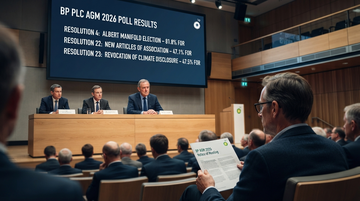
Governance vote → capital-return confidence
BP’s AGM delivered a clear message: governance simplification can’t come at the cost of investor transparency
BP’s 23 April 2026 AGM became less about day-to-day strategy updates and more about whether the board’s governance reset would hold up under investor scrutiny. Shareholders backed the board’s chair election (resolution 4) but rejected the board on three contested governance and disclosure resolutions, putting the company’s “simpler, stronger, more valuable bp” framing under a real-world vote test.
Resolution 4 (Albert Manifold election)
81.8% FOR
AGM held 23 April 2026
Resolution 22 (New Articles of Association)
47.1% FOR
AGM held 23 April 2026
Resolution 23 (Revocation of prior climate disclosure resolutions)
47.5% FOR
AGM held 23 April 2026
Resolution 24 (ACCR proposal on capital discipline disclosure)
25.9% FOR
AGM held 23 April 2026
What the board actually asked shareholders to approve
BP’s board framed the reset as simplification and standardization—but voters treated it like a transparency rollback
Ahead of the vote, BP’s chair messaging positioned the changes as efficiency and comparability. BP supported resolution 22 by arguing a virtual-option AGM model would broaden participation and reduce cost/complexity. It supported resolution 23 by proposing the removal of legacy climate-disclosure items from its constitution, saying this would not change BP’s net-zero ambition and would reduce duplicative obligations. And it urged shareholders to vote against resolution 24, arguing that project-by-project, prescriptive disclosure would be incomplete or misleading versus standardized investor metrics.
| Resolution | BP’s stated objective | Shareholder result (For vs. Against) |
|---|---|---|
| 22 | Allow articles to include option of virtual AGMs (simplification; participation; lower cost/complexity) | 47.12% FOR vs. 52.88% AGAINST |
| 23 | Revoke legacy constitution climate-disclosure resolutions (remove duplication/cost; maintain net-zero ambition) | 47.47% FOR vs. 52.53% AGAINST |
| 24 | ACCR capital-discipline disclosure proposal (board recommends vote against; wants simpler/standardized comparability) | 25.85% FOR vs. 74.15% AGAINST |
This is the crux: BP described the changes as standardizing and reducing duplication; investors voted as if the changes reduce “what they can verify.” That mismatch is what tends to matter for capital-return consensus—because capital-return models depend on trust in the board’s discipline signals (what management will fund, when, and with what guardrails).
Supply-chain lens (full chain): oil cash-flow → capex → payout capacity → approval capital
Even when upstream economics stay strong, governance disputes can change the payout math by shifting the discount rate investors apply
BP’s operational chain is straightforward: upstream and LNG/gas-related cash generation funds capex and shareholder returns, while “how visible and comparable” those decisions are affects how investors value the credibility of future cash returns. When shareholders vote down disclosure and governance rollbacks, the likely market mechanism is not that crude suddenly changes; it’s that the market may apply a higher credibility premium/discount to management’s capital-allocation story because the verification layer investors rely on is weaker.
- First-order effect: votes against disclosure-related resolutions can reduce investor confidence in the completeness of capital-allocation reporting.
- Second-order effect: lower confidence typically widens the range of outcomes (capex timing, asset churn, and payout sustainability), raising the equity risk premium.
- Third-order effect: a higher risk premium can pressure valuation multiples—especially when the business remains exposed to commodity-cycle swings.
Fundamentals cross-check: what the company’s recent financial shape can (and can’t) offset
BP’s recent financial performance supports the payout narrative—but it didn’t immunize the board from governance rejection
BP has reported substantial scale and profitability in recent periods, and its earnings power helps explain why shareholders still elected [Albert Manifold]’s board seat. But the vote pattern shows that financial results alone aren’t enough. Investors are willing to accept performance volatility; they’re less willing to accept reduced transparency on climate and capital-discipline mechanics when it could affect long-run capex and payout credibility.
Revenue (FY2025)
$189.3B
FY2025 income statement filed 6 Mar 2026
Operating income (FY2025)
$15.5B
FY2025 income statement filed 6 Mar 2026
Net income (FY2025)
$1.3B
FY2025 income statement filed 6 Mar 2026
Free cash flow capacity proxy (TTM)
EV/Free cash flow: 12.21x
TTM through latest quarter shown by company-linked market data
This creates a key investor question for the sector’s “capital-return consensus”: when returns are funded by upstream cash cycles, investors still require governance signals that capex discipline won’t drift when conditions change. BP’s AGM vote suggests that—or at least how—those signals were not considered adequate by part of the shareholder base.
What changes next: short-term catalysts and the 1–3 year risk map
The near-term catalyst is follow-through: BP needs to convert the AGM vote into improved disclosure credibility, not just messaging
The most investable “next step” is that BP explicitly acknowledged the level of opposition on resolutions 22, 23, and 24 and said it would seek to understand why shareholders voted as they did and intend to provide an update within six months. In short-term terms, that update window can drive expectations around what BP will disclose next, how it will frame capital discipline, and whether it will adjust its governance stance. If BP doesn’t narrow the disclosure gap, the sector’s capital-return consensus could price in more governance risk even while oil cash flows remain strong.
- Within days–quarters: watch for BP’s six-month update on why resolutions 22/23/24 were opposed and whether disclosure mechanics are adjusted.
- Within quarters: investor dialogue around capital discipline reporting can shift incremental capital allocation perceptions (what gets funded first).
- Over 1–3 years: if governance simplification continues to be interpreted as reduced verification, valuation multiples may stay capped relative to peers that deliver clearer comparability.
Listed supermajor and integrated-energy read-through (evidence-backed linkage to payout-credit and governance credibility)
- If BP’s governance credibility discount rises, markets may re-rate peers toward stronger disclosure regimes over the next 1–3 years.
- If oil cash flows remain strong and Exxon maintains transparent capital discipline, investors likely protect the multiple despite ESG votes in the short run.
- A sectorwide governance premium could widen: Exxon’s payout credibility becomes a relative winner when investors demand verifiability.
- Chevron’s valuation may benefit if investors rotate toward boards that withstand disclosure challenges after BP’s vote.
- If governance-related scrutiny spreads, Chevron could see higher scrutiny on project-level disclosure into upcoming meetings.
- Over 1–3 years, uncertainty around payout sustainability could pressure buyback confidence if disclosure standards decline sectorwide.
- BP’s vote raises the bar: Shell’s AGM and governance updates could steer sector expectations on climate disclosure and capex discipline within quarters.
- If Shell proves it can simplify without reducing verification, investors likely maintain capital-return consensus in the short term.
- If not, Shell may face similar valuation pressure from governance risk as the market learns from BP.
- BP’s rejected resolutions make comparable disclosure frameworks more likely: TotalEnergies could see a valuation advantage if it keeps disclosures standardized over 1–3 years.
- If investors extrapolate the governance backlash, TotalEnergies may face higher voting friction next AGM cycle as a catalyst.
- Near term, capital discipline perceptions may tilt toward investors who can verify project-level outcomes rather than rely on narrative.
- BP’s AGM suggests governance transparency matters even in strong cash years; Equinor could benefit if its climate governance is easier to verify for shareholders.
- If backlash spreads against perceived rollback risk, Equinor’s integrated-energy investors may push for tighter disclosure comparability into upcoming meetings.
- In the short run, commodity cycles still dominate; governance risk likely adds a smaller but persistent valuation discount.