Latest
The day's market news, with the argument attached
New notes every trading day on earnings, policy and market structure. Each one opens with the conclusion, then the evidence, then the companies it hits.
2026-08-25
%22%2F%3E%0A%20%20%3Ccircle%20cx%3D%22220%22%20cy%3D%22150%22%20r%3D%22180%22%20fill%3D%22%2322d3ee%22%20fill-opacity%3D%220.12%22%2F%3E%0A%20%20%3Ccircle%20cx%3D%221010%22%20cy%3D%22130%22%20r%3D%22220%22%20fill%3D%22%2338bdf8%22%20fill-opacity%3D%220.08%22%2F%3E%0A%20%20%3Ccircle%20cx%3D%22920%22%20cy%3D%22520%22%20r%3D%22170%22%20fill%3D%22%2322d3ee%22%20fill-opacity%3D%220.06%22%2F%3E%0A%20%20%3Cpath%20d%3D%22M140%20430h920%22%20stroke%3D%22url(%23line)%22%20stroke-width%3D%2212%22%20stroke-linecap%3D%22round%22%2F%3E%0A%20%20%3Cpath%20d%3D%22M220%20360c120-150%20260-220%20380-220s260%2070%20380%20220%22%20fill%3D%22none%22%20stroke%3D%22%2367e8f9%22%20stroke-opacity%3D%220.5%22%20stroke-width%3D%2216%22%20stroke-linecap%3D%22round%22%20stroke-linejoin%3D%22round%22%2F%3E%0A%20%20%3Cpath%20d%3D%22M300%20398h600%22%20stroke%3D%22%2394a3b8%22%20stroke-opacity%3D%220.24%22%20stroke-width%3D%228%22%20stroke-linecap%3D%22round%22%2F%3E%0A%20%20%3Ctext%20x%3D%22220%22%20y%3D%22510%22%20fill%3D%22%23e2e8f0%22%20fill-opacity%3D%220.7%22%20font-family%3D%22Arial%2C%20Helvetica%2C%20sans-serif%22%20font-size%3D%2238%22%20letter-spacing%3D%228%22%3EINSIGHTS%3C%2Ftext%3E%0A%3C%2Fsvg%3E)

Gold’s 3‑Month High Meets a Put-Heavy Skew: The Rally Depends on Who Paid for Downside Protection
Gold pushing to 3‑month highs is being paired with a put-heavy options positioning signal, meaning more market participants are buying or structuring for downside protection than chasing upside upside. That matters because hedges tend to cap upside follow-through while raising the probability that a late-week macro catalyst (inflation prints and Jackson Hole) triggers a larger, faster pullback.

Honda makes USMCA a capex switch: suppliers feel the “order-book freeze” first
Honda said it may not proceed with an eighth North American assembly plant unless the USMCA trade deal is extended, with a decision due in the next year or two and a potential target start around 2030. The immediate market implication is less about unit volumes and more about upstream supplier behavior: when OEM construction gates close, new tooling, logistics lanes, and cross-border sourcing agreements slow down first.
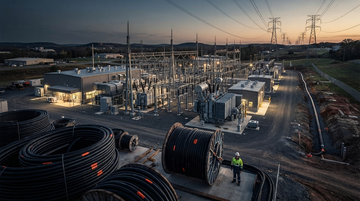
HVDC’s “unmapped toll” is landing in converter stations and XLPE cable, not reactors—because PJM is already pricing grid pain at ~$6B/H1 and AI will have to pay it again
PJM’s transmission-constraint costs surged to $6 billion in the first half of 2026, turning congestion into a near-cash “toll” for any AI load that arrives without enough long-haul transfer capacity. The bottleneck chain for adding that capacity is concentrated: converter stations plus XLPE land/subsea cable (and the HVDC transformer scope around them), where multi-year backlogs and long lead times translate grid buildout into a pricing-power opportunity.

Lego’s record H1 shows toy demand can pay up—and the proof matters for Mattel/Hasbro tariff pass-through
Lego’s first-half results (as reported for H1 2025) delivered record revenue and double-digit growth while the broader toy market remains fragile, reinforcing that consumers keep buying premium-branded play when sellers lift prices. For Mattel and Hasbro, the investor question shifts from “will customers trade down?” to “can pricing actions protect gross margin when tariffs add cost?”

Marvell has a rare “price-vs-performance” setup in Q2 FY2027: its custom-silicon pitch meets Nvidia’s server cost shock
Marvell’s Aug. 27 print is the first earnings-level test of whether demand for custom inference silicon can offset Nvidia’s reported 15%+ AI-server price hikes. Marvell has already guided Q2 FY2027 net revenue to $2.700B ±5%, with gross-margin and non-GAAP EPS ranges that will reveal whether “ASIC substitution” shows up in results—or stays a narrative.

Okta goes on the clock for AI-agent identity monetization after its Permiso bet
Okta will report Q2 fiscal 2027 results on Aug. 26, 2026—its first major earnings test with “AI agents and non-human identities” now part of the story via the Permiso deal. The market question isn’t whether identity security matters for agents; it’s whether Okta can turn that threat-detection scope into recurring revenue fast enough to offset near-term acquisition/transition noise.

OpenAI turns ChatGPT Work + Codex into an admin-governed agent workforce—yet the budget line is still missing
OpenAI’s newly documented enterprise controls for ChatGPT Work and Codex shift implementation from “try agents” to “run agents under workspace governance.” The key is the admin surface: RBAC-style access to plugins/apps, action approvals, and compliance logging via a Compliance API—capabilities typically monetized by identity and security vendors instead of modeled inside AI budget forecasts.

GPT‑5.6 in Kiro turns “price‑performance” into an IDE distribution battle right before OpenAI’s IPO
OpenAI’s Aug. 24 release makes GPT‑5.6 Sol/Terra/Luna available inside Amazon’s Kiro across IDE, CLI, and Web, pairing a clear price ladder with concrete Kiro-side coding benchmarks and credit economics. The investor takeaway: OpenAI’s IPO “usage depth” bet increasingly depends on winning developers at the workflow layer—where the tool that owns the feedback loop also captures the billable tokens.

OpenAI’s Jalapeño posts 1.5–1.9× more inference work per watt—turning “custom silicon” from an option into a pricing-power threat for NVIDIA
OpenAI published its first Jalapeño inference-chip benchmark results on Aug. 25, claiming 1.5–1.9× more AI work per watt at peak throughput and 1.7–3.6× lower end-to-end latency versus stated comparison systems. Because inference is the spend that scales with live usage, the headline is that OpenAI can potentially shift its next compute build from “GPUs as the default” toward purpose-built accelerators—compressing NVIDIA’s margin cushion just ahead of its Aug. 26 earnings.

Biotech’s FDA Week Turns Into a “Yes/No” Trade: Jazz (8/25) and Gilead (8/27) each carry near-term repricing risk
With Jazz’s FDA target action date on Aug 25, 2026 for Ziihera zanidatamab combinations and Gilead’s Aug 27, 2026 target action date for a single-tablet HIV regimen (bictegravir/lenacapavir), this week’s catalysts are fundamentally binary. Investors should treat the market move as an approval-outcome rerate—then quickly map the winners to the downstream uptake bottlenecks (pricing, reimbursement, and label implementation)—rather than anchoring on longer-term product narratives.

The SEC probe that turns “AI-quant losses” into an enforcement playbook: leverage math and disclosure discipline are now the test
The SEC is investigating near-implosion dynamics tied to Situational Awareness, including how its trades and leverage fed margin calls and counterparty communications. The message for investors in AI-quant strategies is blunt: enforcement risk increasingly tracks disclosure mechanics—leverage definitions, counterparty exposure ranking, and timing—more than the model itself.

SpaceX’s $100B “Starbase, Louisiana” reframes AI from power-and-chips to launch-and-orbit capacity
SpaceX’s planned $100B Starbase, Louisiana spaceport targets propellant production, vehicle processing, and an expanded launch cadence—then it explicitly pulls forward the timeline for orbital AI data-center deployments to late 2027. The market implication is simple: when orbital compute moves from prototype flights to scaled constellations, launch slots become a gating input that can reprice the space/value chain.

Stability AI’s $76M round is less about “funding” and more about paying for the standalone image layer before it collapses
Stability AI’s $76M Series B (announced Aug. 25, 2026) shows that rights holders are willing to bankroll image-model tooling when frontier labs increasingly absorb the feature into their apps. The signal to investors: standalone model startups survive when they can attach to licensed, professional workflows—while unbundled generation faces margin pressure as platform bundling and pricing squeeze tighten.

Subsea cable capacity is turning into the “sovereignty toll” for AI inference—because landing stations now face national-security scrutiny
AI traffic is increasingly priced not just by how much fiber exists, but by who can access it at landing stations and on their terrestrial handoff path. A June 4, 2026 FCC order tightens and accelerates national-security oversight around cable landing station equipment, SLTE access reporting, and circuit capacity compliance—raising the cost and friction of cross-border inference paths.

The Treasury’s buyback credibility gap: execution starts Sept. 10, but the long-end is already trading like it won’t
U.S. Treasury Secretary Scott Bessent said on Aug. 24 that the Treasury “hasn’t purchased any bonds yet” under the enlarged buyback plan—despite long-end yields trading near multi-decade highs. The key trade is no longer the announcement itself, but the market’s confidence that actual long-end term-premium support will arrive on time and in size.

President buys SpaceX shares post‑IPO—why that timing matters more than the stake size
Two weeks after SpaceX’s record IPO, President Donald Trump purchased shares disclosed in his financial filings, turning a liquidity event into an immediate governance optics test. For defense-contract investors, the key issue isn’t whether rules were followed—it’s whether the IPO’s tightly controlled voting structure plus mega-IPO float dynamics will intensify scrutiny over disclosure, Pentagon-facing contracting perceptions, and how markets discount “controlled-company” governance.

Ukraine’s drone campaign targets Ozon’s logistics hubs—turning Russia’s consumer e-commerce into a sanctions-adjacent battlefield
Ukraine broadened its strike campaign to four Ozon logistics hubs, forcing temporary operational halts and hitting the company’s near-term execution risk. For investors with Russian consumer exposure, the signal is bigger than one retailer: disrupting last-mile logistics and fulfillment capacity can turn “consumer resilience” into an economic-pressure channel—especially for e-commerce platforms that concentrate warehousing and inventory flow.

Unilever’s “less-is-more” portfolio squeeze turns the staples conglomerate model into a break-up trade
Unilever is using portfolio thinning—explicitly “simpler, sharper, and faster”—to refocus on fewer consumer categories after years of divestments and a major ice-cream demerger. The investor implication is a new staples playbook: when brand-count diversification stops improving returns, the market pays more for focused pure-plays than for scale-with-no-specialization—setting up what activists could target next in the US.

Unitree’s IPO-to-slump turn reframes China humanoid robotics: when “capital magnet” becomes valuation froth
Unitree [9880.HK]’s Shanghai debut drew a ~460% first-day surge versus the IPO offer price (150.80 yuan) before the stock later softened, shifting the debate from “funding windfall” to “bubble risk.” The repricing matters most for the robotics supply chain that investors were paying upfront for—especially automation and industrial-intermediate names that sit closer to unit economics than the robot makers themselves.

When $10 gas hits, LNG becomes an allocation fight: the marginal molecule shifts toward whoever can buy (or avoid) feedgas best
As domestic Henry Hub pricing tightens, U.S. LNG exports face an economics-and-queue problem: LNG still runs, but profitability depends on who holds the next cheapest gas supply and how quickly they can reroute molecules. EIA’s 2026 outlook still calls for relatively low average Henry Hub, yet the same framework implies a sharply higher “break-even sensitivity” if prices persist near $10/MMBtu—turning exporter margin durability into the core equity question.
What to expect
Evidence-first notes with a visible point of view.
This section collects sharp takes on earnings, shareholder meetings, and market structure. Each new piece should make the thesis, the facts, and the implications obvious within the first few screens.
Expect direct analysis, not generic commentary.
Expect the data to be explicit and the argument to be easy to follow.
Plutux is not an investment adviser. Market data and AI-generated analysis are for information and education only, not investment advice. Disclaimer