%22%2F%3E%0A%20%20%3Ccircle%20cx%3D%22220%22%20cy%3D%22150%22%20r%3D%22180%22%20fill%3D%22%2322d3ee%22%20fill-opacity%3D%220.12%22%2F%3E%0A%20%20%3Ccircle%20cx%3D%221010%22%20cy%3D%22130%22%20r%3D%22220%22%20fill%3D%22%2338bdf8%22%20fill-opacity%3D%220.08%22%2F%3E%0A%20%20%3Ccircle%20cx%3D%22920%22%20cy%3D%22520%22%20r%3D%22170%22%20fill%3D%22%2322d3ee%22%20fill-opacity%3D%220.06%22%2F%3E%0A%20%20%3Cpath%20d%3D%22M140%20430h920%22%20stroke%3D%22url(%23line)%22%20stroke-width%3D%2212%22%20stroke-linecap%3D%22round%22%2F%3E%0A%20%20%3Cpath%20d%3D%22M220%20360c120-150%20260-220%20380-220s260%2070%20380%20220%22%20fill%3D%22none%22%20stroke%3D%22%2367e8f9%22%20stroke-opacity%3D%220.5%22%20stroke-width%3D%2216%22%20stroke-linecap%3D%22round%22%20stroke-linejoin%3D%22round%22%2F%3E%0A%20%20%3Cpath%20d%3D%22M300%20398h600%22%20stroke%3D%22%2394a3b8%22%20stroke-opacity%3D%220.24%22%20stroke-width%3D%228%22%20stroke-linecap%3D%22round%22%2F%3E%0A%20%20%3Ctext%20x%3D%22220%22%20y%3D%22510%22%20fill%3D%22%23e2e8f0%22%20fill-opacity%3D%220.7%22%20font-family%3D%22Arial%2C%20Helvetica%2C%20sans-serif%22%20font-size%3D%2238%22%20letter-spacing%3D%228%22%3EINSIGHTS%3C%2Ftext%3E%0A%3C%2Fsvg%3E)
The event that changes the constraint
SpaceX is building launch capacity like it’s a utility—then using it to accelerate orbital compute deployments
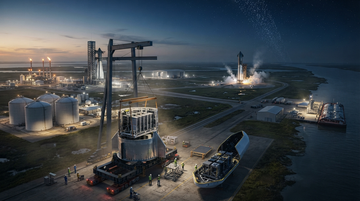
SpaceX’s announced plan for $100B in “Starbase, Louisiana” is not just another rocket site—it is a capacity bet. The published plan ties the project to a multi-pad launch campus and supporting infrastructure (including propellant production and power), with construction expected to start in 2027 and the first launch targeted as early as 2029.
Separately, SpaceX also signaled an orbital-data-center timeline shift: it moved the first orbital AI data-center launch window to Q4 2027, advancing it ahead of a previous “as early as 2028” expectation. Combined, these two announcements strengthen a single thesis for AI investors: launch slots, not GPUs, become the near-term binding constraint when orbital compute scaling depends on getting large payloads into orbit on schedule.
What the announcements actually claim
Starbase, Louisiana scale and timetable
At least $100B investment; construction expected to begin in 2027; first launch targeted as early as 2029
SpaceX-linked reporting citing the project’s stated scope and timing: $100B, campus layout, and launch target.
Orbital AI data-center launch window
First launch targeted for Q4 2027 (final three months of 2027), with significant scale expected in 2028
Timeline revision reported with a direct quote attributed to Elon Musk.
Supply-chain map investors often miss
Orbital AI scaling runs through launch operations—propellant, range throughput, and spacecraft integration
In terrestrial AI, power and data-center buildout are the usual bottlenecks. In orbital AI, the constraint shifts upstream: launches become the “power rail” for capacity. Even if an orbital-data-center startup has GPUs and a spacecraft design ready, scaling requires repeatable access to orbit.
That makes the launch value chain more central to valuation. On the upstream side, companies that can deliver launch services, spacecraft integration, or mission hardware at scale gain optionality when launch cadence improves. On the downstream side, communications and network infrastructure beneficiaries can win when orbital compute turns into a sustained compute+network service rather than a one-off demonstration.
- A new large spaceport can lift the number of payloads the system can support per year, which reduces the “wait-for-launch-slot” bottleneck for orbital compute.
- When orbital deployments move earlier (Q4 2027), integration and test schedules compress, raising demand for reliable manufacturing and mission systems on the space hardware stack.
- As orbital compute looks less like a novelty and more like infrastructure, network demand shifts from backhaul to sustained connectivity—benefiting operators tied to traffic growth and service-layer reliability.
- If spaceport throughput ramps with fewer schedule slips, financiers can underwrite faster go-lives for orbital data-center capacity.
Tie the orbital-data-center story to named funding and partners
Orbital AI isn’t hypothetical: Starcloud’s announced funding explicitly targets future launch allocation
Starcloud positions orbital data centers as an AI-compute platform in space. In its public funding disclosure, it ties additional capital use to scaling efforts that include procurement of future launch allocation. Starcloud also disclosed milestones indicating GPUs operating in orbit (including a first [NVIDIA H100] deployed in orbit “last November” per the funding release).
The investor take isn’t whether orbital compute is “better” than terrestrial—it’s that scaling depends on launch availability on a schedule investors can underwrite. In that sense, SpaceX’s Starbase, Louisiana plan and the Q4 2027 timing update are consistent with the way Starcloud describes its next scaling step: orbital compute capacity becomes a launch-funded, launch-constrained roadmap.
What gets repriced first (short horizon)
The first repricing should be launch throughput and mission-readiness spend—not just AI semiconductors
In the next several quarters, the most tradable variable is whether orbital compute moves from early deployments to a larger “group launch” cadence. The reported shift to Q4 2027 increases the probability-weight of earlier deployment milestones and, therefore, the near-term demand signal for launch services and mission integration.
For publicly traded names, that doesn’t require ownership of SpaceX or a direct contract headline. It requires that investors believe the launch ecosystem moves from prototype sporadicism toward recurring capacity. If so, companies that can participate in space missions—through launch services, mission systems, or downstream connectivity infrastructure—can see estimates change before any long-duration orbital AI revenue line is visible.
| Link in the chain | What the announcement changes | Likely market signal (days–quarters) |
|---|---|---|
| Launch operations / mission cadence | Orbital AI first-launch target shifts to Q4 2027 (final three months of 2027) | Higher probability of earlier mission orders and more predictable deployment windows |
| Space mission integration supply | Earlier timeline compresses integration and test schedules for customer payloads | Expectations for mission hardware utilization and recurring service capacity |
| Downstream communications demand | Orbital compute scaling implies more sustained network throughput needs | Traffic growth assumptions and service-layer demand for network operators |
Fundamentals lens for listed beneficiaries
How to think about listed exposure: capacity, cash burn, and service-layer durability
Rocket Lab scale (TTM revenue)
$769.1M
TTM revenue from company overview metrics for Rocket Lab USA, Inc., latest quarter shown in the same overview.
Northrop Grumman scale (TTM revenue)
$42.9B
TTM revenue from company overview metrics for Northrop Grumman Corporation.
Lumen scale (TTM revenue)
$11.8B
TTM revenue from company overview metrics for Lumen Technologies, Inc..
The listed-company takeaway is not that all beneficiaries share identical business models. It’s that investors should separate three effects:
1) launch-related demand (services, mission hardware readiness) tends to show up in utilization and contract activity before it shows up as “orbital AI” revenue lines.
2) network-service demand (connectivity, switching, routing, and traffic management) can move with a shift from sporadic demonstrations to sustained orbital operations.
3) AI chip demand (e.g., NVIDIA) can benefit long-term, but it’s less likely to be the first variable repriced if the bottleneck shifts to getting systems into orbit.
Long horizon: where the constraint could stay—or disappear
If Starbase throughput ramps as planned, orbital compute could move from venture timelines to infrastructure timelines
In a 1–3 year horizon, the key question is whether the launch-capacity expansion translates into more reliable, earlier deployments at scale—i.e., fewer launch delays and more predictable cadence.
Starcloud’s funding language (including additional capital aimed at procurement of future launch allocation) suggests the company believes launch access is an investable lever. If that lever works, investors should expect orbital compute timelines to converge toward infrastructure lifecycles rather than one-off mission windows.
But there are structural risks: spaceport timelines can slip, integration can take longer than expected, and demand can soften if pricing for orbital compute is higher than projected terrestrial alternatives. The bullish case depends on execution against the revised orbital launch window.
Bottom line for investors
AI’s “power wall” isn’t just about electricity anymore—orbital AI is making launch capacity the new bottleneck
SpaceX’s announced Starbase, Louisiana plan and the reported acceleration to Q4 2027 for the first orbital AI data-center launch together shift the center of gravity for orbital AI from “will the chips work?” to “can the launch system deliver on time?”
For investors, the actionable framing is this: when orbital compute becomes a scaled service, the supply-chain that competes for launch slots (and turns payloads into repeatable missions) should see earlier estimate revisions than companies whose exposure is mainly to the GPU stack. The trade becomes a launch-throughput story with second-order effects on networking and integration services.
Listed stocks that plausibly get repriced via the orbital-launch constraint
- A faster orbital deployment window can raise demand for small/mid-class launch capacity used to support constellation and payload schedules.
- Higher launch cadence can improve utilization assumptions for Electron-class missions in the 2027–2028 buildout period.
- If launch schedules firm up, investor confidence can improve around recurring mission revenue, even before orbital AI revenues show up explicitly.
- Orbital compute scaling increases the value of mission systems and space platform throughput, areas Northrop Grumman participates in.
- If more missions launch on schedule, expectations for space systems program stability can rise over 1–3 years.
- A sustained cadence can support steadier defense/space-related service demand even if commercial orbital AI is still ramping.
- If orbital AI turns into ongoing services, networking demand can shift toward higher sustained throughput (bull case).
- However, orbital compute scaling also competes with other cloud/network architectures, so direct upside may be diffuse versus pure-play datacenter equipment (bear case).
- Over 1–3 years, routing/security attach rates can benefit only if traffic volumes translate into enterprise-like deployments.
- Orbital compute growth implies more network transport needs, so watch for incremental traffic and service wins as deployments scale into 2028–2029.
- Lumen’s financial stability and margin profile make this a higher-volatility expression, so timing matters for any service-layer pickup (near-term risk).
- If throughput upgrades are funded and traffic materializes, operating leverage could improve; if not, upside may stay limited.
- Orbital AI expansion can still increase long-term demand for AI accelerators used in space deployments.
- But if launch capacity is the gating input, near-term GPU demand may not accelerate as fast as buyers want (bear case).
- Over 1–3 years, a successful cadence would support higher total accelerator utilization across more deployment locations.