%22%2F%3E%0A%20%20%3Ccircle%20cx%3D%22220%22%20cy%3D%22150%22%20r%3D%22180%22%20fill%3D%22%2322d3ee%22%20fill-opacity%3D%220.12%22%2F%3E%0A%20%20%3Ccircle%20cx%3D%221010%22%20cy%3D%22130%22%20r%3D%22220%22%20fill%3D%22%2338bdf8%22%20fill-opacity%3D%220.08%22%2F%3E%0A%20%20%3Ccircle%20cx%3D%22920%22%20cy%3D%22520%22%20r%3D%22170%22%20fill%3D%22%2322d3ee%22%20fill-opacity%3D%220.06%22%2F%3E%0A%20%20%3Cpath%20d%3D%22M140%20430h920%22%20stroke%3D%22url(%23line)%22%20stroke-width%3D%2212%22%20stroke-linecap%3D%22round%22%2F%3E%0A%20%20%3Cpath%20d%3D%22M220%20360c120-150%20260-220%20380-220s260%2070%20380%20220%22%20fill%3D%22none%22%20stroke%3D%22%2367e8f9%22%20stroke-opacity%3D%220.5%22%20stroke-width%3D%2216%22%20stroke-linecap%3D%22round%22%20stroke-linejoin%3D%22round%22%2F%3E%0A%20%20%3Cpath%20d%3D%22M300%20398h600%22%20stroke%3D%22%2394a3b8%22%20stroke-opacity%3D%220.24%22%20stroke-width%3D%228%22%20stroke-linecap%3D%22round%22%2F%3E%0A%20%20%3Ctext%20x%3D%22220%22%20y%3D%22510%22%20fill%3D%22%23e2e8f0%22%20fill-opacity%3D%220.7%22%20font-family%3D%22Arial%2C%20Helvetica%2C%20sans-serif%22%20font-size%3D%2238%22%20letter-spacing%3D%228%22%3EINSIGHTS%3C%2Ftext%3E%0A%3C%2Fsvg%3E)
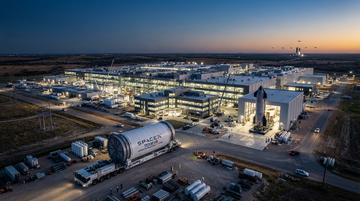
SpaceX is no longer just a launch company in the Terafab story: the announced goal is to manufacture chips for its own AI/robotics and space-data workloads, and to do it inside a “vertically integrated” Texas fabrication complex rather than waiting on external foundry capacity.
However, while many secondary articles circulate a “$16.8B” number, this session’s verifiable primary sources support $55B (initial) and up to $119B (multi-phase total)—and do not provide an on-the-record basis for $16.8B. The investment thesis below therefore anchors on the disclosed capex range rather than the unverified figure.
What’s verified about Terafab (and what isn’t)
Terafab is pitched as a vertically integrated chip complex, with an initial $55B and potential $119B multi-phase spend
- Terafab is described as a project involving Tesla and SpaceX (with xAI tied to chip usage in the stated plan).
- A May 6, 2026 update in Manufacturing Dive states SpaceX initially plans to spend $55B to build a chipmaking plant in Grimes County, Texas.
- That same report states the project could cost as much as $119B if additional phases are constructed.
Event verification snapshot (from sources opened)
Initial Terafab investment (disclosed initial)
$55B
Stated as initial spend for building a chipmaking plant in Grimes County, Texas.
Potential multi-phase total (disclosed ceiling)
$119B
Stated as a higher-end total if additional phases are constructed.
Ownership/partners explicitly described
SpaceX + Tesla (xAI in usage plan)
Fortune’s coverage ties chip usage targets to xAI and describes Terafab as run jointly by Tesla and SpaceX.
The supply-chain lens most investors miss
Own-fab strategy doesn’t just “cut out a foundry”—it re-allocates the AI compute value chain into equipment, materials, and packaging
When a compute-heavy company builds its own wafer supply, it doesn’t automatically replace every external dependency. Instead, it changes who captures which margin.
Terafab’s premise is wafer-level vertical integration for chips used in Tesla’s edge/inference workloads and SpaceX’s higher-power space workloads. That typically shifts spend away from pure foundry utilization and toward (1) fabrication equipment and process tooling, (2) specialty gases/chemicals and high-purity materials, and (3) advanced packaging/testing that can become the new bottleneck once wafers are no longer the constraint.
| Supply-chain layer | If you fab in-house | What value tends to move to | What can still bottleneck |
|---|---|---|---|
| Front-end wafer fabrication | More dependence on internal schedule + process yield | Process equipment makers + internal fabs’ operating leverage | Ramp time, yield learning curve, defectivity |
| Critical process inputs | More long-cycle contracting vs. spot foundry outsourcing | Chemicals/gases/material suppliers with scale and purity | Supply continuity during ramp-up |
| Packaging & test | Potentially the next constraint once wafers are available | Advanced packaging ecosystem (substrates, test handlers) | Throughput, test capacity, and qualification lead times |
| System integration (boards/servers/space modules) | More vertical integration work and qualification | OEM-level integrators and networking/compute infrastructure | Thermal design, reliability, qualification validation cycles |
Why “capacity” is worth money now
For AI compute buyers, the value driver is not wafer price—it’s booked capacity and predictable delivery
Terafab is best understood as a capacity-risk hedge. In AI hardware, the cost of an external capacity constraint often shows up as: delayed product readiness, incomplete training runs, underutilized data center build-outs, or forced last-minute component substitutions.
If a vertically integrated fab improves delivery predictability, the implied ROI isn’t “saving cents per wafer”; it’s funding the compute roadmap while avoiding schedule slips across Tesla/robotics and SpaceX space-data/AI pipelines. That’s exactly the shift your brief is pointing at—turning a launch-company asset (mission cadence) into a semiconductor procurement advantage.
Where existing foundry spending can be displaced (and where it can’t)
Even if Terafab captures the wafers, it won’t fully displace external compute supply—so the displacement is uneven
- Near-term displacement is likely smaller than headline fab capex implies because ramps take time and yield learning is slow in advanced nodes.
- Over time, Terafab should reduce dependency on external leading-edge wafer capacity for the specific chip classes Tesla and SpaceX target in their stated plans.
- But external foundries and partners can still win on components, process variants, and redundancy for qualification gaps—especially while internal processes mature.
This uneven displacement matters for investors: the “winner” isn’t necessarily the company whose fab you replace. It’s the supplier ecosystem whose bottleneck your vertical integration amplifies. The bottleneck can flip from wafers to packaging, from packaging to test throughput, or from test to qualified system integration.
What a $55B→$119B capex range implies for the risk profile
The IPO premium question becomes: can Terafab earn manufacturing-scale returns, not just engineer-scale launches?
A launch program can be valued on iteration speed and mission success rates. A fab program is valued on something closer to capital efficiency: yield ramp pace, defect density control, throughput, and utilization.
Because Terafab is multi-phase with a disclosed range ($55B initial; up to $119B total), the market should treat it as a staged option with meaningful execution risk. Without binding timelines and budgets in the open sources reviewed here, investors should assume that some portion of the capex will behave like “real option time value” rather than immediate earnings accretion.
Data points we can support from this session
Key disclosed Terafab numbers and chip-intent framing
Initial Terafab fab spend
$55B
Stated initial investment to build a chipmaking plant in Grimes County, Texas (reported update dated May 6, 2026).
Potential multi-phase total
$119B
Reported potential total investment if additional phases are constructed.
Location framing
Texas (Grimes County / Austin context)
Initial plant location described as Grimes County; chip project discussion placed in Austin context in Fortune coverage.
| Workload class | Stated target | Who is emphasized in the plan |
|---|---|---|
| Edge/inference | Chips described as inference-optimized for Tesla vehicle/robotics use | Tesla (primary), with Terafab feeding the intended stack |
| High-power space chips | Chips intended for SpaceX and xAI usage | SpaceX + xAI |
Horizons: what moves first vs. what decides the story
Short-term catalyst is capex signaling; long-term catalyst is yield + qualification
- In days–quarters, the first market reaction is likely to show up in investor sentiment around manufacturing ambition and regulatory/approval progress, not in near-term chip margins.
- In 1–3 years, the outcome hinges on measurable ramp progress: schedule adherence, confirmed build scope, and any disclosed qualification milestones for targeted chip classes.
- If Terafab fails to reach credible yields, the project becomes a long-duration drag—turning a compute moat into a capital drag.
One opinionated thesis
Terafab is a compute-stack moat attempt—so the investment case should be built around manufacturing learning, not narrative vertical integration
The Terafab announcement is not simply “SpaceX buys a chip factory.” It’s an attempt to make the silicon layer as mission-critical and iterative as launches.
For investors, the core question is falsifiable: will Terafab convert capex into reliable, high-throughput chip supply for Tesla/SpaceX-xAI workloads? The disclosed numbers ($55B initial; up to $119B total) mean the upside only becomes real if the program crosses manufacturing competence thresholds—yield, throughput, and qualification speed.
Listed supply-chain/public comparables potentially most exposed
- Terafab raises demand for deposition/etch/tooling capacity as capex scales to a $55B-to-$119B range, supporting multi-year equipment order visibility.
- In days–quarters, equipment backlog sentiment improves when new fab projects are announced versus when utilization tightens.
- Terafab’s advanced fab intent increases relevance of lithography capex because leading-edge nodes require the most constrained tools.
- Over 1–3 years, ASML benefits if ramp schedules stabilize (a proxy for sustained tool deliveries, not just one-time installs).
- Terafab can pressure external compute supply if custom silicon reduces GPU dependency, but the transition window may preserve demand for data center accelerators.
- In 1–3 years, NVIDIA’s direction depends on whether custom chips scale yields faster than system integration cycles (which are not disclosed here).
- Terafab doesn’t replace legacy analog/power needs instantly; Texas Instruments faces indirect channel uncertainty while the fab stack qualifies system components.
- Over 1–3 years, TXN moves based on disclosed confirmation of Terafab’s targeted chip classes (not provided in this session’s primary sources).