%22%2F%3E%0A%20%20%3Ccircle%20cx%3D%22220%22%20cy%3D%22150%22%20r%3D%22180%22%20fill%3D%22%2322d3ee%22%20fill-opacity%3D%220.12%22%2F%3E%0A%20%20%3Ccircle%20cx%3D%221010%22%20cy%3D%22130%22%20r%3D%22220%22%20fill%3D%22%2338bdf8%22%20fill-opacity%3D%220.08%22%2F%3E%0A%20%20%3Ccircle%20cx%3D%22920%22%20cy%3D%22520%22%20r%3D%22170%22%20fill%3D%22%2322d3ee%22%20fill-opacity%3D%220.06%22%2F%3E%0A%20%20%3Cpath%20d%3D%22M140%20430h920%22%20stroke%3D%22url(%23line)%22%20stroke-width%3D%2212%22%20stroke-linecap%3D%22round%22%2F%3E%0A%20%20%3Cpath%20d%3D%22M220%20360c120-150%20260-220%20380-220s260%2070%20380%20220%22%20fill%3D%22none%22%20stroke%3D%22%2367e8f9%22%20stroke-opacity%3D%220.5%22%20stroke-width%3D%2216%22%20stroke-linecap%3D%22round%22%20stroke-linejoin%3D%22round%22%2F%3E%0A%20%20%3Cpath%20d%3D%22M300%20398h600%22%20stroke%3D%22%2394a3b8%22%20stroke-opacity%3D%220.24%22%20stroke-width%3D%228%22%20stroke-linecap%3D%22round%22%2F%3E%0A%20%20%3Ctext%20x%3D%22220%22%20y%3D%22510%22%20fill%3D%22%23e2e8f0%22%20fill-opacity%3D%220.7%22%20font-family%3D%22Arial%2C%20Helvetica%2C%20sans-serif%22%20font-size%3D%2238%22%20letter-spacing%3D%228%22%3EINSIGHTS%3C%2Ftext%3E%0A%3C%2Fsvg%3E)
A real capex gate, not just rhetoric
Honda is treating the USMCA extension like a go/no-go condition for its next North American factory
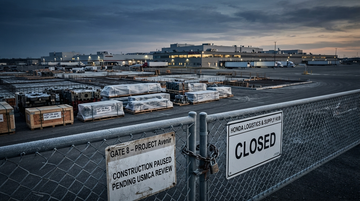
On Aug 25, 2026, Honda’s Noriya Kaihara said Honda “might not build an eighth assembly plant in North America” unless a key trade deal is extended—conditional language that turns the USMCA debate into a direct capital-allocation trigger.
Decision window
1–2 years
Honda said it will need to make a decision within a year or two
Ideal factory ramp
~2030
Honda said it would like the new plant to be running by around 2030
Honda also linked the statement to a capacity reality: it is “close to full production capacity in North America” and therefore needs a new factory. In practice, that means a trade-policy delay doesn’t just postpone headlines—it delays the downstream cascade of construction schedules and supplier qualifications.
From trade text to factory steel
Why an OEM build-hold freezes the supplier chain before it shows up in sales
When Honda gates an “eighth plant” on USMCA extension, the first casualty is typically not finished-car demand; it’s the lead-time economics behind it. Assembly investment requires long-horizon commitments: tooling, stamping/press lines, logistics lanes, hazardous materials planning, and the compliance documentation that makes “North America content” valuable. Suppliers that would normally sign multi-year build-to-print contracts face a timing mismatch—orders can move even when vehicle volumes haven’t.
- Qualification bottlenecks move first: supplier engineering sign-offs and validation test plans often need plant schedules to lock.
- Cross-border sourcing complexity becomes a cost option: without extension clarity, firms hedge by delaying “USMCA-optimized” allocations.
- Working-capital behavior changes: firms reduce certainty-driven inventory build and stretch supplier commitments while waiting for contract rerates.
The supply-chain exposure map
Which publicly traded links are most “sensitive to the capex gate,” and why
The most exposed listed names are the ones with (1) high integration into OEM production readiness and (2) significant spend on manufacturing systems, not just aftermarket replacement parts. In this policy-to-production transmission mechanism, component suppliers that supply modules and driveline content used in assembly ramp schedules generally react earlier than pure downstream distributors.
| Link in the chain | What gets delayed | Near-term supplier signal | Potential longer-term reallocation |
|---|---|---|---|
| OEM assembly capex (Honda’s 8th plant concept) | Press lines, layout approvals, and vendor qualification | Slower new order intake for system/module lines | Re-bid contracts once trade terms become bankable |
| Tier 1 module and system suppliers (e.g., seating/closures/drivetrain systems) | Tooling and plant-specific manufacturing engineering | Lower backlog growth / slower ramp of new platforms | Capacity redeployed into existing programs instead |
| Sub-tier propulsion components and thermal management | Program launch timing and compliance-driven sourcing allocations | Reduced certainty for incremental production lots | Shift to aftermarket or non-optimized supply routes |
| Electronics and sensing systems (for ADAS/controls) | Design-freeze coordination with OEM build dates | Longer lead-time negotiations and forecast volatility | Portfolio prioritization toward programs with stable approval |
What the numbers say about resilience
Supplier balance sheets matter because “waiting” is a cash-flow decision
Trade-policy uncertainty doesn’t automatically reduce demand; it reduces confidence about the terms under which demand will be produced. In supplier economics, that can show up as lower working-capital intensity tolerance or reduced capacity investment. Below are a few context points from listed industrials in the auto-supply orbit: the ability to keep investing (or keep absorbing delays) depends on their operating cash generation and investment coverage.
Honda scale (revenue context)
$22,517.9B
TTM revenue as reported for the fiscal period ended around Jun 30, 2026 (company fundamentals reference)
Magna investment coverage
3.43x
TTM capex-to-Operating Cash Flow as reported for the period ended around Jun 30, 2026
BorgWarner investment coverage
0.30x
TTM capex-to-Operating Cash Flow as reported for the period ended around Jun 30, 2026
Interpretation: if an OEM build hold lasts beyond the “budgeting cycle,” suppliers with tighter investment coverage have less room to carry idle tooling or carry incremental qualification labor. That’s why the first price action often appears in the supplier universe, even when OEM volume guidance remains unchanged.
Investor playbook
What to watch next: which dates and company behaviors will confirm or unwind the ‘freeze’
- Backlog language: suppliers may shift wording from “booked” to “forecasted” or “subject to program timing,” which often precedes revenue moves.
- Capex posture: look for changes in “sustaining vs. growth” spend intensity as companies re-phase tooling to the OEM schedule.
- Program awards timing: watch whether Tier 1s re-issue supplier RFQs or extend negotiation windows, rather than signing new long-lead orders.
Listed stocks with the clearest link to the OEM plant capex gate
- Honda said it may defer an eighth North American plant without a USMCA extension, with a decision in 1–2 years and a target ramp around 2030.
- Honda’s fundamentals show ongoing scale in automotive revenue, so a delayed plant pushes profitability timing rather than removing demand in the near term.
- If extension looks likely, Honda can re-open site selection and vendor qualification faster than supply ramps, shifting execution risk.
- If Honda’s capex gate tightens across OEMs, Magna may see slower incremental module orders tied to new-platform readiness before revenue changes.
- Magna’s TTM capex-to-operating-cash-flow of about 3.43x suggests capacity investment can continue through a modest delay, limiting downside.
- If the USMCA extension improves, Magna could re-accelerate tooling schedules ahead of longer lead-time components over 1–3 years.
- A build-hold can reduce incremental propulsion/thermal system volumes expected from new assembly launches over the next quarters.
- BorgWarner’s TTM capex-to-operating-cash-flow of about 0.30x implies less slack to carry uncertainty-driven idle spend if holds persist.
- If USMCA terms stabilize, BorgWarner can recover as OEM launch calendars resume, but the first quarter signal is usually backlog growth.
- If Honda’s stance increases perceived policy risk across OEMs, Toyota could face similar incremental-plant hesitation in North America, even without a direct statement.
- Toyota’s TTM operating profile supports ongoing production, but capex timing risk can still compress supplier order growth in the near term.
- If USMCA extension becomes likely, Toyota’s supply-chain commitments could benefit from faster stabilization of regional-content planning over 1–3 years.