Capital Markets
Deals, listings and the cost of money
IPOs, mergers, buybacks and credit issuance — what the terms of a deal say about what this market is willing to fund right now.
2026-08-02
%22%2F%3E%0A%20%20%3Ccircle%20cx%3D%22220%22%20cy%3D%22150%22%20r%3D%22180%22%20fill%3D%22%2322d3ee%22%20fill-opacity%3D%220.12%22%2F%3E%0A%20%20%3Ccircle%20cx%3D%221010%22%20cy%3D%22130%22%20r%3D%22220%22%20fill%3D%22%2338bdf8%22%20fill-opacity%3D%220.08%22%2F%3E%0A%20%20%3Ccircle%20cx%3D%22920%22%20cy%3D%22520%22%20r%3D%22170%22%20fill%3D%22%2322d3ee%22%20fill-opacity%3D%220.06%22%2F%3E%0A%20%20%3Cpath%20d%3D%22M140%20430h920%22%20stroke%3D%22url(%23line)%22%20stroke-width%3D%2212%22%20stroke-linecap%3D%22round%22%2F%3E%0A%20%20%3Cpath%20d%3D%22M220%20360c120-150%20260-220%20380-220s260%2070%20380%20220%22%20fill%3D%22none%22%20stroke%3D%22%2367e8f9%22%20stroke-opacity%3D%220.5%22%20stroke-width%3D%2216%22%20stroke-linecap%3D%22round%22%20stroke-linejoin%3D%22round%22%2F%3E%0A%20%20%3Cpath%20d%3D%22M300%20398h600%22%20stroke%3D%22%2394a3b8%22%20stroke-opacity%3D%220.24%22%20stroke-width%3D%228%22%20stroke-linecap%3D%22round%22%2F%3E%0A%20%20%3Ctext%20x%3D%22220%22%20y%3D%22510%22%20fill%3D%22%23e2e8f0%22%20fill-opacity%3D%220.7%22%20font-family%3D%22Arial%2C%20Helvetica%2C%20sans-serif%22%20font-size%3D%2238%22%20letter-spacing%3D%228%22%3EINSIGHTS%3C%2Ftext%3E%0A%3C%2Fsvg%3E)
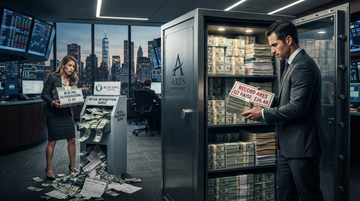
Private Credit Splits in Two: Ares Management Hoards $36B While Blue Owl Capital Scrapes $7.6B — and the $15.6B Retail Redemption Queue Names the Loser
In a single 48-hour window, Ares Management printed a record $36B of Q2 fundraising (Jul 31) while Blue Owl Capital reported its slowest quarter in three years at $7.6B (Jul 30). The same week, $15.6B of redemptions were requested from retail private-credit funds — and only $5.9B, or 38%, were actually returned. The ranking is now quantifiable: institutional-scale managers with diversified platforms and asset-based finance (Ares) are vacuuming up capital, while retail-marketed direct lenders (Blue Owl, Apollo, Blackstone) are repricing access. Ares Management trades at 57x trailing earnings for the privilege; Blue Owl Capital trades at 86x for a direct-lending franchise that fell to 35% of AUM.

The Small-Cap Rally Is Real—but August Must Prove It Is More Than a Rate-Cut Trade
The Russell 2000’s reported 10.3% July gain against a 1.2% rise for the S&P 500 marked a sharp breadth shift, but the evidence is not yet strong enough to call it a durable earnings cycle. Regional banks, industrials, energy and AI-infrastructure names all contributed to the broader move, while the Federal Reserve’s 3.50%–3.75% policy range keeps the trade highly sensitive to rates. August’s test is simple: do earnings revisions and credit conditions validate the rally, or does crowded positioning reverse?
2026-08-01

A Yen Buyer Has Joined the Trade—and It Is Changing the Intervention Math
The July 31, 2026 Japan–South Korea currency operation was reported as potentially involving the United States, but the evidence opened this session does not verify the brief’s claimed $5–10 billion Treasury purchase. The investable shift is still material: Washington’s reported willingness to coordinate converts intervention from a Tokyo-only defense into a policy signal that can reprice yen carry, exporter earnings, and cross-currency liquidity before any official Treasury balance-sheet purchase is confirmed.
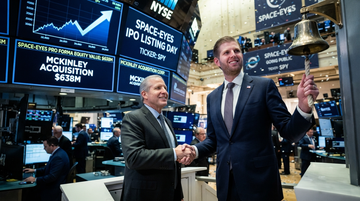
Space-Eyes prints at $638M on $1M of revenue — Eric Trump's defense-SPAC lane sets the price discovery for the next 50 small-caps
Space-Eyes is going public through McKinley Acquisition Corp at a $638M equity value on roughly $1M of trailing revenue and ~$35M of unsigned five-year contracts — a ~600× sales multiple that prices the deal almost entirely on Pentagon-tailwind narrative. The transaction makes Eric Trump the public face of a defense-tech SPAC queue that already includes XTEND's $1.5B JFB merger and Powerus's reverse merger, and it reframes whether Trump-family affiliation becomes a premium or a discount for the small-cap defense names queued behind it.
2026-07-31

The 'Leopold Liquidation' Just Gave iShares MSCI USA Momentum Factor ETF Its Biggest Day Ever — And Quantified How Crowded the AI Trade Really Was
On July 30, 2026, 24-year-old Leopold Aschenbrenner's $45B peak AI fund Situational Awareness LP was forced to dump its entire public stock book into a single block trade with Citadel after running ~4x gross leverage into a 35–47% July drawdown in SK Hynix, CoreWeave, Nebius and friends — and the MTUM momentum ETF closed up 5.7%, its largest one-day gain since inception. The event is the cleanest real-world data point yet on how concentrated, leveraged and factor-correlated the AI-infrastructure rally had become: a single fund's forced unwind erased ~$35B of NAV and triggered a 26% snapback in Sandisk and 27% in Nebius in one session, while shorts like Adobe stayed flat — meaning Citadel absorbed the flow on the long side alone. Investors should read the tape as a crowding bell, not a green light: Goldman Sachs had already disclosed that ~16% of its prime brokerage book was directly tied to AI memory, and the next forced seller will look a lot like Leopold.

Chevron's $12.1B Quarter Beats Exxon's $14.7B on Capital Return Math — The Iran-War Crude Print That Splits the Supermajors
Exxon Mobil and Chevron reported Q2 2026 earnings on July 31, fueled by Brent averaging $96.68/bbl during the Iran war — up 23% sequentially. Chevron's $6.06 EPS beat expectations by $0.50, while Exxon's $3.52 missed by $0.08, exposing a cleaner buyback/yield story at CVX versus XOM's scale advantage. Combined they returned $16B to shareholders and generated ~$35B of FCF in a single quarter, rewriting capital-return math into a sticky $90+ tape.

Tokyo and Seoul Just Staged a Joint FX Strike — And BOJ's Inflation Admission Tells You What Comes Next for US Tech and Banks
On July 30, 2026, Japan and South Korea executed a rare coordinated dollar-selling intervention that pushed the yen to 157.8 and the won up 2%, hours before Bank of Japan policymakers meet with an 'underlying inflation overshoot' warning still on the table. The pairing is a regime change in Asia FX policy — Tokyo can no longer fight the yen alone — and the BOJ's own admission that underlying inflation could overshoot to 2.2% by July 2027 forces at least one more rate hike before year-end. Together they compress the yen carry trade that funds US tech and tighten funding for yen-dependent US banks, with Morgan Stanley, Mizuho Financial Group and Nomura Holdings sitting at the cleanest transmission points.
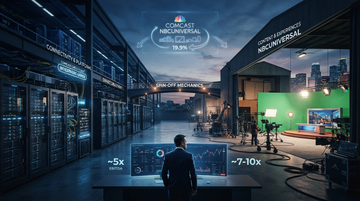
Comcast's CFO Hire for NBCU Pre-Prices the Spin: A Pure Broadband Pure-Play Trades at Cable Multiples, Not Hollywood Ones
Comcast named Christopher Halpin as NBCUniversal's CFO just one month after announcing a tax-free spinoff of its media assets by mid-2027, with former finance chief Michael Angelakis taking the remaining cable company. The hire is plumbing, but it tells the market where the split sits on the balance-sheet priority list — both entities get investment-grade ratings, Comcast keeps a 19.9% stake for up to a year, and the cable parent inherits roughly $90B of debt against a Q2 Connectivity & Platforms print of $19.8B. Investors should price the post-spin Comcast on cable multiples (~5x EBITDA), the new NBCUniversal on media multiples (~7–10x), and watch Versant's post-spin 25% drawdown as the proof-of-concept that small cable spin-offs underperform — but a $30B-plus media giant is a different animal.
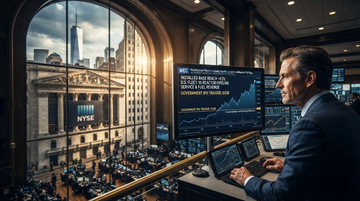
Westinghouse’s IPO Has a $30 Billion Shadow Price — but the Services Base Must Justify It
Westinghouse’s confidential filing is more than an IPO: it tests whether public investors will pay a premium for a reactor OEM that services roughly 63% of the operating fleet while retaining upside to a proposed 10-reactor U.S. buildout. The strongest valuation support comes from recurring fuel and outage work, not unbuilt reactors; the biggest complication is a government participation right that becomes economically relevant above a $17.5 billion threshold. For investors, the filing could reprice Cameco and Brookfield Renewable Partners first, then suppliers such as BWX Technologies if conditional projects become funded orders.
2026-07-30

Did the Fed’s “worst-long-bond-day” finally break the 30-year Treasury auction? The market is about to learn via the bid-cover vs. tail
Today’s $25B 30-year auction is the first real stress test of whether foreign/indirect demand still absorbs US long-end supply at a 5%+ post-Fed backdrop. The key isn’t the headline yield alone—it’s whether bid-cover holds while the tail (price concession) stays contained versus recent auctions, i.e., whether the “Fed put” is transmitting into auction clearing.

Blue Owl hits $319B AUM—here’s whether fee-related earnings actually scale with it
Blue Owl’s $319B AUM headline is the starting point, but the investable question is whether more AUM is converting into higher-quality, recurring fee-related earnings without showing stress in fee-earning engines. Based on the data available from this session, the key performance signal to watch is whether fee-related earnings rise alongside AUM that is already “paying fees” versus AUM “not yet paying fees.”
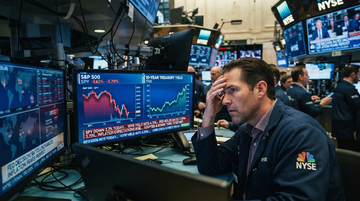
Fed Day Broke the Stock/Bond “Crash Cushion”—Because Inflation Risk and Real Rates Repriced Together
On Fed decision day (July 29, 2026), equities and Treasuries sold off in the same direction, not the usual hedge pattern. The move wasn’t just “rates stayed high”—it reflected a regime where inflation/risk premium and real-rate expectations rose together, weakening the diversification benefit long-duration Treasuries typically provide during growth scares.

ICE’s $5.7B MarketAxess bid can’t be modeled as “more liquidity”—it’s a fixed-income toll booth shift that squeezes execution and data economics
The paper-thin wedge regulators will focus on is not total bond liquidity—it’s who gets to charge for the electronic plumbing after ICE and MarketAxess consolidate fixed-income trading. If the $5.7B bid is approved on the stated economics, electronic credit and corporate-bond ETF “pick-up” spreads become a pricing battleground between the new duopoly’s toll booth and the ETF/dealer demand chain.

Johnson & Johnson's FY2026 EPS guide drops ~5% on deal/integration costs—proof the pharma M&A cycle is now a P&L story
After beating in Q2, Johnson & Johnson still cut FY2026 adjusted EPS guidance to $10.96–$11.11, attributing the reset to integration/transaction costs. The signal is broader than one quarter: the 2026–2027 healthcare earnings template is shifting from “pipeline-shaped upside” to “M&A-shaped near-term earnings pressure,” with investors needing to separate one-time deal costs from underlying franchise health.
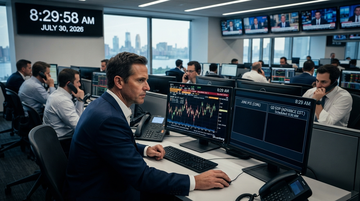
The “double-print” (PCE + Q2 GDP) is a single Fed test—because both prices and growth hit at 8:30 a.m.
Today’s BEA calendar stacks Personal Income and Outlays (June PCE) and GDP (Advance Estimate) (Q2) on the same 8:30 a.m. window, turning the usual macro routine into one all-in policy-input read. The market should treat the next 24 hours as a fork: core PCE cooling is what lets the Fed plausibly look through hot growth, while both running hot is what feeds a 30-year auction-driven duration selloff.
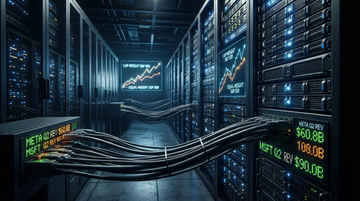
Mag-7 earnings are the first real “broadening” stress test—and the cap-weight is already doing the heavy lifting
The equal-weight S&P 500’s YTD lead suggests investors have been paying for “the average stock,” not just the largest tech complex. The first Mag-7 prints of the cycle (Meta and Microsoft) show why the divergence can flip: when leaders’ AI capex starts to pressure earnings quality, the cap-weight doesn’t just move with growth—it moves with expectations.

Meta’s capex jump buys AI time—but it risks starving FCF while Microsoft turns spend into service-margin growth
Meta and Microsoft printed a near-simultaneous capex signal, but the market’s read-through is likely less about AI demand and more about how each firm funds it. Meta’s latest reported cash flows show a large capex drain versus free cash flow, while Microsoft’s cash engine supports an even heavier buildout, implying power/cooling & connectivity vendors get paid sooner than advertising/consumer-internet margin holders.
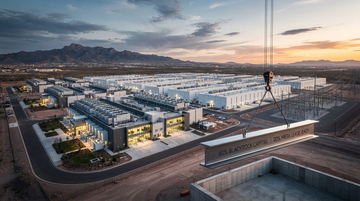
Meta's El Paso JV with BlackRock turns AI real-estate into pension-backed yield—without making Meta the bank
Meta will move the El Paso campus into a JV where BlackRock-managed funds hold 80% and Meta holds 20%, while Meta becomes the sole tenant via a long lease-back. The deal explicitly shifts AI infrastructure from a pure “capex deficit” debate to a “how cheaply can we finance long-lived boxes” debate—because part of BlackRock’s investment is funded with $12.5B of debt.
![Meta Platforms's Q2 FCF crater happens because capex rose faster than cash generation—and it flips the debate from 'earnings' to 'funding discipline'] insight cover](https://images-1379091077.cos.na-ashburn.myqcloud.com/insights/covers/20260730_meta_q2_2026_fcf_craters_ai_capex_double_down_2026_07_360px.png)
Meta Platforms's Q2 FCF crater happens because capex rose faster than cash generation—and it flips the debate from 'earnings' to 'funding discipline']
Meta’s Q2 cash flow shows free cash flow fell to about $1.7B while capex jumped to $30.1B, confirming the “AI capex first” regime with hard numbers. The immediate investor question shifts from whether AI monetizes soon to whether hyperscalers can sustain buybacks/credit ratings while front-loading capex.
2026-07-29

What to expect
Evidence-first notes with a visible point of view.
This section collects sharp takes on earnings, shareholder meetings, and market structure. Each new piece should make the thesis, the facts, and the implications obvious within the first few screens.
Expect direct analysis, not generic commentary.
Expect the data to be explicit and the argument to be easy to follow.
Plutux is not an investment adviser. Market data and AI-generated analysis are for information and education only, not investment advice. Disclaimer