%22%2F%3E%0A%20%20%3Ccircle%20cx%3D%22220%22%20cy%3D%22150%22%20r%3D%22180%22%20fill%3D%22%2322d3ee%22%20fill-opacity%3D%220.12%22%2F%3E%0A%20%20%3Ccircle%20cx%3D%221010%22%20cy%3D%22130%22%20r%3D%22220%22%20fill%3D%22%2338bdf8%22%20fill-opacity%3D%220.08%22%2F%3E%0A%20%20%3Ccircle%20cx%3D%22920%22%20cy%3D%22520%22%20r%3D%22170%22%20fill%3D%22%2322d3ee%22%20fill-opacity%3D%220.06%22%2F%3E%0A%20%20%3Cpath%20d%3D%22M140%20430h920%22%20stroke%3D%22url(%23line)%22%20stroke-width%3D%2212%22%20stroke-linecap%3D%22round%22%2F%3E%0A%20%20%3Cpath%20d%3D%22M220%20360c120-150%20260-220%20380-220s260%2070%20380%20220%22%20fill%3D%22none%22%20stroke%3D%22%2367e8f9%22%20stroke-opacity%3D%220.5%22%20stroke-width%3D%2216%22%20stroke-linecap%3D%22round%22%20stroke-linejoin%3D%22round%22%2F%3E%0A%20%20%3Cpath%20d%3D%22M300%20398h600%22%20stroke%3D%22%2394a3b8%22%20stroke-opacity%3D%220.24%22%20stroke-width%3D%228%22%20stroke-linecap%3D%22round%22%2F%3E%0A%20%20%3Ctext%20x%3D%22220%22%20y%3D%22510%22%20fill%3D%22%23e2e8f0%22%20fill-opacity%3D%220.7%22%20font-family%3D%22Arial%2C%20Helvetica%2C%20sans-serif%22%20font-size%3D%2238%22%20letter-spacing%3D%228%22%3EINSIGHTS%3C%2Ftext%3E%0A%3C%2Fsvg%3E)
Verified deal structure (what was actually announced)
Meta and BlackRock are splitting AI infrastructure risk: financeable “real estate” owned by pensions, compute owned by Meta
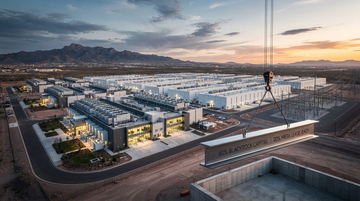
Meta and BlackRock announced a strategic venture to develop a data-center campus in El Paso, Texas. The core structure is a classic mismatch-broker: moves ownership of the long-lived campus to a BlackRock-led vehicle (80%), while Meta retains minority ownership (20%) and leases the entire facility as its sole occupant.
Total development cost (campus)
~$14B
Meta/BlackRock JV disclosed as approximately $14 billion total development costs.
Ownership split
80% / 20%
BlackRock-managed funds control 80% interest; Meta retains 20%.
Tenant / lease-back
Meta sole occupant
Meta will enter lease agreements for use of the entire campus; four-year initial term with four extension options.
Compute capacity when complete
1 GW
Facility expected to deliver 1 gigawatt of compute capacity when finished.
Planned go-live
2028
Venture expects to begin bringing capacity online in 2028.
Financing mechanics disclosed (why this can be “pension capital–friendly”)
Land / C.I.P. contribution
~$2.3B
Meta contributes land and construction-in-progress assets valued at approximately $2.3 billion.
BlackRock cash contribution at close
~$4.9B
BlackRock makes cash contribution of approximately $4.9 billion.
One-time distribution to align stakes
~$1.0B
Meta receives a one-time distribution of approximately $1 billion.
Debt funding component
$12.5B
A portion of BlackRock’s investment is funded through $12.5 billion debt financing.
Downside protection feature
~$13B RVG threshold
Meta provides residual value guarantees (RVG) with an aggregate threshold of approximately $13 billion decreasing over time.
Supply-chain aware framing (who gets what cashflow, who funds what)
The deal reroutes AI capex into four different balance sheets
- The real-estate / long-lived infrastructure cashflows sit in the BlackRock-led venture, where pension/insurer-style capital can target duration and yield—because the JV owns the campus.
- Meta’s balance sheet shifts from “own-and-maintain the campus” toward “lease occupancy,” turning capex uncertainty into contracted usage economics—because Meta becomes the sole tenant under long lease terms.
- BlackRock’s funding mix explicitly includes debt financing that supports ~$12.5B of the investment, creating a capital-stack that can be priced like infrastructure rather than like pure tech build-and-hold.
Zooming out: this is not merely a JV headline; it changes the investor who must be “convinced” at each supply-chain step. In traditional hyperscaler builds, the company that plans compute also bears the financing cost of power/land/buildings. Here, the financing conversation can move from FCF deficits to capital-stack pricing—because the campus is packaged for institutional ownership while Meta preserves operational control through tenancy.
Why this matters for the power-grid bottleneck
El Paso is a test case: when power is scarce, lease-backed campuses make grid upgrades financeable sooner
AI data-center timelines increasingly hinge on power and cooling lead times. While the press release excerpt focuses on ownership, capacity, and lease structure, the disclosed “$14B campus” scope necessarily includes long-lived power, cooling, and connectivity infrastructure. The important point for investors is the sequencing: institutional-capital structures can front-load grid-related capex by turning construction exposure into contracted occupancy economics once the campus is complete.
Fundamentals cross-check: does Meta’s financial profile support taking the compute tenant role?
Meta can afford to be the tenant—and it still has ample operating cash generation to underwrite lease commitments
Meta revenue (FY 2023 → FY 2025)
$134.9B → $201.0B
Revenue: $134.902B (2023), $164.501B (2024), $200.966B (2025).
Meta net income (FY 2023 → FY 2025)
$39.1B → $60.5B
Net income: $39.098B (2023), $62.360B (2024), $60.458B (2025).
Meta capex intensity (context)
Capex is high
Meta’s capex-to-operating-cash-flow ratio is elevated (ttm: 0.611), consistent with ongoing infrastructure investment.
Being the tenant rather than the owner doesn’t remove cash needs—but it can stabilize them. The disclosed lease terms and RVG framework mean Meta’s obligations are structured contractually instead of being fully dependent on asset-market value at exit. In other words, Meta’s role is shifted from “financier of the campus” to “allocator of compute demand”—which is a more natural fit for a hyperscaler whose core competency is utilization and deployment.
Investor transmission: who benefits and who loses in the “AI landlord becomes a yield product” logic
If campus ownership becomes an income product, data-center landlords and utilities become closer substitutes
| Supply-chain node | What gets “re-priced” | Who captures yield | What changes for the hyperscaler |
|---|---|---|---|
| Campus ownership (land + buildings + power/cooling) | Moves toward institutional return targets | BlackRock-led JV / long-duration capital | Tenant lease replaces ownership capex bearing |
| Financing / capital stack | Debt + equity underwritten as infrastructure | Lenders + yield-focused investors in the JV | Meta reduces direct exposure to financing cost volatility |
| Operational capacity (compute) | Becomes contracted usage aligned to hyperscaler demand | Meta captures operational control | Meta’s economics focus on utilization and unit economics, not asset resale |
| Grid & utility interface (power availability) | Earlier commitment becomes financeable if cashflows are contracted | Utilities / grid-adjacent infrastructure stakeholders | Power lead-time becomes more “project-financeable” |
What happens next (short term vs. long term)
Timing is the catalyst: construction jobs now, cashflow underwriting in 2028 and beyond
- Short-term (days to quarters): investors will parse the disclosed RVG mechanics (threshold and step-down) to estimate how much downside sits with Meta vs the JV investors.
- Short-term: watch for follow-on financing announcements tied to the $12.5B debt component—because that reveals lender appetite and pricing for AI real-estate risk.
- Long-term (1–3 years after 2028): if the 1 GW campus performs as expected and lease terms prove resilient, expect the “AI landlord as yield product” model to spread to other hyperscaler sites with power constraints.
Bottom line for investors: the Meta-BlackRock El Paso venture is a capital-structure innovation, not just a new build. It reclassifies hyperscaler real estate into an institutional yield instrument by coupling a BlackRock-owned campus (80%) with a hyperscaler sole-tenant lease-back, while explicitly using $12.5B of debt financing in the stack. That should tighten how quickly financial markets can mobilize against AI infrastructure demand—and it reshapes which listed tickers should trade with data-center “yield” sentiment versus pure construction sentiment.
Listed proxies that are most plausibly linked to the JV’s financing and infrastructure transmission
- The JV design uses BlackRock-led capital stacks with $12.5B debt backing, which supports demand for infrastructure-style underwriting and structuring fees over time.
- Meta’s lease-back shifts risk from technology capex to contract cashflows—which can increase institutional appetite for BlackRock-managed real-asset yields after 2028.
- Moves $14B campus ownership risk off Meta’s balance sheet (Meta retains 20%), but keeps upside/downside via residual value guarantees.
- Because Meta’s revenue and net income scale (FY 2025 net income $60.458B), Meta can likely meet lease economics—yet the RVG threshold (~$13B) is the key exposure as assets age.
- Could face competitive pressure on “institutional-owned campus” narratives if hyperscalers increasingly internalize landlord economics in JV structures.
- If institutional investors replicate this model, the market may reassess REIT/campus valuation sensitivity—so watch for data-center yield sentiment changes around 2028.
- Power constraints are central to AI timelines; if campus financing accelerates, utilities can see earlier grid work—which can improve visibility into long-cycle capex needs.
- Because the press release ties the JV to a “$14B campus” including power/cooling scope (implied by campus description), watch regulatory capital deployment signals over the next 12–24 months.
- If hyperscalers proliferate data-center builds under yield-backed structures, demand for critical connectivity can rise—supporting fiber/telecom build-out indirectly.
- However, because this specific El Paso JV is about compute capacity (1 GW) and campus scope rather than tower density, upside is more sentiment-linked than contract-backed—so treat as a secondary proxy.