Capital Markets
Deals, listings and the cost of money
IPOs, mergers, buybacks and credit issuance — what the terms of a deal say about what this market is willing to fund right now.
2026-09-01
%22%2F%3E%0A%20%20%3Ccircle%20cx%3D%22220%22%20cy%3D%22150%22%20r%3D%22180%22%20fill%3D%22%2322d3ee%22%20fill-opacity%3D%220.12%22%2F%3E%0A%20%20%3Ccircle%20cx%3D%221010%22%20cy%3D%22130%22%20r%3D%22220%22%20fill%3D%22%2338bdf8%22%20fill-opacity%3D%220.08%22%2F%3E%0A%20%20%3Ccircle%20cx%3D%22920%22%20cy%3D%22520%22%20r%3D%22170%22%20fill%3D%22%2322d3ee%22%20fill-opacity%3D%220.06%22%2F%3E%0A%20%20%3Cpath%20d%3D%22M140%20430h920%22%20stroke%3D%22url(%23line)%22%20stroke-width%3D%2212%22%20stroke-linecap%3D%22round%22%2F%3E%0A%20%20%3Cpath%20d%3D%22M220%20360c120-150%20260-220%20380-220s260%2070%20380%20220%22%20fill%3D%22none%22%20stroke%3D%22%2367e8f9%22%20stroke-opacity%3D%220.5%22%20stroke-width%3D%2216%22%20stroke-linecap%3D%22round%22%20stroke-linejoin%3D%22round%22%2F%3E%0A%20%20%3Cpath%20d%3D%22M300%20398h600%22%20stroke%3D%22%2394a3b8%22%20stroke-opacity%3D%220.24%22%20stroke-width%3D%228%22%20stroke-linecap%3D%22round%22%2F%3E%0A%20%20%3Ctext%20x%3D%22220%22%20y%3D%22510%22%20fill%3D%22%23e2e8f0%22%20fill-opacity%3D%220.7%22%20font-family%3D%22Arial%2C%20Helvetica%2C%20sans-serif%22%20font-size%3D%2238%22%20letter-spacing%3D%228%22%3EINSIGHTS%3C%2Ftext%3E%0A%3C%2Fsvg%3E)

2026-08-31

Aon's $17B USI purchase turns brokerage scale into a measurable valuation benchmark
Aon has signed an all-cash agreement to buy USI Insurance Services from KKR for $17B, setting a fresh pricing reference point for middle-market insurance distribution. The more actionable signal for public-broker investors is KKR’s exit economics—expected to generate about $3.3B of after-tax proceeds—because it reflects what private-asset holders now require to move. The same consolidation impulse also raises the odds of continued M&A pressure on rivals positioned to compete for US P&C and employee-benefits placement share.

GameStop's cash-first store shrink turns the earnings story from “meme” to “milking leases”
GameStop’s latest update frames a weaker near-term quarterly sales outlook alongside continued store portfolio optimization and the completed exit of France operations via divestiture accounting. The investor takeaway is not just lower top-line—it's that the market is now valuing execution of cost/lease rationalization and capital preservation over any retail-speculation multiple.

When helium scarcity meets crypto mania: the HNT weekend jump looks less like supply-chain repricing and more like liquidity-driven narrative trading
China’s temporary helium export ban (announced July 10, 2026) is a real physical supply shock for helium-dependent sectors, but it does not translate into a clear, near-term earnings shock for listed helium suppliers. Instead, the reported HNT weekend surge reads more like cross-asset reflexivity—crypto liquidity hunting for “scarcity” story momentum—than a clean reprice of helium gas fundamentals.

Offerpad’s Nasdaq relisting is a “housing bottom” test for iBuyers: Q2 liquidity economics show Cash Offer can scale—but still needs a rate-friendly resale window
Offerpad’s OPAD transfer to Nasdaq on Aug. 31, 2026 is not an iBuyer comeback by itself, but it gives the market a fresh price discovery moment for whether instant-cash offers can sustain margins in a still-stiff mortgage-rate environment. In its latest reported quarter, Cash Offer generated most of revenue while the company’s overall gross profit stayed thin and operating cash flow swung negative—so the iBuyer model’s next phase depends more on resale velocity than on the “cash” headline.

When Wella files for a US IPO, the real question isn’t beauty—it’s whether a debt-led carve-out can still price “prestige” in a soft consumer tape
KKR’s move to take Wella Company public forces investors to underwrite a premium that would normally be reserved for steady, consumer-defensive demand. The filing’s leverage and carve-out structure become the market’s stress test: can brand-led hair/beauty cash flows outperform rising costs and cyclical pressure without KKR-like financial engineering?
2026-08-30

A “World Bank for defense” pitch could shift backlog risk into a loan book—if DSRB really can turn €5B of paid-in capital into a $116B lending pipeline
The Defence, Security and Resilience Bank (DSRB) is aiming to raise $116B of lending capacity backed by roughly €5B of upfront paid-in commitments, according to Reuters. If it launches on a low-cost, long-dated basis in 2027, the structure would change how prime contractors and their supplier base finance production ramp-ups—potentially easing working-capital pressure from defense backlogs while intensifying competition versus defense-focused private credit.

IMAX’s sale openness is really a value-unbundling bet on its technology-and-content licensing engine
IMAX’s stated openness to a sale reframes the company as more than a theater footprint story: investors should expect buyers to underwrite the premium-format licensing rail (technology products plus content solutions) using box-office-linked economics rather than gate counts. The near-term trading impulse may be headline-driven, but the deal math hinges on how “system backlog → recurring licensing revenue” converts under a higher multiple buyer.

Oura’s $3B IPO bet isn’t on smart rings—it’s on a subscription “health-data toll road” that investors must underwrite at a $16B+ valuation
Oura has signaled a potential U.S. IPO that could raise up to $3B and value the business at more than $16B, while projecting roughly $2B in 2026 sales. That combination implies the market is paying consumer-tech multiples for recurring health-data economics—so the real debate is whether retention and downstream monetization can persist even as Apple, Garmin, and other smart-ring entrants scale marketing and device cycles.
2026-08-29

Amaero’s S-1 arrives in a moment when investors don’t just question defense backlog—they question whether “factory capacity” can actually scale
Amaero AMROF is positioning its hypersonics-linked manufacturing chain around domestic, powder-to-near-net-shape production—an angle that directly targets the same execution worry that showed up in the recently pressured defense-IPOs theme. But its fundamentals still look like a pre-scale industrial builder: losses persist and free cash flow remains deeply negative, so the market will likely pay for credible capacity ramp, not just contracts.
![Open-weight AI’s M&A boom is turning “open” into a paid gateway — and NVIDIA [NVDA] is positioning to own the distribution layer insight cover](https://images-1379091077.cos.na-ashburn.myqcloud.com/insights/covers/20260829_open_weight_ai_ma_trend_360px.png)
Open-weight AI’s M&A boom is turning “open” into a paid gateway — and NVIDIA [NVDA] is positioning to own the distribution layer
The hottest acquisition targets in open-weight AI are increasingly the distribution rails: model hubs, licensing platforms, and routing layers. With reported activity clustering around $13B-scale offers for Hugging Face and dealmaking that channels open-weight usage through major platforms, the “open” tier risks being priced into fewer hands. The winners are the infrastructure owners that can convert open models into compute demand and enterprise subscriptions, while the frontier labs face a consolidation-driven moat reset.
2026-08-28

Affirm faces a valuation standoff: the credit curve vs. the M&A market
The Aug. 28 premarket move in Affirm spotlights how investors are re-pricing BNPL credit risk after peers’ guidance resets and deal narratives stall. Because Affirm is the only US-listed BNPL pure-play, its loss provisions and funding costs are the cleanest read-through to whether the “next” BNPL multiple is set by the Fed or by a buyer.

Braveheart Bio’s $382.5M IPO priced at $18—and it quietly widens the “FDA-binary week” stress test for biotech IPO risk
Braveheart Bio BRVE priced an upsized IPO at $18.00 and raised $382.5M in gross proceeds, immediately following the kind of “midterm healthcare repricing” that often makes biotech buyers more selective. With the IPO timed into a high-information FDA cycle and the market just absorbed Latigo’s LTGO $345.6M Nav1.8 pricing, Braveheart’s debut looks less like a one-off and more like the latest read-through on how much biotech uncertainty the IPO window will fund.

OCC moves to make bank enforcement timing and penalties more predictable—raising the “compliance cost” signal for regional banks
On Aug. 27, 2026, the Office of the Comptroller of the Currency (OCC) announced revised policies and procedures aimed at improving transparency and consistency in bank enforcement and supervisory standards. The key investor takeaway is that—if the new framework tightens how “violations” and “unsafe or unsound” determinations translate into supervisory actions—regional banks should face a more consistent compliance-cost distribution and less uncertainty around M&A approval timelines.

Pasqal’s Nasdaq debut turns “quantum second wave” into a cash-and-capex test
Pasqal’s Nasdaq go-public deal with Bleichroeder values the neutral-atom pure-play at a roughly $2.0B pre-money with ~$500M gross proceeds to the company, giving the market a concrete pricing benchmark for deep-tech hardware beyond the AI complex. Using IonQ’s reported cash burn and revenue scale as a yardstick, the question for investors is less “who wins quantum,” and more whether Pasqal can turn a cash runway into commercialization that outgrows burn before the public-market IPO window tightens further.

PayPal’s buyout collapse vs. Stripe’s “platform value”: the deal math implies the market was already discounting PayPal’s standalone turnaround
The reported $53B Stripe–Advent bid reportedly unraveled abruptly, triggering a sharp ~12% one-day drop in PayPal. The bigger lesson isn’t just deal-break risk; it’s what the bid premium versus the post-collapse valuation implies about how much “independent” earnings recovery the market will pay for—without a buyer underwriting the turnaround.
2026-08-27

TD, RBC and CIBC’s same-morning Q3 results turn Canadian majors into a North American credit “vitals check” — TD’s US retail PCL is the signal
With TD, RBC and CIBC reporting fiscal Q3 on the same morning, the trio delivered a near-simultaneous read on credit health across Canadian and U.S. consumer/mortgage exposure. TD’s U.S. Banking credit losses and implied annualized PCL rate act as the swing input for how investors should price near-term U.S. consumer and mortgage risk as Canadian demand cools.
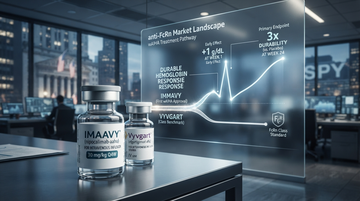
J&J’s Imaavy approval turns wAIHA into the anti‑FcRn class’s first real pricing proving ground—and raises the bar for argenx’s Vyvgart
On Aug. 24, 2026, the FDA approved Janssen’s Imaavy (nipocalimab-aahu) as the first treatment specifically cleared for warm autoimmune hemolytic anemia (wAIHA). Because this is the first commercially approved test of the anti‑FcRn mechanism in wAIHA, the launch will quickly become a benchmark that shapes payer and physician expectations for future FcRn expansions—including whether Vyvgart remains the default reference point within the class.

Moderna’s $2B convertible bets oncology—dilution math hinges on capped calls, not the headline bond size
Moderna MRNA announced a $2.0B private placement of convertible senior notes due 2032 to fund oncology growth flexibility and repayment of debt, while also paying for capped-call hedges to limit dilution. The “bull trap” debate is less about whether the company needs cash and more about whether the equity’s implied conversion path is realistic given the capped premium and Moderna’s persistent cash burn.

NYSE Texas’ Dallas headquarters opening turns the “venue war” into a real capacity bet for the next mega-IPO wave
The NYSE has opened a Dallas headquarters for NYSE Texas, formalizing the incumbent’s physical commitment to Texas’ new listing ecosystem just as the mega-IPO window is back in focus. The key investor takeaway is that the headquarters move shifts exchange competition from marketing and regulatory process to execution: listings, listing support, and end-to-end deal workflow friction all become harder to ignore.
What to expect
Evidence-first notes with a visible point of view.
This section collects sharp takes on earnings, shareholder meetings, and market structure. Each new piece should make the thesis, the facts, and the implications obvious within the first few screens.
Expect direct analysis, not generic commentary.
Expect the data to be explicit and the argument to be easy to follow.
Plutux is not an investment adviser. Market data and AI-generated analysis are for information and education only, not investment advice. Disclaimer