Aerospace, Defense & Space
Defense budgets and the contractors behind them
Procurement rounds, backlogs, launch cadence and rearmament programmes, read as multi-year revenue with the primes and suppliers named.
2026-07-29
%22%2F%3E%0A%20%20%3Ccircle%20cx%3D%22220%22%20cy%3D%22150%22%20r%3D%22180%22%20fill%3D%22%2322d3ee%22%20fill-opacity%3D%220.12%22%2F%3E%0A%20%20%3Ccircle%20cx%3D%221010%22%20cy%3D%22130%22%20r%3D%22220%22%20fill%3D%22%2338bdf8%22%20fill-opacity%3D%220.08%22%2F%3E%0A%20%20%3Ccircle%20cx%3D%22920%22%20cy%3D%22520%22%20r%3D%22170%22%20fill%3D%22%2322d3ee%22%20fill-opacity%3D%220.06%22%2F%3E%0A%20%20%3Cpath%20d%3D%22M140%20430h920%22%20stroke%3D%22url(%23line)%22%20stroke-width%3D%2212%22%20stroke-linecap%3D%22round%22%2F%3E%0A%20%20%3Cpath%20d%3D%22M220%20360c120-150%20260-220%20380-220s260%2070%20380%20220%22%20fill%3D%22none%22%20stroke%3D%22%2367e8f9%22%20stroke-opacity%3D%220.5%22%20stroke-width%3D%2216%22%20stroke-linecap%3D%22round%22%20stroke-linejoin%3D%22round%22%2F%3E%0A%20%20%3Cpath%20d%3D%22M300%20398h600%22%20stroke%3D%22%2394a3b8%22%20stroke-opacity%3D%220.24%22%20stroke-width%3D%228%22%20stroke-linecap%3D%22round%22%2F%3E%0A%20%20%3Ctext%20x%3D%22220%22%20y%3D%22510%22%20fill%3D%22%23e2e8f0%22%20fill-opacity%3D%220.7%22%20font-family%3D%22Arial%2C%20Helvetica%2C%20sans-serif%22%20font-size%3D%2238%22%20letter-spacing%3D%228%22%3EINSIGHTS%3C%2Ftext%3E%0A%3C%2Fsvg%3E)

General Dynamics can’t monetize defense demand if shipbuilding execution hits a fixed “output ceiling”
Recent disclosures show record backlog scale for General Dynamics alongside explicit recognition that higher U.S. Navy demand is pressuring the shipbuilding industrial base already stressed by demographics. The investable question shifts from “is demand strong?” to “how fast can backlog be turned into margin and cash when capacity, labor, and supplier throughput bind?”

Defense backlogs are not “capacity”—fixed-price contract structure and supply-chain + labor execution decide which primes (and suppliers) actually monetize demand
Across Lockheed Martin and Northrop Grumman, the filings show that backlog growth can coexist with contract-level cost and margin pressure under fixed-price development/early-production risk. Investors should treat backlog as a demand signal—but value conversion hinges on labor availability, supply-chain performance, and how much profit/loss risk sits inside the contract terms.

DoorDash's Part 135 move turns drone delivery from a partnership add-on into a regulated, asset-heavy moat
DoorDash says its DoorDash Labs unit earned FAA Part 135 air-carrier certification on Jul 29, 2026, and is launching an in-house “DoorDash Air” vertical stack. That changes the economics of last-mile drone delivery because DoorDash can amortize its own aircraft + hub setup while shifting integration away from Wing/Flytrex/Manna partners—while Part 135 certification acts like a regulatory capacity barrier.

General Dynamics' backlog conversion is already showing up in cash—now the question is whether that production curve can keep up
General Dynamics is printing classic backlog-to-execution signals: a 2-to-1 book-to-bill in Q1 2026 and operating cash conversion of 192% of net earnings. The risk for investors isn’t demand—it’s whether delivery pacing (especially in aerospace) can sustain as backlog rises, without margin or cash quality slipping.

House Democrats Just Forced xAI/SpaceXAI to Answer a Clean-Air Permitting Loophole—Turning 27–60 “Unpermitted” Gas Turbines Into a Federal Risk
A House Energy & Commerce ranking-member letter to SpaceXAI demands documents and site-visit access about Colossus 1/2 turbines alleged to be operating “without air permits,” explicitly describing an attempted dodge via “mobile sources.” For hyperscalers planning behind-the-meter gas capacity, the message is simple: once on-site turbines reach scale, permitting becomes a federal oversight issue, pushing the market mix toward utility PPAs (and away from regulatory arbitrage).
2026-07-28

FAA’s 453-jet 737 MAX seat-track AD turns a “capacity ramp” into a workmanship audit—Boeing’s quality story now has billable hours
The FAA’s proposed AD (Docket FAA-2026-7228; Federal Register 91 FR 46881) would require inspections of incorrectly installed seat-track assemblies on 453 Boeing 737 MAX aircraft, with an FAA-estimated compliance cost of up to $2.656M for U.S. operators. The key market signal is not the dollar amount itself—it’s that regulators are forcing proof that the production system can reliably “lock” interior hardware, not just pass safety-critical validations.

The 10Y TIPS auction is the bond market’s “Fed put” audit—real yields easing is the signal Nasdaq duration needed
After the Jul 28 auction, the key question isn’t whether CPI cooled again—it’s whether Treasuries are willing to underwrite a Fed cut-path without demanding higher real compensation. If real-yield normalization holds into the Sep FOMC, it mechanically lowers discount rates on long-duration cash flows, giving a cleaner tailwind to Nasdaq-style growth versus an oil-driven inflation re-think.
2026-07-27

Amazon turns a 5,105-satellite direct-to-device plan into a spectrum + handset + carrier-power contest
Amazon’s proposed 5,105-satellite LEO direct-to-device (D2D) system reframes satellite connectivity from an emergency add-on into a carrier-grade service layer. The economic battleground shifts toward which operator controls (1) the right spectrum to reach unmodified phones, (2) launch-and-capacity cadence, and (3) device/carrier distribution—making launch partners and MSS spectrum owners strategically closer to the handset profit pool.

Nasdaq’s 15% Revenue Jump Looks Like Mix Shift, Not Just More Trading Volume
In Nasdaq’s latest quarter, total net revenue rose 15%, while Market Services's segment net revenue rose 11%—a smaller step than the consolidated growth. The implication for investors: upside is leaning on recurring index/data/workflow economics, but the stock still inherits cyclical sensitivity through trading-activity and listing-driven flows.

Pentagon’s “years behind Ukraine” drone admission turns into a stock-picker’s map: who gets the bridge contracts (and who gets stuck with legacy scale)
The Pentagon has publicly acknowledged that U.S. industry is still years away from matching Ukraine’s wartime drone output, reframing the U.S. drone push as an industrial-capacity gap problem—not just software or tactics. For investors, the immediate read-through is a procurement bridge: winners should be the firms that can scale production and backlog conversions fast under DoD funding momentum, while legacy primes face slower ramp and execution risk even if their total defense budgets benefit.
2026-07-26

FAA’s $2.2B Airline Retrofit Rebate Quietly Turns the Altimeter Upgrade into a 2027 Supply-Chain Price War
The FAA is tying part of the C-band wireless proceeds to a radio-altimeter upgrade schedule by offering up to $2.2B in rebates to eligible airlines that retrofit to withstand 5G interference. That converts what looked like an aviation-safety compliance cost into a structured, time-bounded industrial-policy transfer—creating a near-2027 decision fight between airlines’ fleet replacement plans and avionics upgrade timing, while boosting demand visibility for airframe OEM and avionics suppliers.

Embraer's record backlog only matters if suppliers and engines stop slowing the delivery clock
Embraer reported a US$34.5B backlog in 2Q26, up 16% YoY, but the market’s real question is conversion: how much of that backlog becomes near-term deliveries and working-capital cash flows.Backlog can stay “high” while cash timing slips when delivery slots are constrained by engines and upstream components; the supply-chain risk shows up in the gap between backlog growth and liquidity/FCF generation.

Nasdaq’s Pre‑Earnings “Capex Confession” Sell Signal Hits Semis First—Because Hyperscaler Guidance Can Break the Math
On the tape, the Nasdaq can reprice AI exposure before hyperscalers even print, when investors treat guidance tone as a proxy for whether $300B+ of planned infrastructure spend stays intact. For semiconductors, the key risk isn’t “AI demand exists or not”—it’s whether hyperscaler capex cadence and margin narratives soften fast enough to pull forward a downgrade cycle through the supply chain.
2026-07-25

Anduril’s ~$100B talk is a software-multiple bet—but only if it can manufacture like a defense prime
A reported round in which Anduril could be valued at about $100B would test whether investors will underwrite defense autonomy on “growth + speed” instead of traditional procurement denominator math. The value hinges on proving repeatable production ramp, durable backlog conversion, and system-level sustainment economics—otherwise the Pentagon’s old guard can defend share by slowing adoption and raising integration friction.
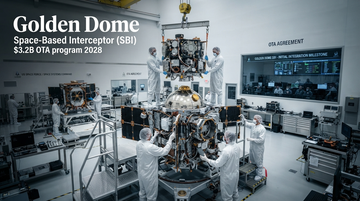
U.S. “Golden Dome” shifts from program hype to a 2028 capacity-and-integration test—timing becomes the real risk
The U.S. Space Force’s Space-Based Interceptor (SBI) awards for Golden Dome lock in a multi-vendor prototype sprint aimed at demonstrating initial capability by 2028. For investors, the key isn’t just who won—it's whether primes and subsystem suppliers can convert those OTA-funded prototypes into integrated, production-relevant capacity as budgets move from planning to deployment.

Embraer’s backlog can’t be a “capacity moat” if suppliers control the delivery clock
Embraer’s backlog hit record levels (total backlog of $32.1B in 1Q26), but the investable question is whether orders convert into near-term deliveries and operating cash. Embraer's cash flow and working-capital profile suggests conversion is possible—but supplier-constrained build slots can still push cash timing out faster than revenue recognition.

Starship’s “pause-to-prove” moment reframes the US launch complex’s next-3-year valuation math around cadence, not just cost
Starship’s latest “market-watching” step isn’t a new performance claim—it’s a test of whether the US launch complex can sustain sub-monthly tempo without hidden reliability drag. For listed suppliers of launch hardware and mission assurance, the investment question shifts from theoretical reusability to whether launch providers can win contracts that require repeatable schedules and liability/insurance confidence.
2026-07-24

Europe’s “buy-local” procurement shifts Lockheed, RTX, and Northrop from premium programs to margin-managed components—while Rheinmetall/BAE/Leonardo take the production leverage
Verified reporting shows the EU’s procurement push is turning “access to platforms” into “access to local sustainment and co-production capacity,” starting with missiles and air-defense spares. For US primes, the margin risk is not losing the customer—it’s winning fewer high-margin builds and more tightly specified work that requires licenses, local partners, and sustainment-heavy economics.

Lockheed Martin’s Missile Ramping Isn’t a One-Off: The 2026 Guidance Lift Implies the Restock Cycle Is Turning Into a Multi-Quarter Revenue Engine
When Lockheed Martin and RTX raised 2026 targets on missile restocking momentum, it marked the first earnings-confirmed “build more, faster” signal for U.S. primes. The key investor question is whether 2026 is pull-forward—or the start of a durable production-and-delivery cadence where the primes become the steepest part of the defense curve.

Oracle’s $7B Pentagon software consolidation win reframes its defense business from “AI megacampus drain” to durable on-prem cashflow
The Pentagon’s nearly $7B, up-to-10-year contract with Oracle is less about frontier AI and more about consolidating sprawling on‑prem enterprise software—plus maintenance and consulting—into a single procurement path. That changes how investors should think about Oracle’s defense exposure: from “spend-heavy AI buildout risk” to a repeatable, subscription-and-license-style government revenue stream tied to IT standardization.
What to expect
Evidence-first notes with a visible point of view.
This section collects sharp takes on earnings, shareholder meetings, and market structure. Each new piece should make the thesis, the facts, and the implications obvious within the first few screens.
Expect direct analysis, not generic commentary.
Expect the data to be explicit and the argument to be easy to follow.
Plutux is not an investment adviser. Market data and AI-generated analysis are for information and education only, not investment advice. Disclaimer