Aerospace, Defense & Space
Defense budgets and the contractors behind them
Procurement rounds, backlogs, launch cadence and rearmament programmes, read as multi-year revenue with the primes and suppliers named.
2026-08-17
%22%2F%3E%0A%20%20%3Ccircle%20cx%3D%22220%22%20cy%3D%22150%22%20r%3D%22180%22%20fill%3D%22%2322d3ee%22%20fill-opacity%3D%220.12%22%2F%3E%0A%20%20%3Ccircle%20cx%3D%221010%22%20cy%3D%22130%22%20r%3D%22220%22%20fill%3D%22%2338bdf8%22%20fill-opacity%3D%220.08%22%2F%3E%0A%20%20%3Ccircle%20cx%3D%22920%22%20cy%3D%22520%22%20r%3D%22170%22%20fill%3D%22%2322d3ee%22%20fill-opacity%3D%220.06%22%2F%3E%0A%20%20%3Cpath%20d%3D%22M140%20430h920%22%20stroke%3D%22url(%23line)%22%20stroke-width%3D%2212%22%20stroke-linecap%3D%22round%22%2F%3E%0A%20%20%3Cpath%20d%3D%22M220%20360c120-150%20260-220%20380-220s260%2070%20380%20220%22%20fill%3D%22none%22%20stroke%3D%22%2367e8f9%22%20stroke-opacity%3D%220.5%22%20stroke-width%3D%2216%22%20stroke-linecap%3D%22round%22%20stroke-linejoin%3D%22round%22%2F%3E%0A%20%20%3Cpath%20d%3D%22M300%20398h600%22%20stroke%3D%22%2394a3b8%22%20stroke-opacity%3D%220.24%22%20stroke-width%3D%228%22%20stroke-linecap%3D%22round%22%2F%3E%0A%20%20%3Ctext%20x%3D%22220%22%20y%3D%22510%22%20fill%3D%22%23e2e8f0%22%20fill-opacity%3D%220.7%22%20font-family%3D%22Arial%2C%20Helvetica%2C%20sans-serif%22%20font-size%3D%2238%22%20letter-spacing%3D%228%22%3EINSIGHTS%3C%2Ftext%3E%0A%3C%2Fsvg%3E)

2026-08-16

2026-08-15

Alphabet’s SpaceX stake turns buybacks into an asset-liquidity story, not just cash-return math
Alphabet’s disclosed SpaceX position is now valued around $94B and dwarfs typical “minority investment” narratives on the balance sheet. The implication for GOOGL investors is that the cash-return story depends not only on free cash flow, but also on when (and how) this post-IPO equity can become sale proceeds or other shareholder value.

Trump’s “Finland Model” opens a limited route for foreign-built U.S. Navy hulls—Hanwha Ocean and Fincantieri gain optionality while GD/HII lose their “U.S.-only yard” pricing power
A White House memorandum signed Aug. 13, 2026 lets qualifying foreign shipbuilders build initial Navy hulls abroad while requiring major U.S. yard investment, U.S. workforce training, U.S. supply-chain sourcing, and technology licensing. The near-term demand signal is most supportive for Hanwha Ocean and Fincantieri, because they already have large U.S. shipyard footprints, while the traditional U.S. prime shipyard duopoly faces a structurally wider builder base and more competitive capacity.
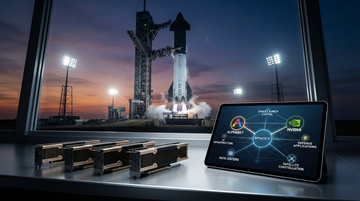
Nvidia’s $21B SpaceX stake turns mega-cap AI cash into launch/defense equity—and concentrates risk where demand can’t be rerouted fast
Nvidia NVDA disclosed a roughly $21B SpaceX position in its latest 13F-HR (as of June 30, 2026), making SpaceX one of its biggest strategic equity exposures. The same ownership map also shows Alphabet’s decade-old bet at about $94B and Tiger Global’s entry, underscoring a new, self-reinforcing loop: AI infrastructure economics can increasingly decide space launch capital, and that concentration can magnify governance and cash-use second-order risks.
SpaceX’s Closed Cursor Deal Turns an AI Coding “Oligopoly” Into a Distribution Fight
SpaceX SPCX made its $60.0B all-stock Cursor (Anysphere) acquisition effective on Aug. 14, 2026—converting Cursor shareholders into 389,289,254 shares of SpaceX Class A stock. The immediate market impact is less about model quality and more about which developer tools get privileged distribution inside a vertically integrated “Musk stack,” potentially pressuring pricing and partner leverage for GitHub Copilot and other coding-agent workflows.
2026-08-14

Steam- and hydraulic-driven catapult changes could flip aircraft-carrier electronics content—rewarding legacy electromechanical supply chains while pressuring modern shipboard-electronics primes
A new White House directive orders the Navy to replace EMALS and advanced weapons elevators with steam and hydraulic systems for future CVN-81. That reverses the shipboard electronics content mix: it shifts value from modern electromechanical-and-software-heavy launch/recovery subsystems toward legacy electromechanical/hydraulic supply chains, while also introducing schedule and cost risk for carrier programs near industrial capacity limits.
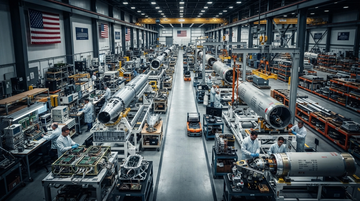
Pentagon’s SM-3 “restock” plan is now a factory-capacity bet (Boeing & RTX)
Framework agreements signed by the U.S. Pentagon with Boeing and RTX aim to scale the production of specific SM-3 interceptor components—not place a simple new missile order—shifting the restock story to a bottleneck question. The near-term market takeaway: component-output ramp capability at primes and propulsion/rocket-supply partners matters as much as the headline procurement numbers.
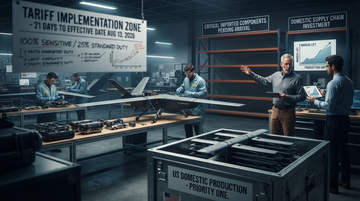
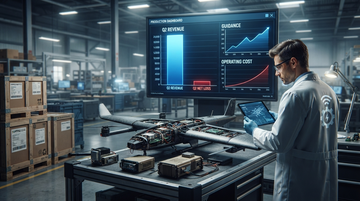
Drone tariffs can lift U.S. drone margins fast—but they cannot replace the Pentagon’s missing production capacity
Trump’s Aug. 13, 2026 drone-tariff package raises duties on imported drones (including 100% on “particularly sensitive” platforms, 25% on smaller drones, and 15% on covered allied countries) starting 21 days after signing. The immediate market read-through for UMAC, RCAT, ONDS, AVAV, and KTOS is a short-cycle pricing and sourcing repricing, not a volume solution. The Pentagon’s own assessment of a years-long U.S. industrial-output gap means tariffs are a margin catalyst, while capacity still depends on procurement programs and industrial base investment.
2026-08-13
2026-08-12
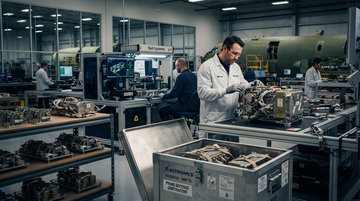
Astronics proved the defense restock can run through aerospace-electrical suppliers—Q2 backlog math now backs a higher FY26 revenue runway
In Q2 FY2026, Astronics reported record sales of $260.0M (+27.0% y/y) and lifted FY2026 revenue guidance to $1.02B–$1.04B (midpoint ~$1.03B). The key tell isn’t just the beat; it’s that bookings (book-to-bill 1.18) and segment backlog expansion are already concentrated in its Aerospace and Test Systems businesses, implying demand is reaching the supply tier—not stopping at the primes.

Joby's $500M defense acquisition reframes eVTOL economics: air-taxi won’t pay yet, but defense cargo might fund the next version
Joby is paying about $500M to acquire Resonant Sciences, a defense-technology business, positioning its eVTOL platform for military-relevant payload and manufacturing pathways. The key investor question becomes whether defense revenue is scalable enough to offset years of air-taxi dilution and losses—something the deal terms and Joby’s cash burn make measurable.

United States Antimony just reset antimony pricing—and the stock is telling you who still gets paid at policy-linked levels
In its Q2 2026 reporting, United States Antimony disclosed a ~52% drop in average antimony selling prices to $13.70/lb and linked the reset directly to weaker spot pricing, cutting its full-year 2026 gross revenue guidance range. The key investor takeaway is not the commodity headline—it’s that the US mineral “policy premium” for the retail trade can vanish overnight when the embedded pricing formula reverts, creating a buyer/dislocation risk across the downstream defense/flame-retardant demand chain.
2026-08-11

Hanwha’s $1.05B–$1.2B bid for Austal’s U.S. shipbuilding arm turns allied capital into a capacity lever
Hanwha Defense USA has made a preliminary, non-binding offer for Austal’s U.S. entities and operations valued at $1.05B–$1.2B (cash- and debt-free), and the next test is whether Korean execution can lift U.S. naval shipbuilding throughput without slowing qualification. For investors, the deal is less about “who builds ships” and more about whether allied ownership can compress the schedule-and-supply bottlenecks that have historically capped output.
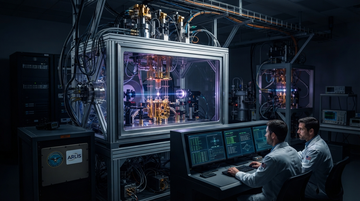
IonQ and ARLIS Are Building the DoD’s First Networked “Blind” Quantum System—Turning Quantum From Demos Into Deployable Mission Capability
IonQ’s newly awarded ARLIS contract is a meaningful step from “quantum access” toward a deployable, multi-node “blind quantum computing” system for national-security research. The investor implication is not just a government check—it’s whether quantum vendors can operationalize networked quantum with the security, control, and integration stack the Pentagon will repeatedly fund.

The SEC is finally policing the private secondary market — and its first big “compliance date” is attached to SpaceX and Klarna
A new SEC litigation release shows the agency is treating certain pre-IPO secondary trading intermediations as securities-fraud and investment-adviser compliance failures, citing misconduct tied to both Space Exploration Technologies Corp. (SpaceX) and Klarna Group plc. For investors and platforms that rely on “private-market access,” the key shift is that enforcement risk is moving upstream—from after-IPO disclosures to the mechanics of how pre-IPO shares are sourced, priced, and moved.
2026-08-10

Archer just bought Boeing’s autonomous-air-taxi stack for ~19.75% equity—turning eVTOL consolidation into a flight-certification supply story
Archer Aviation’s planned all-equity purchase of Boeing’s [Wisk Aero], [SkyGrid], and [Insitu] subsidiaries gives Boeing an ~19.75% stake plus $200M of option-like warrants—effectively bundling a certification-and-operations pathway into Archer’s capital plan. The deal reframes “autonomous air taxi” from a software thesis into an integrated, Boeing-adjacent supplier of flight, sensing, and airspace integration assets.

Fisher’s AI-Infrastructure Crowding Trade Is Real—But It’s the “Grid-to-Aircraft-to-Network” Link That Should Matter for Investors
Fisher Asset Management’s latest 13F (quarter ended June 30, 2026) shows aggressive positioning across AI’s “real economy” buildout—power and electrification via GE Vernova, aerospace platforms via GE Aerospace, and enterprise/data-center connectivity via Cisco Systems, alongside the usual AI compute core. The investable takeaway is not that AI exists—it’s that Fisher is paying up for the bottlenecks and replacement cycles that sit between AI demand and the supply chain that fulfills it.
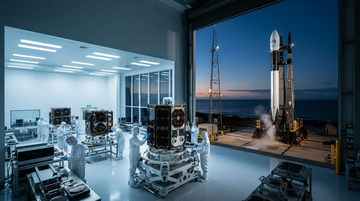
Rocket Lab's margin signal is a satellite-mix test: Q2 gross margin rose to 36.1% even as space-systems revenue shifted
In Rocket Lab's latest quarterly filing, Space Systems delivered most revenue ( $189.5M of $234.1M total) while Launch Services shrank, yet consolidated gross margin still rose to 36.1% from 32.1% a year earlier. The investment question isn’t whether satellite sales are growing—it’s whether Rocket Lab can keep space-service unit economics from resetting margins downward when lower-profit satellite-heavy revenue mix shows up in quarterly results.

SpaceX’s First Retail Sell Turns the Mega‑IPO Regime Signal: When Mom‑and‑Pop Becomes a Source, Liquidity Stops Being One‑Way
SpaceX saw its first net retail selling in the post‑IPO era when mom‑and‑pop traders sold a net $4.5M of shares on Aug. 7, 2026 (first negative reading since the June IPO). That matters because the next wave of tradable supply is already scheduled via lockup expiries—starting with a major tranche eligible around Aug. 20—so sentiment can now amplify supply rather than absorb it.
What to expect
Evidence-first notes with a visible point of view.
This section collects sharp takes on earnings, shareholder meetings, and market structure. Each new piece should make the thesis, the facts, and the implications obvious within the first few screens.
Expect direct analysis, not generic commentary.
Expect the data to be explicit and the argument to be easy to follow.
Plutux is not an investment adviser. Market data and AI-generated analysis are for information and education only, not investment advice. Disclaimer