%22%2F%3E%0A%20%20%3Ccircle%20cx%3D%22220%22%20cy%3D%22150%22%20r%3D%22180%22%20fill%3D%22%2322d3ee%22%20fill-opacity%3D%220.12%22%2F%3E%0A%20%20%3Ccircle%20cx%3D%221010%22%20cy%3D%22130%22%20r%3D%22220%22%20fill%3D%22%2338bdf8%22%20fill-opacity%3D%220.08%22%2F%3E%0A%20%20%3Ccircle%20cx%3D%22920%22%20cy%3D%22520%22%20r%3D%22170%22%20fill%3D%22%2322d3ee%22%20fill-opacity%3D%220.06%22%2F%3E%0A%20%20%3Cpath%20d%3D%22M140%20430h920%22%20stroke%3D%22url(%23line)%22%20stroke-width%3D%2212%22%20stroke-linecap%3D%22round%22%2F%3E%0A%20%20%3Cpath%20d%3D%22M220%20360c120-150%20260-220%20380-220s260%2070%20380%20220%22%20fill%3D%22none%22%20stroke%3D%22%2367e8f9%22%20stroke-opacity%3D%220.5%22%20stroke-width%3D%2216%22%20stroke-linecap%3D%22round%22%20stroke-linejoin%3D%22round%22%2F%3E%0A%20%20%3Cpath%20d%3D%22M300%20398h600%22%20stroke%3D%22%2394a3b8%22%20stroke-opacity%3D%220.24%22%20stroke-width%3D%228%22%20stroke-linecap%3D%22round%22%2F%3E%0A%20%20%3Ctext%20x%3D%22220%22%20y%3D%22510%22%20fill%3D%22%23e2e8f0%22%20fill-opacity%3D%220.7%22%20font-family%3D%22Arial%2C%20Helvetica%2C%20sans-serif%22%20font-size%3D%2238%22%20letter-spacing%3D%228%22%3EINSIGHTS%3C%2Ftext%3E%0A%3C%2Fsvg%3E)
Policy & trade
What changed overnight: the tariff math is designed to reprice imported drones and parts, not to manufacture them in America
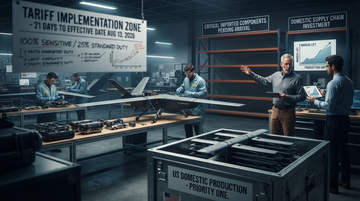
On Aug. 13, 2026, the White House announced a new tariff package on imported drones and drone parts/components, with different ad valorem rates by drone sensitivity and by country of origin. The structure matters for investors: the policy targets the cost of imported inputs and finished systems, but it does not instantly create industrial capacity inside the U.S.
Main “particularly sensitive” drones
100% ad valorem
Drones with maximum takeoff weight >25 kg, thermal imaging capability, docking stations for these drones, and certain critical components; policy timing starts 21 days after signing
Smaller, less-sensitive drones
25% ad valorem
Applied to smaller drones and certain components that are not in the most sensitive category; timing starts 21 days after signing
Tariffs on covered allied import sources
15% ad valorem
Applied to drones and components from the EU, Japan, Liechtenstein, South Korea, Switzerland, and Taiwan; timing starts 21 days after signing
Timing for less-sensitive components
180 days after signing
Components of drones that are “not particularly sensitive,” plus certain exemption-related FCC-covered-list timing paths
Defense-industrial capacity
The Pentagon’s own admission: the U.S. industrial base is still years behind what the battlefield needs
The market’s “tariff = volume” instinct runs into a harder constraint: U.S. drone manufacturing capacity. In late July 2026, a Pentagon/Defense Innovation Unit official told Reuters that the U.S. would have ordered only just under 200,000 drones cumulatively by February under the Drone Dominance Program, while Ukraine was expected to produce roughly six to seven million small FPV attack drones over the same year—about 500,000 per month. The same reporting notes that winning future orders would require localization in the U.S.
| Metric (as reported) | U.S. program pace | Ukraine wartime pace | Implication for tariffs |
|---|---|---|---|
| Cumulative drones by February (Drone Dominance Program) | Just under 200,000 | Not directly comparable (Ukraine output cited separately) | Tariffs can reprice imported systems, but the baseline U.S. scale is still low |
| Ukraine FPV output expectation (this year) | Not cited in the same line | 6–7 million small FPV drones (≈500,000/month) | U.S. capacity still lags by order(s) of magnitude |
Supply-chain transmission
How the tariff lever transmits through a drone bill of materials (and where it stops)
- If a meaningful share of a company’s bill of materials or sourcing is imported, tariffs raise landed costs and force pricing renegotiation before new U.S. assembly capacity can scale.
- For drone platforms and docking systems in the “particularly sensitive” bucket, the 100% rate is a direct incentive for buyers to qualify alternate sourcing or domestically assembled products—supportive for U.S. suppliers with qualification pathways.
- For components classified as less sensitive, the 180-day timing creates a staged repricing: finished-system pricing moves first, parts-cost pressure follows later (unless exemptions apply).
- The industrial-base gap acts as a ceiling: even if tariffs create demand pull, production ramp still depends on tooling, supplier qualification, workforce, and procurement commitments.
Company-level fundamentals
What the margin story looks like in the five U.S.-listed names investors traded: revenue scale differs, profitability maturity differs, and that changes how tariffs matter
The five U.S.-listed small/mid-cap drone-exposed names linked to the policy narrative trade differently than a “pure volume” play because their profitability maturity and cost structure differ. That means tariffs can be supportive via margin and order timing, but the ability to benefit depends on whether a company can (1) qualify as a substitute, and (2) turn a repriced procurement pipeline into incremental revenue fast enough to offset higher input costs.
Where upside can show up first
Short-term (days to a few quarters): the tariff hits pricing, qualifying, and inventory economics—then earnings follow only if orders convert
- Expect the earliest visible move in gross margin pressure or uplift depending on whether a firm’s products are priceable to customers faster than input costs rise (the 21-day vs. 180-day timing creates sequencing).
- Companies with government-facing qualification cycles can see backlog timing effects: buyers rush to lock in supply before tariffs and/or exemption pathways change economics.
- For smaller-cap names, any incremental revenue in the near term is likely small in dollars but large in stock sensitivity, so near-term guidance language (wins, production qualification, and supply agreements) matters more than trailing profitability.
What investors must not assume
Long-term (1–3 years): tariffs can’t close a multi-year industrial gap without procurement + industrial-base financing
The longer-term question is whether the tariff-induced demand pull gets translated into U.S.-based output. The Pentagon’s Reuters-cited “years behind” framing suggests that even a sharp policy shock will be insufficient if capacity and qualification pipelines remain constrained. A stock-picker should therefore separate (a) margin repricing and substitution effects—which can happen quickly—from (b) sustained volume acceleration—which depends on procurement scale-up and industrial-base expansion.
Investor playbook
How to pick winners from this tariff shock (a checklist tied to what the policy can and can’t do)
- Prefer names where revenue is tied to systems sold through procurement channels that can award quickly rather than purely speculative platform demand.
- Stress-test whether the firm can protect margins when tariffs change both finished-system and component economics (compare gross profit levels to cost structure for the most recent reported periods).
- Look for supply-chain flexibility: can the firm switch from tariff-exposed sourcing to alternative qualified sourcing without breaking performance or delivery timelines?
Tariff-exposed drone names most directly linked to substitution and margin repricing
- Tariffs can raise pricing power expectations for substitute drone supply, but UMAC’s TTM revenue is only ~$31.9M, so conversion speed must be proven.
- UMAC’s operating loss in the latest TTM means any tariff-driven gross profit uplift must be large enough to offset fixed operating costs to change earnings trajectory.
- Near term, tariff timing (21 days vs. 180 days) should influence which parts-cost pressures show up next in reported periods.
- If buyers shift away from tariff-exposed imported drones, RCAT can gain substitution share into government and adjacent buyers that need faster qualified supply.
- With TTM revenue around $71.5M, even modest incremental orders can move revenue without requiring immediate factory-scale change (but conversion must be evidenced).
- Because the tariff package hits within weeks, RCAT’s stock reaction should be most tied to order timing language rather than long-term capacity claims.
- ONDAS has TTM revenue near $96.6M; tariff-driven substitution can support near-term revenue momentum if its drone ecosystem maps to qualified supply needs.
- Gross profit of $43.3M (TTM) implies tariff economics may affect margins, but sustaining profitability still depends on converting demand into repeatable procurement.
- The Pentagon’s multi-year output gap means tariff support is likely margin-first, volume-second unless procurement scale-up is disclosed.
- AVAV’s scale (TTM revenue about $1.98B) positions it to benefit from qualified substitution when import costs spike, with less reliance on ramping new capacity for early quarters.
- AVAV’s operating performance remains negative in the latest TTM, so tariff benefits must flow through gross profit into earnings to be durable.
- Because tariffs include 100%/25%/15% categories with staged component timing, AVAV’s contract mix should determine how quickly margin direction stabilizes over subsequent filings.
- KTOS’s TTM revenue near $1.52B suggests it can capture substitution effects if procurement schedules reallocate buys toward U.S.-sourced platforms.
- With positive net income in the latest TTM ($30.9M), tariffs could improve margins if KTOS can price faster than its own input costs rise.
- However, the Pentagon-cited multi-year industrial gap implies KTOS still can’t assume unit-volume acceleration purely from tariffs; capacity and awards matter.