%22%2F%3E%0A%20%20%3Ccircle%20cx%3D%22220%22%20cy%3D%22150%22%20r%3D%22180%22%20fill%3D%22%2322d3ee%22%20fill-opacity%3D%220.12%22%2F%3E%0A%20%20%3Ccircle%20cx%3D%221010%22%20cy%3D%22130%22%20r%3D%22220%22%20fill%3D%22%2338bdf8%22%20fill-opacity%3D%220.08%22%2F%3E%0A%20%20%3Ccircle%20cx%3D%22920%22%20cy%3D%22520%22%20r%3D%22170%22%20fill%3D%22%2322d3ee%22%20fill-opacity%3D%220.06%22%2F%3E%0A%20%20%3Cpath%20d%3D%22M140%20430h920%22%20stroke%3D%22url(%23line)%22%20stroke-width%3D%2212%22%20stroke-linecap%3D%22round%22%2F%3E%0A%20%20%3Cpath%20d%3D%22M220%20360c120-150%20260-220%20380-220s260%2070%20380%20220%22%20fill%3D%22none%22%20stroke%3D%22%2367e8f9%22%20stroke-opacity%3D%220.5%22%20stroke-width%3D%2216%22%20stroke-linecap%3D%22round%22%20stroke-linejoin%3D%22round%22%2F%3E%0A%20%20%3Cpath%20d%3D%22M300%20398h600%22%20stroke%3D%22%2394a3b8%22%20stroke-opacity%3D%220.24%22%20stroke-width%3D%228%22%20stroke-linecap%3D%22round%22%2F%3E%0A%20%20%3Ctext%20x%3D%22220%22%20y%3D%22510%22%20fill%3D%22%23e2e8f0%22%20fill-opacity%3D%220.7%22%20font-family%3D%22Arial%2C%20Helvetica%2C%20sans-serif%22%20font-size%3D%2238%22%20letter-spacing%3D%228%22%3EINSIGHTS%3C%2Ftext%3E%0A%3C%2Fsvg%3E)
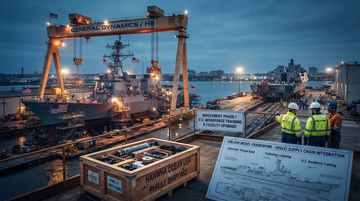
Policy pivot with direct industrial-base implications
What changed: foreign yards can compete for a limited set of Navy ship classes under the “Finland Model”
On Aug. 13, 2026, the White House issued a national security memorandum titled “Rebuilding the United States Navy and America’s Shipbuilding Industrial Base.” It formalizes a pathway for foreign shipbuilders to participate in U.S. Navy shipbuilding capacity expansion—so the eligible builder base is no longer purely “U.S.-yard only.” The core mechanism is a “Finland Model” framework: foreign suppliers must localize the industrial footprint in the United States, then can use their parent yard to build the first units.
The policy’s design is intentionally constrained. It allows foreign suppliers to pursue the Finland Model for up to three ship classes, but it limits the abroad-built phase such that ships are built in U.S. yards after the first two ships in the program.
Foreign participation model
Finland Model
Defined in the Aug. 13, 2026 White House memorandum’s Section 3(a)–(d)
Ship classes eligible
Up to three
Section 3(a) states the Finland Model “shall be used for up to three ship classes”
Abroad-built exception
First two ships
Foreign shipbuilders must build all ships “after the first two” in U.S. shipyards
Congress timing gate
30-day wait
No contract may be made under the waiver until 30 days after the determination is received by Congress
Scope and constraints
Which ship types the policy points to—and why it matters for who wins early work
The memorandum’s Section 3(b) names target categories of acquisitions that can be implemented using the Finland Model approach: (1) surface combatants with sufficient inherent capabilities for anti-submarine warfare, surface warfare, and convoy escort duties; and (2) a new competitive acquisition approach for CONSOL (Consolidated Cargo Replenishment at Sea) tankers; and (3) roll-on/roll-off (Ro-Ro) vessels tied to military sealift.
It also includes constraints that affect how much redesign work can be imposed on mature “parent” designs. Section 3(c) prohibits the Navy from imposing iterative design changes on the original mature parent designs within these programs without high-level approvals. Investor takeaway: the “transferable design” requirement favors builders with proven, standardized production pathways and mature parent designs that can be adapted for U.S. survivability and sustainment without repeated redesign cycles.
Operationally, downstream integration pressure is real: foreign-built hull systems still must plug into U.S. sustainment and maintenance ecosystems, which raises the value of companies that already have established U.S. yard operations and local supplier networks.
- Surface combatants become eligible under the Finland Model approach only if the Navy refrains from iterative parent-design changes
- Consol tankers and Ro-Ro vessels are positioned as near-term candidates where local supply chain transition is more tractable
- The waiver framework includes a congressionally observable 30-day window that can slow awards even when policy permits them
Winner mapping
Why Hanwha and Fincantieri get the market’s attention—what their U.S. footprint makes possible under Section 3(a)
The fastest path to economic optionality under Section 3(a) is having a realistic ability to satisfy the four qualification conditions: (i) build or acquire a U.S. yard position; (ii) hire and train U.S. citizen workforce; (iii) license proprietary shipbuilding techniques/technologies to U.S. yards; and (iv) source U.S. supply chain for construction and maintenance.
Public reporting around the Aug. 13, 2026 announcement highlights that investors are treating this as capacity competition rather than pure politics. The memorandum also establishes that eligible foreign suppliers can be used for limited abroad-built units—creating a lead time advantage while U.S. yard scaling continues.
From a supply-chain perspective, the value is upstream and structural: once a company is structured to provide U.S.-sourced maintenance and a U.S.-trained workforce, it becomes more than a hull contractor—it becomes a sustainment-capability contractor, which can extend beyond initial production into long-run service revenue.
| Policy condition (Section 3(a)) | What it requires in practice | Why a pre-existing U.S. footprint helps |
|---|---|---|
| U.S. yard creation or majority equity position | A legal/operational foothold in a U.S. shipyard to anchor production | It reduces time-to-qualification and increases award credibility |
| U.S. citizen workforce training | Active workforce development for the yard expansion | It makes ramp planning more bankable for program teams |
| License parent techniques/technologies | Transfer of know-how and production methods to U.S. yards | It supports shorter onboarding and reduces re-engineering risk |
| U.S. supply chain sourcing | Sourcing of construction/maintenance inputs from U.S. suppliers | It protects sustainment economics and avoids late-stage localization risk |
Duopoly risk and pricing power
How the “U.S.-only assumption” weakens the GD/HII moat
General Dynamics’ Marine Systems and Huntington Ingalls Industries both have entrenched positions in U.S. naval shipbuilding, and historically the industry benefited from the presumption that new Navy hulls would remain within the domestic yard ecosystem. The Aug. 13, 2026 memorandum explicitly changes that assumption by adding a structured pathway for foreign participation.
The key is not that GD/HII lose their ability to compete—they still remain core U.S. yards and prime participants. The key is that the government now has an additional, policy-qualified builder base for a limited phase and multiple ship classes. That can compress bargaining power in negotiations around capacity allocation, execution risk, and sustaining industrial ramp.
Short-term, the biggest duopoly threat is not immediate share loss across the whole program portfolio; it is competitive pressure on early awards (especially where parent design maturity and supply-chain localization can be executed efficiently). Long-term, if the program expands beyond a narrow set of hulls, GD/HII’s domestic-only pricing power is less defensible.
- The memo widens the builder pool beyond U.S.-yard-only, raising the chance of alternative bid teams for early awards
- Section 3(c)’s redesign constraint favors mature parent designs that can be licensed and adapted without repeated iterations
- Because the waiver is time-gated by Congress, near-term award timing may slow even as competition rises
Fundamentals lens (what investors can check next)
What to watch in filings and contracts: margin durability, yard ramp capacity, and sustainment lock-in
For investors, the question is whether the foreign-yard pathway creates durable new competition or stays confined to a small number of early hulls. If it stays narrow, the main effect will be order-book dispersion and execution risk repricing. If it expands, the sustainment supply chain becomes the battlefield: spares, maintenance schedules, training systems, and configuration control.
For Hanwha Ocean and Fincantieri, the practical proof points should show up in contract announcements, yard capacity investments, workforce buildouts, and U.S.-anchored supplier agreements. For General Dynamics and Huntington Ingalls Industries, the proof points are sharper: segment backlog mix, defense marine margins, and whether the companies’ U.S. yards face order deferrals or competitive pricing pressure in ship classes that map to Section 3(b).
This is a “policy-to-orderbook” event. The near-term signal is market repricing; the mid-term signal is whether program teams keep procurement strategies centered on domestic yard capacity or start reallocating portions of the shipbuilding workload.
Hanwha Ocean status
Publicly traded yard operator
Profile: Hanwha Ocean operates shipbuilding and offshore engineering solutions (company overview)
Fincantieri status
Publicly traded naval shipbuilder
Profile: Fincantieri builds a portfolio spanning naval vessels and ship lifecycle services (company overview)
General Dynamics status
U.S. naval shipbuilding exposure
Profile: General Dynamics has a Marine Systems segment focused on U.S. Navy shipbuilding
Huntington Ingalls status
U.S. naval shipbuilding exposure
Profile: Huntington Ingalls Industries is a primary U.S. non-nuclear naval shipbuilder
Listed stocks with the most direct upside/downside transmission
- Section 3(a) eligibility turns U.S.-yard investment into award optionality across up to three ship classes over 1–3 years
- If procurement prioritizes quickly transferred parent design production, early abroad-built phases favor ramp-capable bidders
- Competitive pressure is partly offset if Hanwha’s U.S. supply chain and workforce localization reduce execution friction during sustainment
- A policy that allows qualified foreign suppliers reprices Fincantieri from cruise-and-naval generalist to eligible Navy builder
- Section 3(c)’s parent-design limits benefit groups with mature, transferable designs in 1–3 years
- Downside exists if awards skew toward simpler aux vessels, limiting surface combatant revenue capture relative to capacity built
- The duopoly’s domestic-only pricing anchor weakens when qualified foreign bids enter the pool in the next 6–18 months
- If Section 3(a) conditions raise localization costs, General Dynamics can retain share via execution credibility
- Long-term risk is a persistent diversion of margin-rich marine work unless GD’s backlog mix stays tilted to sustainment-linked programs
- Even limited foreign participation increases bid competition for early Navy awards over the next 1–2 quarters
- If Congress’s waiver notifications slow awards, near-term order timing may be lumpy rather than structurally deteriorating
- Upside persists if HII’s U.S. yard execution and sustainment pipeline wins back differentiation once awards proceed