%22%2F%3E%0A%20%20%3Ccircle%20cx%3D%22220%22%20cy%3D%22150%22%20r%3D%22180%22%20fill%3D%22%2322d3ee%22%20fill-opacity%3D%220.12%22%2F%3E%0A%20%20%3Ccircle%20cx%3D%221010%22%20cy%3D%22130%22%20r%3D%22220%22%20fill%3D%22%2338bdf8%22%20fill-opacity%3D%220.08%22%2F%3E%0A%20%20%3Ccircle%20cx%3D%22920%22%20cy%3D%22520%22%20r%3D%22170%22%20fill%3D%22%2322d3ee%22%20fill-opacity%3D%220.06%22%2F%3E%0A%20%20%3Cpath%20d%3D%22M140%20430h920%22%20stroke%3D%22url(%23line)%22%20stroke-width%3D%2212%22%20stroke-linecap%3D%22round%22%2F%3E%0A%20%20%3Cpath%20d%3D%22M220%20360c120-150%20260-220%20380-220s260%2070%20380%20220%22%20fill%3D%22none%22%20stroke%3D%22%2367e8f9%22%20stroke-opacity%3D%220.5%22%20stroke-width%3D%2216%22%20stroke-linecap%3D%22round%22%20stroke-linejoin%3D%22round%22%2F%3E%0A%20%20%3Cpath%20d%3D%22M300%20398h600%22%20stroke%3D%22%2394a3b8%22%20stroke-opacity%3D%220.24%22%20stroke-width%3D%228%22%20stroke-linecap%3D%22round%22%2F%3E%0A%20%20%3Ctext%20x%3D%22220%22%20y%3D%22510%22%20fill%3D%22%23e2e8f0%22%20fill-opacity%3D%220.7%22%20font-family%3D%22Arial%2C%20Helvetica%2C%20sans-serif%22%20font-size%3D%2238%22%20letter-spacing%3D%228%22%3EINSIGHTS%3C%2Ftext%3E%0A%3C%2Fsvg%3E)
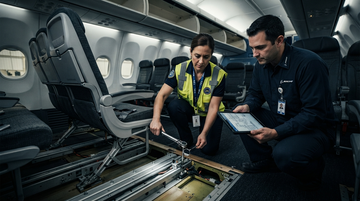
The FAA is proposing an airworthiness directive that targets workmanship-style interior installation risk across 453 737 MAX aircraft—a category of issue that can quietly become a schedule and margin story even when it’s not framed as a primary safety-system failure.
In this proposed rule, the FAA ties the regulatory action to passenger seat assemblies that were reportedly not correctly installed in the 737 MAX seat tracks, specifically describing aft fitting shear plungers that were not correctly lowered and engaged. The compliance mechanism is inspection (and on-condition correction), with an FAA cost estimate for U.S. operators.
What happened (and what the FAA actually is ordering)
A proposed AD for 453 737 MAX aircraft focuses on seat-track locking—inspection first, on-condition fix
FAA proposed AD (seat-track incorrect locking) — core terms
FAA document
2026-15072 (Proposed AD) / Docket FAA-2026-7228
Federal Register publication
Affected fleet
737-8, 737-9, 737-8200
As identified by Boeing special attention bulletin 737-25-1927 RB
Unsafe condition description
Seat assemblies not correctly installed in seat tracks; aft fitting shear plungers not correctly engaged
Potential for seat disengagement under increased load
Required action
Detailed inspection of left/right track-mounted passenger seat assembly fittings; on-condition corrections
Performed at applicable times in Boeing bulletin
Estimated cost (U.S. operators)
Up to $2,656,845
Based on $85/hour; 1 work-hour per seat assembly; parts cost $0
Comment deadline
September 10, 2026
Public comment period
| Line item | FAA stated assumption | What it means in practice |
|---|---|---|
| Inspection labor | 1 work-hour × $85 per hour | Each seat assembly inspection is billable and time-bound (operators must schedule it). |
| Inspection parts | $0 parts cost (FAA estimate) | The cost is mostly labor/time, not major hardware replacement (if the seat can be reinstalled). |
| Total estimated cost | Up to $2,656,845 (U.S. operators) | The impact scales with “seat assemblies per airplane,” cited as up to 69. |
| On-condition installation (if needed) | 1 work-hour × $85 per hour per seat assembly (parts $0) | If corrections are required, downtime + labor repeat per affected seat assembly; FAA notes it can’t determine how many aircraft need repairs. |
Supply-chain and production-system view
Seat tracks are “simple” until the regulator audits the assembly chain—how a locked plunger becomes a fleet-wide AD
At face value, a seat-track locking issue sounds like interior hardware maintenance. But the FAA’s choice of control—inspection of left/right seat-track fittings with a condition tied to whether the aft fitting shear plunger is engaged—implicitly traces to the production and workmanship process that installs interior seat assemblies.
That matters for Boeing because regulators don’t typically propose fleet-scale directives unless they believe a verifiable subset of aircraft could share the same installation path. Here, the FAA points to a Boeing “special attention requirements bulletin” and describes a specific mechanical symptom (plunger engagement), which is exactly the kind of evidence that turns a labor error into an airworthiness compliance obligation.
- The FAA orders a repeatable inspection point, because the failure mode is defined mechanically (shear plunger engagement), enabling regulators to treat it as a workmanship control rather than a vague “possible problem.”
- The compliance cost is labor- and downtime-sensitive: the FAA states 1 work-hour at $85 per hour per seat assembly, so operator scheduling becomes the first-order near-term impact.
- The rule is on-condition by design: FAA can’t determine how many aircraft need repairs, meaning the expected economic hit is uncertain but the compliance workflow is guaranteed.
Why this lands now (quality narrative vs. ramp narrative)
The market usually prices safety-system risk; this may price workmanship-system risk instead
Boeing’s investment narrative often oscillates between (1) safety/system reliability and (2) production throughput and delivery execution. This proposed AD shifts attention to (2) again—but through the lens of regulator verification: a quality slip now has a measurable compliance pathway (inspect, correct, document).
Even though FAA’s estimate is “only” up to $2.656M for U.S. operators, the investor signal is about what regulators are demanding Boeing prove: that the “assembly pipeline” can consistently produce the correct installation state of seat-track fittings.
FAA-estimated total compliance cost (U.S.)
$2,656,845
Based on $85/hr and up to 69 seat assemblies per aircraft (proposed AD estimate)
Inspection labor per seat assembly
$85
FAA stated assumption: 1 work-hour × $85/hour; parts cost $0
Scope of affected aircraft
453
Aircraft count as described by FAA in the Federal Register proposal
Company fundamentals context (Boeing’s capacity/ramp sensitivities)
Boeing’s financial backdrop makes even “small” regulatory hits matter—because operating leverage is already thin
Boeing is operating in a period where margins and cash generation have been fragile in the reported data. For FY 2025, Boeing reported revenue of $89.463B with gross profit of $4.289B and an operating income of -$5.416B (per the tool’s income statement series). That doesn’t imply the seat-track AD directly drives those figures—but it does imply that any incremental disruption to delivery and airline confidence can matter more than it would in a steadier earnings regime.
The regulatory action is not a flight-control or navigation retrofit; it is workmanship verification. Still, the economics show up in operator labor, aircraft availability, and reputational risk—factors that can affect near-term sentiment and long-cycle delivery plans.
| Metric | FY 2024 | FY 2025 |
|---|---|---|
| Revenue | $66.517B | $89.463B |
| Gross profit | -$1.991B | $4.289B |
| Operating income | -$10.824B | -$5.416B |
Horizons — what moves first vs. what changes structurally
Short-term compliance workflow pressure; long-term “quality system” perception is the real risk
- In days–weeks, airlines will plan maintenance slots for seat-track inspections because the FAA’s cost basis is time-per-seat-assembly (1 work-hour × $85).
- In the next quarter(s), if compliance uncovers a higher-than-expected fraction of assemblies needing correction, it will increase downtime and labor—especially because FAA notes it cannot determine how many aircraft require repairs.
- Over 1–3 years, the structural risk is that regulators treat this as evidence of workmanship-system weakness, prompting more ADs in the same “installed condition” category (interiors, fixtures, bracketry).
- Over 1–3 years, a positive counter-signal would be if Boeing demonstrates rapid corrective action closure via subsequent FAA updates and operator compliance data (not disclosed in the proposed rule itself).
Supply-chain linkage (who can be upstream/downstream of this specific failure)
This is an interiors installation problem with clear downstream customers—airlines—while upstream culpability likely sits in installed hardware and assembly controls
The proposed AD does not name specific aftermarket seating vendors, interior contractors, or track-manufacturers in the text captured here. That limits attribution: we can confirm the compliance target (Boeing 737 MAX airframes and specific seat-track installation condition) and the regulatory method (inspection/on-condition correction), but we cannot responsibly name a specific seat-track supplier from this proposed rule alone.
What we can do confidently is map the supply chain by role: Boeing controls the aircraft build and the issuance of the special attention bulletin; airlines downstream must perform inspections and corrective actions; and the economic “shock” is concentrated in airline maintenance operations and fleet utilization.
Investable linkage (listed companies with evidence-backed exposure to the compliance workflow)
- The FAA’s proposal puts a workmanship-style compliance cost onto the 737 MAX program via up to $2,656,845 estimated for U.S. operators (sentiment risk, not necessarily margin destruction).
- Near term, the market will price compliance-and-closure execution risk (inspection + on-condition work) even without parts replacement costs in FAA’s estimate.
- Long term, Boeing’s ability to prevent repeat installation-state errors becomes a “quality system” signal regulators may extend.
- U.S. operators face billable maintenance labor tied to seat assemblies ($85 per seat assembly inspection per FAA estimate), which pressures near-term scheduling.
- If on-condition repairs are triggered, aircraft utilization could be disrupted because FAA can’t quantify the number of aircraft needing corrections.
- Over 1–3 years, repeated interior-workmanship ADs raise the probability of recurring compliance downtime in fleet plans.
- The FAA’s mechanism implies a near-term maintenance-workload increase at $85 per seat assembly and 1 work-hour per assembly.
- The impact is less about parts and more about labor and aircraft time, so cost shows up even if hardware replacement is limited.
- Long term, persistent workmanship findings can degrade airline planning certainty during ramp and aircraft acceptance cycles.
- FAA’s cost basis indicates inspection labor is the primary immediate spend ($85/hour × 1 work-hour per seat assembly).
- Because FAA notes it cannot determine how many aircraft need repairs, the downside case expands with the discovered on-condition rate.
- Over 1–3 years, a “workmanship audit” pattern can tighten maintenance capacity and raise operational risk buffers.