%22%2F%3E%0A%20%20%3Ccircle%20cx%3D%22220%22%20cy%3D%22150%22%20r%3D%22180%22%20fill%3D%22%2322d3ee%22%20fill-opacity%3D%220.12%22%2F%3E%0A%20%20%3Ccircle%20cx%3D%221010%22%20cy%3D%22130%22%20r%3D%22220%22%20fill%3D%22%2338bdf8%22%20fill-opacity%3D%220.08%22%2F%3E%0A%20%20%3Ccircle%20cx%3D%22920%22%20cy%3D%22520%22%20r%3D%22170%22%20fill%3D%22%2322d3ee%22%20fill-opacity%3D%220.06%22%2F%3E%0A%20%20%3Cpath%20d%3D%22M140%20430h920%22%20stroke%3D%22url(%23line)%22%20stroke-width%3D%2212%22%20stroke-linecap%3D%22round%22%2F%3E%0A%20%20%3Cpath%20d%3D%22M220%20360c120-150%20260-220%20380-220s260%2070%20380%20220%22%20fill%3D%22none%22%20stroke%3D%22%2367e8f9%22%20stroke-opacity%3D%220.5%22%20stroke-width%3D%2216%22%20stroke-linecap%3D%22round%22%20stroke-linejoin%3D%22round%22%2F%3E%0A%20%20%3Cpath%20d%3D%22M300%20398h600%22%20stroke%3D%22%2394a3b8%22%20stroke-opacity%3D%220.24%22%20stroke-width%3D%228%22%20stroke-linecap%3D%22round%22%2F%3E%0A%20%20%3Ctext%20x%3D%22220%22%20y%3D%22510%22%20fill%3D%22%23e2e8f0%22%20fill-opacity%3D%220.7%22%20font-family%3D%22Arial%2C%20Helvetica%2C%20sans-serif%22%20font-size%3D%2238%22%20letter-spacing%3D%228%22%3EINSIGHTS%3C%2Ftext%3E%0A%3C%2Fsvg%3E)
Bottom line
Boeing has demand. What it still needs to prove is execution at a higher rate.
The June 5 announcement that Boeing will activate the new North Line on July 6 matters because it shows management is finally adding physical capacity at the 737 program again. But the company itself made the key condition explicit: the ramp must happen under the Safety & Quality Plan, and the production system has to prove it is ready before Boeing pushes faster.
That is why this is not just a capacity story. It is a balance between output, quality, supplier readiness, and cash generation.
What changed
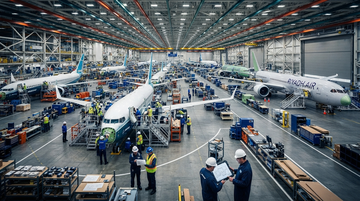
The new North Line is the most visible sign that Boeing is trying to industrialize the recovery instead of narrate it.
Boeing said the North Line will be its fourth 737 production line and its first such line in Everett. The company also said the three current Renton lines are moving from 42 airplanes per month to 47 per month this summer, with the new line designed to support future rate increases beyond Rate 47.
- Boeing explicitly tied the ramp to the Safety & Quality Plan.
- Ortberg said the supply chain for the 737 MAX is stable enough to support future rates.
- The new line is intended to complete an initial low-rate build process before the ramp accelerates further.
- Boeing is signaling that it will only move when the production system is ready.
Numbers that matter
The backlog is huge, but the cash conversion still lags the demand story.
| Metric | Latest figure | Read-through |
|---|---|---|
| Q1 2026 revenue | $22.2B | Demand and deliveries are large enough to support recovery. |
| Commercial deliveries | 143 | Boeing is moving airplanes through the system, not just talking about them. |
| Total backlog | $695B | The demand base is extremely deep. |
| Commercial airplane backlog | Over 6,100 jets | The order book is long enough to justify more production capacity. |
| Operating cash flow | -$179M | Cash generation is still fragile. |
| Free cash flow | -$1.5B | The recovery has not yet turned into durable cash. |
The Riyadh Air delivery at the start of June is another useful datapoint. Boeing handed over the first two 787 Dreamliners from a deal for up to 72 aircraft. That tells you the company still has real customer pull, especially in widebodies. But it also underscores how much of Boeing's recovery depends on turning backlog into reliable, repeatable delivery economics.
Execution risk
More capacity only helps if the system is stable enough to avoid rework, delay, and cost creep.
Execution pressure index
Analytical scores based on the public facts Boeing disclosed. These are not company-reported metrics; they are my estimate of where the program is still under the most stress.
Unit: score
Backlog support
Demand is not the problem
9.5
Supplier stability
Management says the supply chain is stable
8.4
Quality discipline
The ramp is explicitly tied to safety and quality
9.1
Cash conversion
Free cash flow is still negative
4
- If the line works, Boeing can turn backlog into a more predictable cash machine.
- If quality slips, the company will add complexity before it adds value.
- The real bear case is not weak demand. It is that the factory still leaks time and money.
My conclusion
The North Line is a necessary step, but it does not prove the recovery. It merely makes the proof possible.
I view this as a tangible industrial milestone, not a solved story. The next few quarters should tell us whether Boeing can pair a higher delivery rate with a cleaner quality system and less negative cash flow. If that happens, the stock starts to look like a recovering manufacturer instead of a perpetual turnaround.