Materials & Supply Chain
Raw materials and the chokepoints that price them
Lithium, rare earths, copper and shipping — permits, export bans and capacity, followed to the miners and manufacturers on either side.
2026-08-25
%22%2F%3E%0A%20%20%3Ccircle%20cx%3D%22220%22%20cy%3D%22150%22%20r%3D%22180%22%20fill%3D%22%2322d3ee%22%20fill-opacity%3D%220.12%22%2F%3E%0A%20%20%3Ccircle%20cx%3D%221010%22%20cy%3D%22130%22%20r%3D%22220%22%20fill%3D%22%2338bdf8%22%20fill-opacity%3D%220.08%22%2F%3E%0A%20%20%3Ccircle%20cx%3D%22920%22%20cy%3D%22520%22%20r%3D%22170%22%20fill%3D%22%2322d3ee%22%20fill-opacity%3D%220.06%22%2F%3E%0A%20%20%3Cpath%20d%3D%22M140%20430h920%22%20stroke%3D%22url(%23line)%22%20stroke-width%3D%2212%22%20stroke-linecap%3D%22round%22%2F%3E%0A%20%20%3Cpath%20d%3D%22M220%20360c120-150%20260-220%20380-220s260%2070%20380%20220%22%20fill%3D%22none%22%20stroke%3D%22%2367e8f9%22%20stroke-opacity%3D%220.5%22%20stroke-width%3D%2216%22%20stroke-linecap%3D%22round%22%20stroke-linejoin%3D%22round%22%2F%3E%0A%20%20%3Cpath%20d%3D%22M300%20398h600%22%20stroke%3D%22%2394a3b8%22%20stroke-opacity%3D%220.24%22%20stroke-width%3D%228%22%20stroke-linecap%3D%22round%22%2F%3E%0A%20%20%3Ctext%20x%3D%22220%22%20y%3D%22510%22%20fill%3D%22%23e2e8f0%22%20fill-opacity%3D%220.7%22%20font-family%3D%22Arial%2C%20Helvetica%2C%20sans-serif%22%20font-size%3D%2238%22%20letter-spacing%3D%228%22%3EINSIGHTS%3C%2Ftext%3E%0A%3C%2Fsvg%3E)
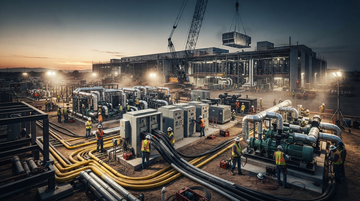
The AI data-center buildout’s schedule risk is shifting from permits to field capacity—and it changes who prints margin
As AI megawatt demand accelerates, the bottleneck is increasingly the “build the building” layer: general contractor throughput and the MEP electrical/mechanical labor pool that physically delivers power and cooling. For listed contractors and engineering-services firms, that translates into a different margin map than the chip stack: working-capital intensity and execution reliability start to matter more than design throughput alone.

New home sales jump into a confidence wobble: what Richmond Fed manufacturing says about the “slowing, not breaking” consumer right before the July PCE reset
Today’s macro stack—July new home sales, Conference Board consumer confidence, and the Richmond Fed manufacturing survey—tests whether housing’s rate-driven bottom is durable or just a temporary demand lull. The key investor question is whether confidence is stabilizing for the same consumers who can now buy new homes, or whether spending risk is shifting from the calendar into the PCE/PPI window.

Canada’s 15% retaliation is a consumer-durables and electronics hit—so margins, not energy, are what US investors should model next
Canada’s Aug. 25 retaliation package sets 15% counter-tariffs on US steel, dairy, appliances and electronics effective Sept. 8, contradicting the prior read that pressure would mainly land on oil/uranium/potash and power. For US-listed suppliers to these categories, the near-term question shifts from energy spreads to tariff-driven demand and pricing power—with a second risk layer emerging from Trump’s threatened 50% auto tariffs starting Jan. 1.
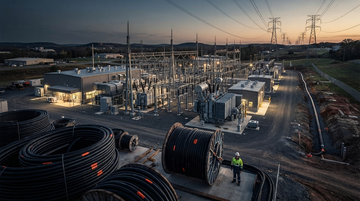
HVDC’s “unmapped toll” is landing in converter stations and XLPE cable, not reactors—because PJM is already pricing grid pain at ~$6B/H1 and AI will have to pay it again
PJM’s transmission-constraint costs surged to $6 billion in the first half of 2026, turning congestion into a near-cash “toll” for any AI load that arrives without enough long-haul transfer capacity. The bottleneck chain for adding that capacity is concentrated: converter stations plus XLPE land/subsea cable (and the HVDC transformer scope around them), where multi-year backlogs and long lead times translate grid buildout into a pricing-power opportunity.

Subsea cable capacity is turning into the “sovereignty toll” for AI inference—because landing stations now face national-security scrutiny
AI traffic is increasingly priced not just by how much fiber exists, but by who can access it at landing stations and on their terrestrial handoff path. A June 4, 2026 FCC order tightens and accelerates national-security oversight around cable landing station equipment, SLTE access reporting, and circuit capacity compliance—raising the cost and friction of cross-border inference paths.
2026-08-24
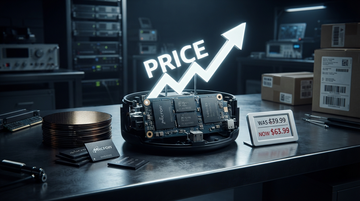
Amazon's 60% device price hikes confirm memory pricing power is moving into consumer hardware
Amazon raised prices on multiple first-party devices—including the Echo Dot base model—by as much as 60%, explicitly citing “significant increases” in memory and storage component costs. The move is a retail-grade proof point that DRAM/NAND tightness can translate into end-demand pricing, sharpening 2H26 contract-price narratives for Micron, SK Hynix, and Samsung Electronics while increasing the near-term risk that Amazon’s device ecosystem growth depends on a tighter—or costlier—hardware attachment loop.

Evergrande’s sentencing turns the property-debt crisis into a balance-sheet timetable for steel and iron ore
When China sentenced Evergrande’s founder to life in prison and fined connected entities, it didn’t “buy” new apartments—but it did tighten the endgame timeline for how losses are absorbed across lenders and suppliers. The next read-through for markets is not construction demand alone; it is how banks and developers reprice risk and how that propagates into steel output intensity and iron-ore buying behavior.

Exxon’s reported bid for Shell’s U.S. chemicals assets tests the ethane advantage—against a global oversupply that can turn “margin” into a margin trap
Reportedly bidding for Shell’s U.S. chemicals assets would be a strategic shift: Exxon is effectively paying for more integrated cracking capacity at the very moment global petrochemicals risk staying structurally oversupplied. For investors, the key question is whether Exxon can translate U.S. ethane feedstock advantage into durable cash margins—without inheriting the same downcycle volatility that has repeatedly hit global polyolefins.
2026-08-23

AI Data Centers Are Entering a “Second Constraint” Era—Water Permits, Not Just Power, Decide Who Can Scale
Water scarcity and permitting are moving from background risk to a primary scheduling constraint for AI data centers in drought-prone regions. The practical battleground is cooling choice (water-withdrawing vs. closed-loop) and whether hyperscalers can route cooling demand through recycled-water systems—shifting capex from plant construction into treatment, monitoring, and recycling infrastructure.

AI fabrics hit the “fabric wall”: switch-ASIC + SerDes/retimer capacity, not GPU supply, is tightening the next data-center upgrade cycle
As AI clusters scale toward higher-port-count, 800G-class and 1.6T-era fabrics, the limiting factor is shifting from GPU compute availability to the networking fabric bill of materials—especially switch-ASIC throughput and the SerDes/retimer ecosystems that make optical and copper links behave at scale. Arista has already disclosed that component shortages and lead-time dynamics force it to use non-cancellable semiconductor purchase commitments that can raise working-capital needs and pressure gross margins, while its 1.6T-ready 7060XE7 line shows the engineering push toward the next fabric tier. The practical investor takeaway: watch the silicon and interface bottlenecks that sit between “GPU arrival” and “fully networked training,” because that’s where revenue timing and margins can swing first.

AI server build-out is paying ODMs with single-digit margins — the market sees GPU demand, but not the margin math between silicon and racks
AI server demand is booming, yet the ODM layer that converts GPU shipments into hyperscaler-usable racks is structurally capped by cost-of-sales pass-through, tariffs, expedite charges, and component sourcing concentration. Using Supermicro’s latest SEC disclosure as a load-bearing reference point for gross margin drivers, and cross-checking the revenue scale of major ODMs like Hon Hai Precision, Quanta Computer, and Wistron, the payoff is less “margin expansion” than “volume absorption,” which changes how investors should price order growth and onshoring headlines.

The AI transatlantic build-out is bumping into a real-world bottleneck: cable installation ships and landing capacity
Hyperscalers’ AI demand is translating into a longer “time-to-connect” problem: subsea cable capacity is not just manufactured, it must also be installed with a limited fleet of specialized ships and then terminated at cable landing stations. Prysmian’s planned €350M investment to expand its cable-laying fleet to eight vessels by adding new deep- and shallow-water assets underlines how installation capacity is becoming the choke point—one that can delay AI traffic rollouts even when fiber and systems are ready.
Canada’s retaliation pressure is skipping cars and aluminum—because the tariff “holes” are concentrated in oil, uranium, potash, and Quebec power
The Aug. 21–23 escalation under the Section 338 tariff snap-back framework explicitly exempts energy and potash from the U.S. action, shifting the real economic stress to the segments the U.S. cannot replace quickly. For investors, that means the first repricing is likely to show up in Cameco, Nutrien, and Canadian oil producers’ U.S.-listed peers—while U.S. utilities and power merchants face second-order stress from Quebec’s cross-border electricity exposure.

Canada can’t “just replace” US aluminum demand—tariffs turn a 60% supply advantage into a $10B+ import-mix problem
U.S. Section 338 actions against Canada and Canada’s dollar-for-dollar posture restart the question of whether Canadian aluminum can absorb the new tariff shock without price and volume fallout. The answer matters because Canada’s share of US primary-aluminum demand is so large that even partial substitution quickly turns into a fill-the-gap scramble that reallocates margin to non-Canadian smelters, scrap recyclers, and aluminum-intensive manufacturers who can re-route supply fast.

Credo’s AEC print is the first “copper-rack” signal for AI buildouts — and it matters because optics don’t fix the margin math
Credo’s latest guidance implies the AI-connectivity bottleneck is shifting downstream to the rack-level interconnect layer, where its active copper AECs should protect gross margin. In FY2026, Credo linked revenue growth overwhelmingly to AEC ramp and credited margin expansion to scale rather than optics mix — a setup where a “quiet” AEC beat can outweigh the market’s focus on the optical leg.

Quantum’s next supply chain winner won’t be the “best qubit”—it’ll be the firm that owns the atoms-to-atmosphere stack
DoD, Oracle, and hyperscalers are pulling quantum hardware decisions forward, but the bottleneck is no longer the algorithm—it’s cryogenics (or its absence), trapped-ion control electronics, and the foundry/packaging chain. IonQ’s planned SkyWater acquisition and its $5.7M DoD-backed networked-quantum design work point to a defensible economic play: closing the loop between device physics and manufacturability before the market standardizes.

Ultragenyx's Genglycos wins accelerated approval—but RARE's real proof will be whether manufacturing can keep up
The FDA’s accelerated approval for Ultragenyx’s GENGLYCOS (pariglasgene brecaparvovec-opnr) hinges on a surrogate endpoint—reduced daily cornstarch intake—and requires a multi-year confirmatory study. For investors in Ultragenyx, the near-term upside is straightforward; the hardest part is the regulatory- and quality-controlled ramp: the company must sustain manufacturing, lot release, and long-horizon follow-up across eligible patients as AAV8-antibody constraints shape access.

US P&C’s repricing cycle needs more than 4.7% yields: reserve risk, business‑interruption gaps, and AI-era liability determine whether profits convert
For US property & casualty insurers, the investment tailwind from higher long yields can only be “shareholder-accretive” if underwriting repricing is tight enough to offset catastrophe drawdowns, reserve-model uncertainty, and expanding liability exposures. Evidence from filings shows how (1) cat losses and prior-year development can swing results quarter to quarter, and (2) reserve sensitivities can translate small assumption shifts into hundreds of millions of dollars—meaning the rate cycle pays only when both the claims side and the liability side stay inside expectations.

Vietnam’s customs IP upgrade turns “tariff math” into compliance math for US brands
Vietnam’s newly approved customs-law changes expand IP powers at the border—covering goods in import/export and transit and adding specific rules for e-commerce shipments—starting March 2027. For US brands that have already rerouted supply chains toward Vietnam to protect tariff outcomes, the practical risk shifts from “duty rate only” to higher clearance friction, longer holds, and more grey-market leakage cost that can compress Vietnam-sourced margins.
2026-08-22

What to expect
Evidence-first notes with a visible point of view.
This section collects sharp takes on earnings, shareholder meetings, and market structure. Each new piece should make the thesis, the facts, and the implications obvious within the first few screens.
Expect direct analysis, not generic commentary.
Expect the data to be explicit and the argument to be easy to follow.
Plutux is not an investment adviser. Market data and AI-generated analysis are for information and education only, not investment advice. Disclaimer