%22%2F%3E%0A%20%20%3Ccircle%20cx%3D%22220%22%20cy%3D%22150%22%20r%3D%22180%22%20fill%3D%22%2322d3ee%22%20fill-opacity%3D%220.12%22%2F%3E%0A%20%20%3Ccircle%20cx%3D%221010%22%20cy%3D%22130%22%20r%3D%22220%22%20fill%3D%22%2338bdf8%22%20fill-opacity%3D%220.08%22%2F%3E%0A%20%20%3Ccircle%20cx%3D%22920%22%20cy%3D%22520%22%20r%3D%22170%22%20fill%3D%22%2322d3ee%22%20fill-opacity%3D%220.06%22%2F%3E%0A%20%20%3Cpath%20d%3D%22M140%20430h920%22%20stroke%3D%22url(%23line)%22%20stroke-width%3D%2212%22%20stroke-linecap%3D%22round%22%2F%3E%0A%20%20%3Cpath%20d%3D%22M220%20360c120-150%20260-220%20380-220s260%2070%20380%20220%22%20fill%3D%22none%22%20stroke%3D%22%2367e8f9%22%20stroke-opacity%3D%220.5%22%20stroke-width%3D%2216%22%20stroke-linecap%3D%22round%22%20stroke-linejoin%3D%22round%22%2F%3E%0A%20%20%3Cpath%20d%3D%22M300%20398h600%22%20stroke%3D%22%2394a3b8%22%20stroke-opacity%3D%220.24%22%20stroke-width%3D%228%22%20stroke-linecap%3D%22round%22%2F%3E%0A%20%20%3Ctext%20x%3D%22220%22%20y%3D%22510%22%20fill%3D%22%23e2e8f0%22%20fill-opacity%3D%220.7%22%20font-family%3D%22Arial%2C%20Helvetica%2C%20sans-serif%22%20font-size%3D%2238%22%20letter-spacing%3D%228%22%3EINSIGHTS%3C%2Ftext%3E%0A%3C%2Fsvg%3E)
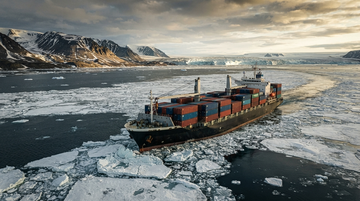
On Aug 22, South Korea launches what multiple outlets describe as its first commercial Arctic container-voyage trial via Russia’s Northern Sea Route (NSR), using the PanStar Acro container ship. The market focus is usually “shorter transit time”—but the investable question is more specific: does the voyage create a repeatable willingness to pay for ice-capable capacity, net of insurance and operational uncertainty?
Verified event base
Aug 22 departure: PanStar Acro heads for Europe via the Northern Sea Route, with a 40–45 day target
What was verified in the primary reporting
Departure timing
Flag-off scheduled around 8 p.m. (1100 GMT), Sat Aug 22
Vessel and operator
PanStar Acro; operated by PanStar
Route skeleton
Busan → north toward Russia’s Kamchatka → Bering Sea/Arctic → Northern Sea Route; then stops including Felixstowe and Rotterdam (and a Gdansk call reported)
Duration target
Voyage expected around 40–45 days
Reuters’ reporting frames this as a pilot meant to test commercial viability and operational feasibility in the Arctic lane—explicitly tying route choice to concerns about getting stuck in ice and operational uncertainty.
Supply-chain mechanism
Why the NSR reopens “Asia–Europe” economics: it competes with Suez when risk and congestion raise the effective cost of time
Conventional routing is no longer just about nautical miles. When the effective cost of delay rises—through war-risk premiums (e.g., Hormuz-related) and corridor congestion (notably through Panama constraints at times)—shippers start underwriting alternative corridors. The NSR’s value proposition improves if it can convert fewer days into fewer uninsured costs and fewer operational penalties.
But the Arctic introduces a different cost structure: it shifts uncertainty toward seasonal ice limits and the need for polar/navigation-capable operations.
| Economics input | Primary claim in coverage | Investor interpretation |
|---|---|---|
| Transit time vs Suez | South Korea authorities estimated up to ~35% faster | If repeatable, it improves schedule reliability; if not, it becomes a one-off marketing win |
| Operational constraint | Container vessels navigable only during seasonal windows | Creates a “demand window” for ice-capable tonnage, not year-round lane economics |
| Ice handling readiness | Polar navigation modifications; reporting notes ice-pilot use in coverage | Suggests incremental costs are real; investors should watch whether cargo volume offsets them |
What the trial implies (and what it doesn’t)
Ice-class capacity demand is the signal—ice thickness specs are not disclosed in the coverage, so the market may under-price the capability premium
A critical limitation: the Reuters chunks and the additional coverage reviewed here describe the voyage as modified for polar navigation and mention ice-pilot involvement, but they do not provide an explicit ice-class rating or ice-thickness tolerance in the parts opened. That means investors shouldn’t assume “ice-class = known benchmark.”
Still, the economics transmission mechanism is clear: even without a stated ice-class number, Arctic routing requires vessels and staffing that can operate under seasonal ice constraints, and that typically commands a premium in chartering, insurance, and crew/pilot operations.
So the actionable tell is whether cargo bookings and follow-on voyages build enough volume to support higher all-in costs.
Supply-chain mapping
Full supply-chain view: who benefits upstream (capex/insurance-ready tonnage) and downstream (shippers pricing time risk)
- Arctic routing shifts upstream value toward ice-capable operations because pilots, modified handling, and insurance underwriting become recurring inputs during seasonal windows.
- Insurance and war-risk pricing can widen the “corridor spread” between NSR and conventional lanes, turning routing into a risk-trade rather than a distance trade.
- Downstream shippers should reward schedule reliability more than marginal cost when congestion turns voyage timing into a balance-sheet item (inventory, demurrage, and customer penalties).
- If NSR demand remains episodic, the market may still price it like a novelty instead of a capacity market—slowing charter-rate pass-through.
Company fundamentals (listed linkage for investor positioning)
Investor-relevant listed linkage: PanOcean [028670.KS] and Hyundai Glovis [086280.KS] sit near shipping/logistics fundamentals that can be pulled by lane-change demand
Pan Ocean revenue
KRW 6.17T
TTM through Aug 22, 2026 (financial-year revenues used for trend context)
Pan Ocean operating income
KRW 587.7B
TTM through Aug 22, 2026
Pan Ocean free cash flow
KRW 350.6B
TTM through Aug 22, 2026
Hyundai Glovis revenue
KRW 31.35T
TTM through Aug 22, 2026
These fundamentals don’t “prove” Arctic demand on their own. Instead, they support positioning: logistics/shipping exposure can show financial transmission through revenue mix, utilization, and network pricing if Arctic routings (or ice-capable capacity) capture incremental cargo flows during disrupted lane periods.
Two-horizon investor view
Short term: watch bookings and schedule adherence; long term: watch whether ice-capable premiums normalize into a durable capacity market
- Within days–quarters, the first measurable outcome is whether bookings convert into actual sailings without ice-stoppage shock—insurance and delay costs will show up immediately in route economics.
- Near term, investors should look for pricing discipline: do shippers accept higher all-in costs, or does the trial cap cargo uptake to a small demo volume?
- Over 1–3 years, durable value appears only if Arctic routing produces repeatable utilization for ice-capable tonnage, not just better transit-time headlines.
| Catalyst window | What to verify | Why it matters for lane economics |
|---|---|---|
| Days–weeks (while sailing) | Any publicly described schedule deviations, port delays, or operational changes tied to ice conditions | Makes “repeatability” testable; affects insurance/charter pass-through expectations |
| By next seasonal window | Whether the carrier (and competing services) book follow-on cargo at scale | Determines whether the NSR is a capacity market or a one-off trial |
| 1–3 years | Whether insurance/war-risk frameworks treat Arctic transits as meaningfully different (or just similarly risky) | Decides if the NSR truly escapes the same geopolitical cost stack |
So what should investors do?
Synthesis: the NSR trial is less about shipping heroics and more about whether a new premium capacity segment is economically monetizable under conflict-driven pricing
The core tension is straightforward.
1) When Hormuz-linked war-risk premiums and other conflict-driven costs squeeze conventional lanes, alternatives can look financially rational. 2) The Arctic alternative, however, asks shippers to underwrite a different uncertainty—seasonality and ice-driven operational constraints.
The PanStar Acro pilot provides a rare public test case. Investors should treat the trial as a “pricing experiment,” not a geography experiment. If the economics work, the payoff shows up as repeat utilization for ice-capable operations—and that tends to flow through logistics and shipping networks first, fundamentals second.
Listed stocks with the most plausible transmission path (supply-chain economics, utilization, and logistics pricing)
- Pan Ocean revenue scaled to KRW 6.17T (TTM through Aug 22, 2026), giving operational mass that can benefit if Arctic-linked lanes pull incremental cargo demand into networks.
- Extra routing optionality can raise utilization economics and support cash generation if Arctic-related flows become recurring (free cash flow KRW 350.6B in TTM through Aug 22, 2026).
- If pilot stays demo-scale, benefits likely remain marginal versus core tanker/container/bulk cycles; watch management commentary around routing mix.
- Hyundai Glovis generated KRW 31.35T revenue (TTM through Aug 22, 2026), so logistics throughput is large enough to absorb incremental lane shifts without needing a whole-company transformation.
- Routing disruptions can temporarily increase logistics intensity, but Arctic constraints can cap scale outside seasonal windows (performance depends on repeat bookings, not one trial voyage).
- If NSR reduces transit-time variance for certain lanes, order cycles can stabilize; if not, the effect may be limited to short-term repricing.
- Hapag-Lloyd is a global container carrier; if NSR economics prove out, competition could shift capacity and pricing across Asia–Europe services over 1–3 years.
- The fastest risk is that NSR incumbency concentrates during seasonal windows and re-routes high-margin cargo early—watch for any service redesign around Arctic seasonality.
- Near term, trial cargo volumes may be too small for financial impact; evidence would be follow-on routings and contract pricing changes.
- PanStar’s trial legitimacy can pull forward credibility for Arctic routing, potentially improving commercial terms for future deployments if follow-on cargo bookings materialize.
- The pilot’s value depends on repeatability rather than one voyage; investors should watch whether bookings expand beyond pilot cargo in the next seasonal window.
- If Arctic operational uncertainty forces frequent changes, the equity impact can fade quickly; the key is whether insurance and delay costs remain controlled.