%22%2F%3E%0A%20%20%3Ccircle%20cx%3D%22220%22%20cy%3D%22150%22%20r%3D%22180%22%20fill%3D%22%2322d3ee%22%20fill-opacity%3D%220.12%22%2F%3E%0A%20%20%3Ccircle%20cx%3D%221010%22%20cy%3D%22130%22%20r%3D%22220%22%20fill%3D%22%2338bdf8%22%20fill-opacity%3D%220.08%22%2F%3E%0A%20%20%3Ccircle%20cx%3D%22920%22%20cy%3D%22520%22%20r%3D%22170%22%20fill%3D%22%2322d3ee%22%20fill-opacity%3D%220.06%22%2F%3E%0A%20%20%3Cpath%20d%3D%22M140%20430h920%22%20stroke%3D%22url(%23line)%22%20stroke-width%3D%2212%22%20stroke-linecap%3D%22round%22%2F%3E%0A%20%20%3Cpath%20d%3D%22M220%20360c120-150%20260-220%20380-220s260%2070%20380%20220%22%20fill%3D%22none%22%20stroke%3D%22%2367e8f9%22%20stroke-opacity%3D%220.5%22%20stroke-width%3D%2216%22%20stroke-linecap%3D%22round%22%20stroke-linejoin%3D%22round%22%2F%3E%0A%20%20%3Cpath%20d%3D%22M300%20398h600%22%20stroke%3D%22%2394a3b8%22%20stroke-opacity%3D%220.24%22%20stroke-width%3D%228%22%20stroke-linecap%3D%22round%22%2F%3E%0A%20%20%3Ctext%20x%3D%22220%22%20y%3D%22510%22%20fill%3D%22%23e2e8f0%22%20fill-opacity%3D%220.7%22%20font-family%3D%22Arial%2C%20Helvetica%2C%20sans-serif%22%20font-size%3D%2238%22%20letter-spacing%3D%228%22%3EINSIGHTS%3C%2Ftext%3E%0A%3C%2Fsvg%3E)
What’s changing in AI buildouts
Water availability is becoming a gating item for AI capacity, because cooling technologies don’t “consume” water the same way
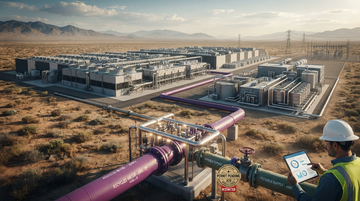
AI buildouts already face a power-connections bottleneck; the newer constraint is physical water access. A key reason is that cooling is not a single standardized requirement: once you move from wet cooling toward closed-loop liquid cooling, you shift from “freshwater withdrawals” toward “treatment + recycling + monitoring.” That changes both permitting friction and who pays for capex.
How the demand side is being reframed
Cooling approaches that reduce freshwater draw
Dry or hybrid cooling reduce evaporative losses; closed-loop designs enable reuse
U.S.-focused policy and technical discussions increasingly treat cooling tech as the primary lever to meet water-use restrictions.
Permitting lever in the recycled-water direction
States need clearer pathways to permit recycled water for cooling applications
The EPA’s Water Reuse Action Plan explicitly calls out data-center cooling and regulatory enablement.
Verified policy signal
A clear upstream marker: the EPA is pushing recycled-water pathways for data-center cooling through “building blocks” and state support
A major “upstream” confirmation that water is entering the center of the AI buildout stack comes from U.S. federal actions. In January–May 2026, the EPA’s Water Reuse Action Plan 2.0 (WRAP 2.0) Summer Update includes data-center-specific commitments: advancing recycled water for data-center cooling through information exchanges, supporting states in expanding recycled water use for data-center cooling, and convening a collaborative forum for water and wastewater utilities on data centers.
What matters for investors is not the existence of water reuse as an idea; it is the move toward implementation mechanics: the EPA also discusses creating “building blocks” for treating and monitoring recycled water so regulators can permit reuse technologies with more confidence. This is where capex is likely to migrate—into treatment reliability, validation protocols, and monitoring—because those are what turn a theoretical water-right or reuse policy into a buildable project.
Upstream supply chain
Utilities and industrial water-tech are the first financial beneficiaries—when cooling choices turn water into a “capacity” product
When AI growth collides with drought-belt restrictions, the water supply chain shifts from “background operations” to “capacity underwriting.” If a hyperscaler must reduce freshwater withdrawals via closed-loop or hybrid cooling, it still needs water for system fills/makeup—then it needs that makeup to come from a permitted recycled-water stream. That pulls in utilities (source/reuse/distribution), water treatment providers (membranes, disinfection, solids handling), and pump/controls and hydronic system suppliers (distribution reliability under tighter operating windows).
- Utilities become pipeline gatekeepers when reclaimed water capacity and quality controls limit how fast a site can commission cooling.
- Water-tech earns margin when projects require new reliability layers: validation, monitoring, and treatment upgrades to satisfy permitting.
- Closed-loop cooling reduces freshwater draw but forces more engineering discipline on recirculation and water quality control.
Xylem’s product narrative is directionally aligned with this shift: it positions closed-loop cooling and advanced thermal-water management as a pathway to reduce freshwater use and enable reuse/heat recovery. For investors, the implication is that the “unit of value” is no longer only kW of compute; it becomes the engineered capability to deliver compliant water quality to thermal systems under stress.
Midstream demand chain
Hyperscalers can treat recycled water as a deployment multiplier—but only if permits clear faster than construction schedules
Hyperscalers are already public about the direction of travel. Amazon’s AWS sustainability materials state recycled water use in U.S. data centers is expanding from 24 locations to more than 120 locations, and it frames the expected fresh drinking water savings annually. That matters because AWS is implicitly betting that recycled-water scale and permit pathways can keep pace with new AI capacity deployment.
The constraint is timing and assurance: if permitting timelines for recycled water lag new site commissioning, hyperscalers may be forced into alternatives (delays, water trucking, hybrid cooling, or different siting). In other words, recycling can be a growth enabler, but only after regulators can “greenlight” the treatment and monitoring envelope.
What the numbers say about the water-supply battleground economics
Water constraint turns capex into a “two-bucket” problem: thermal retrofits vs. water reuse infrastructure
The investment angle is that water constraint changes where capex lands and how quickly it converts into deliverable capacity. Thermal-system engineering (e.g., closed-loop designs, pumps, controls) can reduce freshwater withdrawals but does not remove the need for water quality compliance. Recycled-water sourcing and treatment converts regulatory requirements into hardware spending—filtration/disinfection, membrane systems (where needed), and instrumentation for monitoring and validation.
To ground the “who pays” question for listed companies, consider how water utilities and water-tech firms fund capex cycles. For example, American Water Works reported net cash provided by operating activities of $2.045B and free cash flow of -$0.811B in FY2024. That matters because if AI-driven cooling growth creates incremental demand for upgraded treatment and distribution capacity, the spending could align with utility capex plans and regulated investment frameworks.
Competitive map
Which listed equities are most directly exposed: utilities (reclaimed supply), water-tech (treatment + distribution), and grid-adjacent power providers (indirect water effects)
FY2024 cash generation context for a key U.S. water utility
Operating cash flow and free cash flow provide a quick read on how much balance-sheet flexibility a regulated utility has for capex cycles tied to new demand.
Unit: USD
Net cash provided by operating activities
American Water Works FY2024
2,045,000,000
Free cash flow
American Water Works FY2024
-811,000,000
| Company | FY2022 revenue | FY2023 revenue | FY2024 revenue |
|---|---|---|---|
| American Water Works | $20.956B | $28.114B | $24.753B |
| Xylem | $5.522B | $7.364B | $8.562B |
| Veolia Environnement | Not compiled in this run | Not compiled in this run | Not compiled in this run |
This article does not claim the revenue changes are caused solely by AI data centers; rather, it frames the exposure: these firms are positioned where AI-driven cooling and recycled-water permitting increase the value of water treatment, distribution reliability, and compliance monitoring.
Non-obvious causal chain investors can act on
Cooling adoption will increasingly be “water-permit optimization,” and the winning projects will monetize compliance speed
The non-obvious link is that liquid cooling can reduce freshwater withdrawals, but the bottleneck becomes the regulatory and operational envelope that keeps recycled water compliant under recirculation. That turns a technical choice into an execution choice: the fastest scaling sites will be those whose local water/wastewater utility and treatment ecosystem already have the permitting-ready monitoring and validation stack.
- Closed-loop designs can reduce freshwater reliance, but they increase the importance of water quality management inside the thermal loop.
- Recycled-water expansion depends on regulator comfort with treatment verification and monitoring protocols—precisely what EPA is highlighting in WRAP 2.0’s “building blocks.”
- Hyperscalers that scale recycled water across many locations signal that permitting friction is manageable—but only where utilities can supply compliant reclaimed water at the required reliability.
Horizons
What to watch over the next quarters vs. the next 1–3 years
In the short term, watch for local utility capacity commitments, permit language that requires specific monitoring/validation, and cooling-system procurement that explicitly references recycled-water sourcing. In the medium term, watch how fast state permitting regimes incorporate EPA’s WRAP 2.0 “building blocks,” because that determines whether recycled-water retrofits become a standard line item for new AI data centers.
Listed plays tied to the water-rights + recycling capex cycle
- American Water Works can be a buildout bottleneck reducer when reclaimed-water capacity and treatment upgrades align with new cooling demand, with FY2024 operating cash flow of $2.045B supporting capex cycles.
- In 0–4 quarters, utilities with stronger cash generation can more quickly respond to incremental treatment/distribution requests tied to data-center commissioning, reducing project delays.
- In 1–3 years, faster recycled-water permitting adoption in key drought states can increase the likelihood of sustained demand for treatment expansion and operational reliability.
- Xylem is positioned for closed-loop and thermal-water management upgrades because it states closed-loop cooling can cut freshwater use by up to 70% while enabling reuse and heat recovery, matching the policy direction on treatment + monitoring.
- In 0–4 quarters, orders for hydronic/recirculation components and water-management systems should track visible adoption of liquid cooling and recycled-water sourcing in new sites.
- In 1–3 years, regulatory “building blocks” for monitoring and validation can raise the technical content of water upgrades, supporting pricing power for firms with compliance-grade offerings.
- NextEra Energy is indirectly exposed because electricity generation can be associated with consumptive water use; solutions that reduce reliance on water-intensive generation can reduce system-wide indirect water stress.
- In 0–4 quarters, if utilities push faster grid expansion to meet AI load, incremental power demand may raise water stress unless cooling/dispatch choices stay efficient.
- In 1–3 years, the direction of generation mix and cooling technology can make the water intensity of AI power less of a bottleneck, but execution risk remains with infrastructure timelines.
- Veolia Environnement is a watch candidate because the market is shifting toward treatment, monitoring, and validation capabilities needed to permit recycled water for data-center cooling (EPA WRAP 2.0).
- In 0–4 quarters, the catalyst would be specific contract awards or stated capacity expansions tied to industrial/utility recycled-water programs for large cooling loads.
- In 1–3 years, if states formalize EPA-aligned “building blocks,” projects could scale quickly, but timing depends on local permitting and utility procurement cycles.