Energy
Crude, refining and the price at the pump
Supply, inventories, crack spreads and OPEC decisions, followed down to the producers, refiners and buyers who book the difference.
2026-07-26
%22%2F%3E%0A%20%20%3Ccircle%20cx%3D%22220%22%20cy%3D%22150%22%20r%3D%22180%22%20fill%3D%22%2322d3ee%22%20fill-opacity%3D%220.12%22%2F%3E%0A%20%20%3Ccircle%20cx%3D%221010%22%20cy%3D%22130%22%20r%3D%22220%22%20fill%3D%22%2338bdf8%22%20fill-opacity%3D%220.08%22%2F%3E%0A%20%20%3Ccircle%20cx%3D%22920%22%20cy%3D%22520%22%20r%3D%22170%22%20fill%3D%22%2322d3ee%22%20fill-opacity%3D%220.06%22%2F%3E%0A%20%20%3Cpath%20d%3D%22M140%20430h920%22%20stroke%3D%22url(%23line)%22%20stroke-width%3D%2212%22%20stroke-linecap%3D%22round%22%2F%3E%0A%20%20%3Cpath%20d%3D%22M220%20360c120-150%20260-220%20380-220s260%2070%20380%20220%22%20fill%3D%22none%22%20stroke%3D%22%2367e8f9%22%20stroke-opacity%3D%220.5%22%20stroke-width%3D%2216%22%20stroke-linecap%3D%22round%22%20stroke-linejoin%3D%22round%22%2F%3E%0A%20%20%3Cpath%20d%3D%22M300%20398h600%22%20stroke%3D%22%2394a3b8%22%20stroke-opacity%3D%220.24%22%20stroke-width%3D%228%22%20stroke-linecap%3D%22round%22%2F%3E%0A%20%20%3Ctext%20x%3D%22220%22%20y%3D%22510%22%20fill%3D%22%23e2e8f0%22%20fill-opacity%3D%220.7%22%20font-family%3D%22Arial%2C%20Helvetica%2C%20sans-serif%22%20font-size%3D%2238%22%20letter-spacing%3D%228%22%3EINSIGHTS%3C%2Ftext%3E%0A%3C%2Fsvg%3E)
2026-07-24
2026-07-23
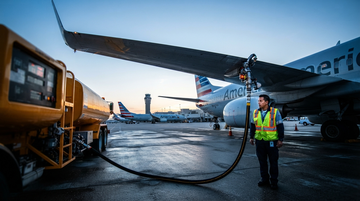
American’s fuel-cost warning matters because airline cash flow is the shock absorber—and it just looks too thin
When American Airlines Group warns that fuel costs can overwhelm margin improvements, the market shouldn’t just model weaker earnings—it should also model weaker operating cash generation. Using AAL financial statements, we show how small earnings-quality shifts can translate into a disproportionate free-cash-flow hit, which then raises industry-wide funding pressure and makes fare “pass-through” less timely than investors assume.
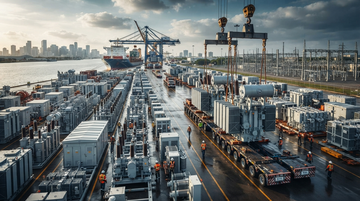
GE Vernova GEV Backlog Confirms Electrification Demand—but Margins and Cash Timing Depend on What Gets Built, Not What’s Booked
GE Vernova’s June 30, 2026 backlog rose to $176.3B and its Electrification backlog to $44.6B (+30% sequential), giving investors unusually concrete evidence that utility electrification capex is still translating into orders. But the profit map is changing: near-term margins and working capital are driven by execution timing, segment mix, and “order-to-revenue” conversion rather than backlog level alone. The backlog can be a demand canary—yet it can still mislead on margin durability if the incremental dollars skew toward slower-to-earn projects or higher execution risk.
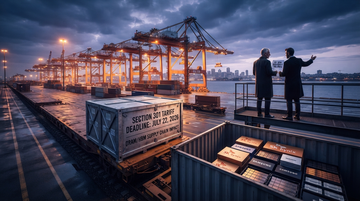
GE Vernova’s Backlog Is Strong—but the “Margin Leakage” Risk Lives in Equipment Mix and Execution-Cost Timing, Not Demand
GE Vernova reports a growing electrification and grid backlog (RPO) of $44.6B, but the backlog’s margin quality depends on equipment-vs-services mix and how execution costs and timelines hit project-level contracts. In its latest filings, GE Vernova shows large RPO growth concentrated in Power and Electrification equipment (where schedule and cost overruns matter most), while it separately flags tangible cost/timeline pressure in other execution-heavy businesses—an investor analogue for what can go wrong. The actionable takeaway: treat backlog growth as necessary proof of demand, and backlog composition + disclosed execution risks as the real predictor of margin and cash-flow outcomes.

Treasury’s Iran sanctions repricing is a term-premium shock in disguise—watch how oil risk leaks into rates, dollar funding, and credit hedges before CPI
The July 2026 Iran sanctions cycle is not just an oil story: market pricing implies a higher embedded “energy risk premium,” which then spills into Treasury term premium and the macro risk register. The investable implication is hedge selection—duration and curve hedges may outperform purely commodity hedges early, while FX and credit hedges are likely to require faster, more conditional trigger rules.
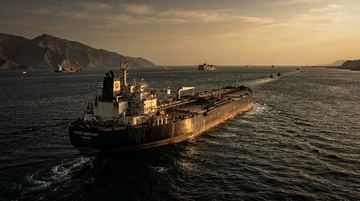
Oil’s “six-week high” is often a shipping-risk repricing: the payoff belongs to tankers and margin-flex refiners, not to everyone holding crude
When Middle East shipping risk rises, part of the crude move is a time-spread shipping-and-uncertainty premium rather than pure physical tightness. That distinction changes who wins: oil-product margins at refiners like Valero Energy and Marathon Petroleum can benefit if product spreads widen faster than feedstock, while airlines such as Delta Air Lines face asymmetric fuel-cost pressure. Conversely, tanker owners like Frontline and Scorpio Tankers tend to capture a more direct shipping-risk revenue pass-through—if the premium persists into the next charter/freight cycles.

Tesla’s “SpaceX merger” is a capex-and-margin value-capture map—2026 capex guidance shows where integration would likely re-anchor multiples
If Tesla–SpaceX integration ever becomes “real,” the value will likely shift based on capex timing: Tesla is already guiding to $20B+ of 2026 capex tied to AI compute and manufacturing/R&D ramps, while its Automotive and Energy segments show materially different gross-margin profiles (17.8% vs. 29.8% in FY2025). The merger narrative therefore matters less for probability and more for what it changes in Tesla’s capex mix and the resulting Automotive-vs-Energy margin pathway.
2026-07-22
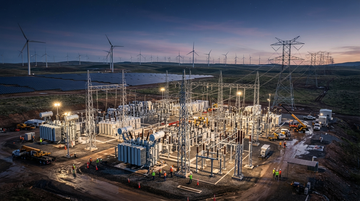
GE Vernova’s Q2 2026 Grid Backlog Signal: Why Utility-Scale Electrification Is the Real “Demand Proof”
GE Vernova GEV is set to report Q2 2026 results on July 22, 2026, with investor focus on backlog growth tied to grid modernization and utility-scale infrastructure. The key question for an industrial-energy supply-chain bet: does the backlog expansion translate into a higher-quality mix (electrification + services) and durable cash generation—or is it offset by execution risk and schedule timing. Investors should underwrite the quarter through the lens of backlog composition, not just headline orders.

The U.S.-Saudi Nuclear Deal’s Real Market Signal: Enrichment Permission Is the Policy Variable Congress Can Still Break
As of July 22, 2026, a U.S.-Saudi civil nuclear cooperation agreement is still awaiting final signature and is reportedly structured in a way that could permit uranium enrichment on Saudi soil. The investment relevance isn’t “nuclear is coming,” but whether enrichment/reprocessing and safeguards constraints survive the U.S. Section 123 / congressional review process. If the deal’s enrichment pathway is curtailed, the first-order winners shift from fuel-cycle capacity beneficiaries toward reactor EPC and nuclear components—changing near-term contracting and long-cycle supply-chain demand.

The US–Saudi Nuclear Pact’s Real Risk Isn’t Reactors—It’s the Fuel-Cycle Loopholes Congress May Force Closed
As of July 2026, the US–Saudi civil nuclear pact is still being debated in Washington because the draft safeguards framework reportedly falls short of the IAEA “Additional Protocol” (and the “gold standard” approach) even as it tentatively permits Saudi enrichment and/or reprocessing. That mismatch creates a fuel-cycle risk that could delay or reshape US vendor participation and the supply-chain plans tied to Saudi nuclear industrialization, regardless of how fast reactor contracting moves.
2026-07-19

2026-07-17

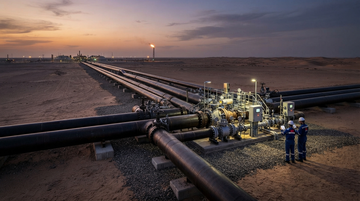
Chevron's Iraq Pipeline Push Turns Hormuz Risk Into a Midstream Re-Routing Trade
New Iraq agreements worth roughly $60 billion do more than add barrels. They signal that the market is starting to price alternative export routes, which changes the value of Chevron, ConocoPhillips, and the entire Gulf energy infrastructure stack.

Kuwait's Desalination Strike Makes Gulf Utilities the Hidden Front Line of the Oil Shock
An Iranian strike on Kuwait's water-and-power infrastructure turns a crude-price headline into a utility and inflation problem. The deeper read is that Gulf desalination, not just shipping lanes, is now part of the market's geopolitical risk premium.
2026-07-16
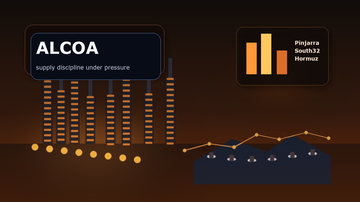
Alcoa Missed the Bar, But the Real Signal Is Supply Discipline: Pinjarra, South32, and Hormuz Are Repricing Aluminum
Alcoa reported Q2 2026 adjusted EPS of $2.12 and revenue of $3.97B, both below expectations, while cutting alumina production guidance after setbacks at the Pinjarra refinery. The stock slid despite better year-over-year profitability because the market is now focused on supply discipline, capital intensity, and how much of the aluminum chain is being shaped by Middle East risk and a major South32 acquisition.

IEA Warns 'Weeks, Not Months' to Reopen Strait of Hormuz - Brent Jumps 13% in 7 Days - The Cleanest Single Stagflation Catalyst of 2026
IEA Chief Fatih Birol warned on July 16, 2026 that the world has 'weeks, not months' to reopen the Strait of Hormuz, with Brent crude jumping 13% in 7 days to ~$84.60/barrel. The IEA warning + IMO Secretary General's declaration that Hormuz transit is 'too dangerous' for ship owners + the US naval blockade reinstatement + Iran's strikes on 5 Gulf countries and 2 UAE-operated supertankers have all combined to create the cleanest single stagflation catalyst of 2026. The read-through is direct for E&P (XOM, CVX, OXY), oilfield services (SLB, HAL, BKR), refiners (VLO, MPC, PSX), tankers (FRO, INSW, STNG), defense (LMT, RTX, NOC), and the cleanest single most direct headwind for airlines (UAL, DAL, AAL), consumer cyclicals, and the cleanest single Fed pause regime.
2026-07-15
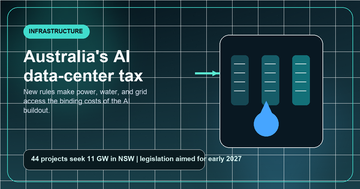
Australia's New AI Data-Center Rules Turn Power and Water Into the Next AI Capex Tax
Australia's July 15-16, 2026 policy shift says large AI data centers must secure their own power, cover their connection costs, manage peak-load behavior, and use water efficiently. The headline is about regulation, but the real message is capital discipline: AI infrastructure is no longer just a software or hardware spend, it is a grid, water, and permitting problem. That matters for Vertiv, Eaton, Equinix, Digital Realty, and every hyperscaler trying to scale demand without colliding with local utility politics.

Trump's 24-Hour Hormuz Toll Reversal Was the First Real Test of the Global Shipping Industry's Leverage
On July 14, 2026, U.S. forces struck Iranian targets and reinstated the naval blockade of Iranian ports. President Trump simultaneously announced a 20% toll on cargo transiting the Strait of Hormuz via Truth Social. Within 24 hours, the policy was reversed and replaced by 'Trade and Investment Deals' with Gulf states. The episode is the first public test of whether the global shipping industry, working through the International Maritime Organization, has enough leverage to reshape a unilateral U.S. policy in real time. The read-through matters for Maersk, Hapag-Lloyd, ZIM Integrated Shipping, Diana Shipping, Frontline, and the broader tanker and dry-bulk complex.
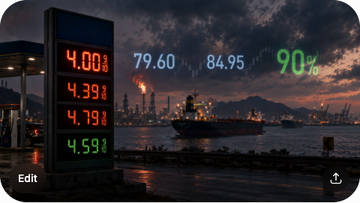
Kalshi Traders Now Put 90% Odds on Gas Crossing $4 This Month - And the Prediction Market Just Became the Cleanest Real-Time Tape on Hormuz Risk
CNBC reported on July 15, 2026 that prediction market Kalshi traders had priced a 90% probability that U.S. gas prices cross $4 per gallon by end of July - up from 56% just two days ago - with a 93% chance of crossing $4 and a 63% chance of exceeding $4.10, following the U.S. ending its Iran ceasefire and relaunching strikes. With WTI at $79.60 and Brent at $84.95, the prediction market is now the cleanest real-time tape on Hormuz risk - faster than futures, faster than retail gas data, faster than analyst notes. The read-through is direct for ExxonMobil, Chevron, ConocoPhillips, Valero, Marathon Petroleum, Phillips 66, United Airlines, Delta Air Lines, American Airlines, and the entire energy + transport complex.

LNG Deep Dive: How Cheniere Energy, Shell, TotalEnergies, QatarEnergy, and Woodside Run the $400B Global LNG Trade - and Why the 2026-2030 Supply-Demand Is the Binding Read on the Energy Transition
LNG (Liquefied Natural Gas) is a $400B/year global trade that has become the binding flexible-supply leg of the global energy transition. The 5 largest LNG suppliers are QatarEnergy (~25% global LNG export share), Cheniere Energy (~15%, the largest US LNG exporter), Shell (~10%, the largest IOC LNG portfolio), TotalEnergies (~8%), and Woodside (~5%, the largest Australian LNG exporter). This is a full-stack deep-dive into LNG: liquefaction technology (ConocoPhillips Optimized Cascade, Air Products AP-C3MR, Black & Black & Veatch PRICO), the FLNG revolution (Shell Prelude + Petronas PFLNG), the customer base (China, Japan, Korea, Europe), the top experts, the capex ($80-100B/year industry), the 2026-2030 supply-demand, and the read-through for the energy transition.
What to expect
Evidence-first notes with a visible point of view.
This section collects sharp takes on earnings, shareholder meetings, and market structure. Each new piece should make the thesis, the facts, and the implications obvious within the first few screens.
Expect direct analysis, not generic commentary.
Expect the data to be explicit and the argument to be easy to follow.
Plutux is not an investment adviser. Market data and AI-generated analysis are for information and education only, not investment advice. Disclaimer