Crypto
Crypto, priced as an asset class
Flows, ETFs, regulation and the listed companies with balance-sheet exposure — what moves the price, and what only moves the conversation.
2026-08-19
%22%2F%3E%0A%20%20%3Ccircle%20cx%3D%22220%22%20cy%3D%22150%22%20r%3D%22180%22%20fill%3D%22%2322d3ee%22%20fill-opacity%3D%220.12%22%2F%3E%0A%20%20%3Ccircle%20cx%3D%221010%22%20cy%3D%22130%22%20r%3D%22220%22%20fill%3D%22%2338bdf8%22%20fill-opacity%3D%220.08%22%2F%3E%0A%20%20%3Ccircle%20cx%3D%22920%22%20cy%3D%22520%22%20r%3D%22170%22%20fill%3D%22%2322d3ee%22%20fill-opacity%3D%220.06%22%2F%3E%0A%20%20%3Cpath%20d%3D%22M140%20430h920%22%20stroke%3D%22url(%23line)%22%20stroke-width%3D%2212%22%20stroke-linecap%3D%22round%22%2F%3E%0A%20%20%3Cpath%20d%3D%22M220%20360c120-150%20260-220%20380-220s260%2070%20380%20220%22%20fill%3D%22none%22%20stroke%3D%22%2367e8f9%22%20stroke-opacity%3D%220.5%22%20stroke-width%3D%2216%22%20stroke-linecap%3D%22round%22%20stroke-linejoin%3D%22round%22%2F%3E%0A%20%20%3Cpath%20d%3D%22M300%20398h600%22%20stroke%3D%22%2394a3b8%22%20stroke-opacity%3D%220.24%22%20stroke-width%3D%228%22%20stroke-linecap%3D%22round%22%2F%3E%0A%20%20%3Ctext%20x%3D%22220%22%20y%3D%22510%22%20fill%3D%22%23e2e8f0%22%20fill-opacity%3D%220.7%22%20font-family%3D%22Arial%2C%20Helvetica%2C%20sans-serif%22%20font-size%3D%2238%22%20letter-spacing%3D%228%22%3EINSIGHTS%3C%2Ftext%3E%0A%3C%2Fsvg%3E)

2026-08-16

Bitcoin miners just got a brutal new margin line: power that can jump ~100x in an hour
A reported Aug 16, 2026 spike in wholesale power prices—from roughly $10 to about $1,000/MWh in ~60 minutes—turns electricity volatility into the binding variable for crypto miners’ margins. For IREN, CLSK, CIFR, and WULF, the investor takeaway is simple: even with BTC upside, unhedged power exposure can overwhelm operating models on the very time scale miners can’t fully manage.

Nevada’s geofencing fine targets the real prediction-market bottleneck: state regulators—not the CFTC
Kalshi’s dispute with Nevada’s Gaming Control Board over an alleged geofencing failure has moved from a licensing argument into an operational compliance fight with a $120,000-per-day price tag. If state gambling regulators keep winning on “in-state access,” prediction-market growth will hinge less on federal exchange status and more on whether each state’s licensing rules can be translated into enforceable geofencing.

Cramer’s Bitcoin exit turns “quantum threat” from crypto folklore into an investors’ timing problem
Jim Cramer said he’s selling his Bitcoin over a near-term “quantum threat” framing, even though today’s risk is mostly a timeline risk: data and keys that look safe can become exposed when quantum-capable decryption arrives. When you map that to NIST’s post-quantum migration milestones (deprecated after 2030; disallowed after 2035), the market’s pricing gap is less about whether Bitcoin can be attacked, and more about who is holding the transition risk—ETFs, Strategy MSTR, and crypto intermediaries.
2026-08-15

Bitcoin’s first August ETF outflow says macro is no longer the marginal driver—flows are
On Aug. 14, U.S. spot Bitcoin ETFs logged a second consecutive outflow day, totaling ~$187.3M across Aug. 13–14, while Bitcoin’s 30-day implied volatility slipped back below ~36%. With volatility compressing even as inflation optimism failed to move BTC, the risk map is shifting: ETF flow regime is increasingly setting short-term price direction—and reshaping who wins or loses across crypto equities.

The $1T crypto rout isn’t mainly an “ETF outflow” story — it’s the leverage unwind that punishes day-trader-style funding
A fast, large crypto drawdown tends to hit the same part of the market every time: leveraged positioning and the short-duration cash funding behind it. That matters for fund complexes that monetize “active” crypto exposure through carry/yield-style mechanics, because redemption pressure and margin-liquidation losses can force deleveraging before ETF-style flow data shows anything.

JPMorgan’s quiet Polymarket debanking shows the real chokepoint is the banking rail, not the CFTC
Reuters reported JPMorgan terminated its banking relationship with Polymarket in October, citing regulatory concerns—an event that reframes the prediction-market boom as a compliance-and-rail access story. At the same time, World Liberty’s move toward a national trust charter underscores a widening split: crypto platforms want “banking comfort,” while banks want controllable risk under federal oversight.

Payward’s crypto-winter slump shows the toll-booth model breaks when retail volume stays dead — not when trading activity merely dips
Payward (the parent of Kraken) reported Q2 2026 adjusted revenue of $508M (+17% YoY) alongside a cost-and-liquidity pivot that kept adjusted EBITDA positive at $23M, even as total platform transaction volume fell 18% YoY. The key investor takeaway is that “stable assets on platform” and “more funded accounts” are not enough to protect fee-style P&L when the volume engine (especially retail-driven spot) doesn’t rebound.
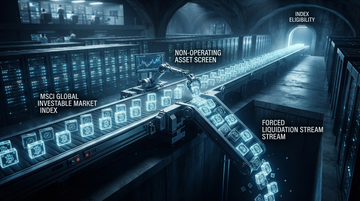
MSCI plants a “non-operating” eligibility trap that makes Strategy’s bitcoin treasury structure a forced-sale risk
MSCI has launched a consultation to screen “non-operating” companies out of its MSCI Global Investable Market Indexes, using operating-asset intensity and cash-flow style ratios. If rules are implemented for index changes effective at the close of Aug. 31, 2026, Strategy is exposed because its balance sheet is dominated by investment assets rather than operating assets, and the market impact can cascade through passive flows and forced crypto rebalancing by similarly structured issuers.

World Liberty’s bank charter turns crypto lending into a deposit bet—and the conflict-of-interest “discount” is the real valuation driver
The U.S. Office of the Comptroller of the Currency (OCC) granted World Liberty Trust Company a conditional preliminary approval for a national trust bank charter that would let the group issue and redeem its USD1 stablecoin and custody/convert related assets. The approval also bakes in governance passivity commitments meant to curb investor control, while critics argue the structure still creates a political-economy “ethics discount” that could weigh on adoption and partnerships—especially where stablecoin issuance and custody sit at the center of the lending supply chain.
2026-08-12

FlightAware’s instant dismissal signals Kalshi can’t be squeezed by “data leverage” alone
FlightAware filed a suit against Kalshi over flight-cancellation prediction markets using its data and branding, then voluntarily dismissed the entire case hours later without prejudice. The filing shows FlightAware’s strongest theory was contract + trademark control, yet the quick withdrawal suggests Kalshi likely forced a faster path to remove/contain the specific claims—shifting the real pressure point from “sourcing data” to “litigation mechanics and remedies timing.”

NYC’s Predatory-Marketing Probe Turns Prediction-Market Growth into a “Regulatory Gate” Business — and Favors Platforms with the Scale to Comply
New York City Council Speaker Julie Menin has launched an inquiry into Polymarket’s alleged predatory marketing practices and is asking the operator (and several peers named in the letter) to respond within 14 business days. The practical risk for listed crypto and event-trading intermediaries is that city-by-city marketing and age-gating rules can fragment “event-trading” demand, raising compliance costs faster than revenue—until a handful of incumbents can absorb the hit.
2026-08-11

2026-08-09

AI Financial's $12M exit implies “meme-to-impairment” contagion for crypto-linked payments and Perpetuals.com’s deal pipeline
When AI Financial sold its payments unit (ALT 5 Sigma Canada) for a $12M secured promissory note plus Prime Delta stock, the structure looked less like “growth strategy” and more like a liquidity/valuation reset. For investors watching Trump-linked fintech/crypto narratives, this matters because it converts prior upside hype into a concrete impairment-style event and turns counterparties like Perpetuals.com into the next holder of that risk.

CLARITY Act’s 12-month slip pushes crypto regulation into a “fee-and-rail” trade: Coinbase waits on revenue, Circle waits on redemption rules, and Solana ETF math rolls to 2027
When the U.S. Senate effectively defers the CLARITY Act into 2027, the market doesn’t just delay “clarity”—it delays the stablecoin redemption/market-structure plumbing that determines who earns fees and who must re-architect rails. The result is a near-term Coinbase/Circle split (timing of exchange revenue vs. stablecoin reserve/redemption economics), while Solana ETF approval expectations migrate into a later regulatory window.

Trump Media shut down its token and prediction-market bets—so investors must underwrite Truth API as the only credible cash-conversion layer
Trump Media & Technology Group DJT ended its Crypto.com token/tax-treasury pathway and pulled back from embedding prediction markets inside Truth Social, reducing the “financial-wrapper” optionality around DJT. The data business—Truth API—moves to the center because it monetizes distribution and speed (a tollbooth for market-moving posts) rather than operating risk markets or staking token treasuries.

OFAC’s Aug 7 Shelbit Sanction Turns “UAE Iran-Crypto Compliance” Into a Bankable Risk Premium for Exchanges
Treasury’s Aug 7 OFAC action against Dubai’s SHELBIT GENERAL TRADING LLC frames a new enforcement surface: crypto “rails” used to support the IRGC and Nobitex. The second-order read-through is that any U.S.-facing exchange, wallet, or stablecoin on/off-ramp touching UAE OTC liquidity chains must treat “Iran-linked geo-compliance” as a material, tradable risk—not a reputational afterthought.
2026-08-08

2026-08-07

2026-08-05

What to expect
Evidence-first notes with a visible point of view.
This section collects sharp takes on earnings, shareholder meetings, and market structure. Each new piece should make the thesis, the facts, and the implications obvious within the first few screens.
Expect direct analysis, not generic commentary.
Expect the data to be explicit and the argument to be easy to follow.
Plutux is not an investment adviser. Market data and AI-generated analysis are for information and education only, not investment advice. Disclaimer