%22%2F%3E%0A%20%20%3Ccircle%20cx%3D%22220%22%20cy%3D%22150%22%20r%3D%22180%22%20fill%3D%22%2322d3ee%22%20fill-opacity%3D%220.12%22%2F%3E%0A%20%20%3Ccircle%20cx%3D%221010%22%20cy%3D%22130%22%20r%3D%22220%22%20fill%3D%22%2338bdf8%22%20fill-opacity%3D%220.08%22%2F%3E%0A%20%20%3Ccircle%20cx%3D%22920%22%20cy%3D%22520%22%20r%3D%22170%22%20fill%3D%22%2322d3ee%22%20fill-opacity%3D%220.06%22%2F%3E%0A%20%20%3Cpath%20d%3D%22M140%20430h920%22%20stroke%3D%22url(%23line)%22%20stroke-width%3D%2212%22%20stroke-linecap%3D%22round%22%2F%3E%0A%20%20%3Cpath%20d%3D%22M220%20360c120-150%20260-220%20380-220s260%2070%20380%20220%22%20fill%3D%22none%22%20stroke%3D%22%2367e8f9%22%20stroke-opacity%3D%220.5%22%20stroke-width%3D%2216%22%20stroke-linecap%3D%22round%22%20stroke-linejoin%3D%22round%22%2F%3E%0A%20%20%3Cpath%20d%3D%22M300%20398h600%22%20stroke%3D%22%2394a3b8%22%20stroke-opacity%3D%220.24%22%20stroke-width%3D%228%22%20stroke-linecap%3D%22round%22%2F%3E%0A%20%20%3Ctext%20x%3D%22220%22%20y%3D%22510%22%20fill%3D%22%23e2e8f0%22%20fill-opacity%3D%220.7%22%20font-family%3D%22Arial%2C%20Helvetica%2C%20sans-serif%22%20font-size%3D%2238%22%20letter-spacing%3D%228%22%3EINSIGHTS%3C%2Ftext%3E%0A%3C%2Fsvg%3E)
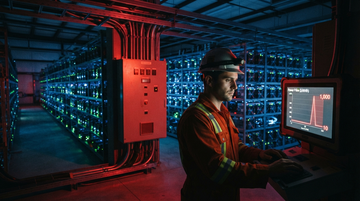
On Aug 16, 2026, a bitcoin-mining site reportedly experienced a wholesale electricity price move from about $10/MWh to ~$1,000/MWh within ~60 minutes—a ~100x change in an hour. The episode matters because mining is usually modeled on a stable “power cost per MWh” assumption, but real wholesale markets can reprice fast enough that risk management, not just unit costs, becomes the margin driver.
Verified event mechanics → why an hour matters
A 100x power spike reframes miner profitability around hedging and dispatch, not BTC
A Minneapolis-style earnings model won’t save miners if their incremental electrons go through a market that can reprice by orders of magnitude within the interval length. In the reported incident, the key observation isn’t just the absolute $/MWh level—it’s the speed: the power price shock was fast enough to erase the economics of an hour’s worth of mining output.
The immediate supply-chain implication: this is not only a generator/cable story. The margin line sits downstream of the grid—where the miner’s power purchase (spot exposure, contract structure, or curtailment rights) determines whether the facility can preserve margins by (1) switching off quickly or (2) converting volatility into cash via demand-response/market participation.
Supply-chain aware mapping → where volatility travels
Where the volatility lands in the full chain: generation → market price → miner dispatch → AI-like “marginal buyer” exposure
- Grid scarcity and constraints reprice wholesale power on short intervals, which changes the miner’s actual $/MWh paid.
- Dispatch speed decides losses vs. curtailment revenue, because shutting down after the spike doesn’t refund already-incurred power draw.
- Contract shape determines hedge effectiveness—fixed-price, indexed, or spot-exposed structures change sensitivity to intraday moves.
- AI data centers inherit the same marginal-buyer risk when they rely on grid-backed power while seeking fast scale-up.
Think of the miner as both a load and, in some setups, a flexible participant. If the facility can curtail and monetize flexibility during high-price intervals, volatility can become a revenue opportunity. If it can’t—because of operational constraints, contract terms, or delayed response—volatility becomes a direct hit to gross profit.
What public numbers say → why these miners look structurally exposed
Miner fundamentals already show operating leverage; power shocks magnify it
IREN net income (TTM)
$76.9M
TTM ended ~Jun 2026; reported May 8, 2026
CLSK net income (TTM)
-$1.0B
TTM ended ~Jun 2026; reported Aug 6, 2026
CIFR net income (TTM)
-$1.1B
TTM ended ~Jun 2026; reported Aug 4, 2026
WULF net income (TTM)
-$1.95B
TTM ended ~Jun 2026; reported Aug 5, 2026
These earnings outcomes aren’t “proof” of hedging failure in the Aug 16 event. But they do tell you something investors can act on: several of the major public miners are operating with limited margin resilience. In that context, a power-price volatility shock that hits the incremental power line can have outsized effects compared with businesses where energy is a small, stable input.
Investor interpretation → the new margin line
Power-cost volatility is a timing risk: the market reprices before miners can rewrite the P&L
Why timing can overwhelm unit economics in a spot-exposed hour
Illustrative hour-cost math using the reported $/MWh move; unchanged BTC output assumed (the only changing variable is electricity price).
Unit: x (relative)
Power price before spike
≈$10/MWh
10
Power price during spike
≈$1,000/MWh
1,000
Relative cost impact
100x cost scaling
100
The practical takeaway is that miners (and, increasingly, power-hungry AI operators) need to manage electricity not only as a long-run average, but as an intraday distribution. Hedging can reduce variance; curtailment rights can cap exposure; and procurement structures can shift risk between the buyer and the grid.
Actionable due diligence → what to ask about “unhedged megawatts”
What investors should check next: contract exposure, curtailment optionality, and liquidity buffer
- How much load is effectively spot-exposed vs. covered by fixed or structured arrangements during high-volatility windows.
- Whether curtailment is operationally fast enough to stop draw before high-price intervals end.
- How the company treats power volatility in guidance (explicit sensitivity or scenario ranges).
- Whether liquidity can absorb margin drawdowns without forced asset sales or dilutive financing.
The easiest way to get this wrong is to look only at “average power cost.” The Aug 16 episode is a reminder that investors should weight tail scenarios—because that’s where a quarter’s earnings can be decided.
Investable coverage: which listed miners’ margin models most need a volatility audit
- IREN’s latest reported TTM shows positive net income, but power cost shocks can flip operating leverage quickly if electricity exposure isn’t capped on intraday repricing.
- With net income of $76.9M over the TTM, one hour of extreme unhedged exposure could compress returns disproportionately versus baseline averages.
- Watch disclosures for how its electricity procurement and curtailment frameworks respond to wholesale volatility windows.
- CLSK’s TTM net loss of -$1.0B implies less margin room to absorb sudden electricity repricing if contracts behave spot-like during spikes.
- At -$360.9M gross profit over the TTM, energy volatility can dominate the remaining earnings structure rather than merely be a line item.
- Over the next quarters, the market will likely penalize any evidence of ineffective hedging during high-price intervals.
- CIFR’s TTM net loss of -$1.1B suggests limited resilience if power procurement fails to smooth volatility in fast repricing events.
- With gross profit at -$57.6M over the TTM, tail electricity moves can overwhelm non-energy improvements on earnings timing.
- The key near-term catalyst is whether management frames power-risk hedging as a controllable variable, not an average.
- WULF’s TTM net loss of -$1.95B means unhedged megawatts can translate directly into equity-level impairment risk if volatility spikes recur.
- Despite positive gross profit ($114.4M) versus severe below-the-line losses, power volatility can still widen the path from gross to cash if it disrupts operations and financing.
- In the next 1–3 quarters, investors should expect power-risk discussion to matter more than BTC price direction.